"PLEASANTVILLE" AS HISTORICAL
ALLEGORY
Move
Over, World War Two Generation, the Sixties Generation Has
Arrived!
An Essay Review of the Movie, "Pleasantville"
by Mickel
Adzema
MusePaper
December 12th, 1998
A Tale of Two Siblings
The film, "Pleasantville," is a modern sociological allegory or fable.
It begins in modern times against a backdrop of the usual violence, chaos,
and turbulence that we are conditioned by the media to believe characterizes
the 90s in America. Two high school teenagers, David and Jennifer,
played by Tobey Maguire and Reese Witherspoon are planning their evening.
David is planning to watch the Pleasantville marathon on television
and to participate in the trivia contest that will be part of it.
Pleasantville is a an old sitcom from the 1950s in
the Father Knows Best, Leave It to Beaver, My  Three Sons style which has attained a cult-like following and is shown
regularly on a cable channel similar to the "Nick at Nite" one that we know
of which specializes in reruns of old sitcoms. It becomes clear that
David is an ardent devotee of the show in part because it compensates for
the lameness of his real life. Unlike his sister, who is portrayed as
a real "firecracker" of a young woman, he doesn't date or participate in
the school scene. It is implied that he may be using the sitcom as
an escape from not only a boring life but a threatening one and that he longs
to live in the kind of ordered, safe, and unchallenging reality that the
sitcom depicts. David is such an avid follower of the show that he
is shown to be a master of "Pleasantville" trivia and is primed and eager
for the contest on Pleasantville trivia.
Three Sons style which has attained a cult-like following and is shown
regularly on a cable channel similar to the "Nick at Nite" one that we know
of which specializes in reruns of old sitcoms. It becomes clear that
David is an ardent devotee of the show in part because it compensates for
the lameness of his real life. Unlike his sister, who is portrayed as
a real "firecracker" of a young woman, he doesn't date or participate in
the school scene. It is implied that he may be using the sitcom as
an escape from not only a boring life but a threatening one and that he longs
to live in the kind of ordered, safe, and unchallenging reality that the
sitcom depicts. David is such an avid follower of the show that he
is shown to be a master of "Pleasantville" trivia and is primed and eager
for the contest on Pleasantville trivia.
But his sister, Jennifer, is planning for a hot date
at home . . . their parents being away for the weekend providing an opportunity
for her to be unchaperoned with her guy -- which she eagerly anticipates.
At odds over what will be played on the TV – Jennifer wanting to watch instead
an MTV concert with her date -- they wrestle over the TV remote and end up
breaking it. However all is not lost as at just that moment and completely
inexplicably a television repairman played by Don Knotts drives up in his
truck, knocks on the door, and imposes his services on them in fixing the
problem.
Don Knotts -- perfectly cast, in a Jungian sense, for
it is often the impish or normally overlooked and unnoticed element that
initiates sweeping changes in people's lives -- indeed does introduce the
magical element into the film. He produces a different kind of remote
control, which he claims has special effects saying, "You want something
to put you right in the show!" Sure enough, in checking out the remote
they hit a mysterious button and are transported into the TV and thus into
the sitcom and the town that is called Pleasantville.
To Follow Or Not to Follow
"The Script"
After their initial confusion, they realize what has happened and try
to return, but do not know how to. David – who it becomes apparent
has been thrust into the role of Bud in the sitcom – advises his sister –
Jennifer who has become Mary Sue in the TV series – to go along with events
until they figure a way to get home. Since he knows  all the plots of every show of the sitcom, his idea is that they act out
the events as they are supposed to happen and that they do what the two characters
– the teenage son and daughter of the parents in the sitcom, Betty and George
Parker, played superbly by Joan Allen and William H. Macy – are known to do
in the different episodes he has seen. Essentially, then, he is advising
his sister to "follow the script." And of course it is not hard to
discern at this point that we are beginning to see a metaphor for psychological
realities and that "following the script" has a broader meaning for a choice
that everyone must make in life in growing up, viz., to follow the
script laid out for oneself by one’s parents and society in general or to
follow one’s inner direction and inner guide in asserting one’s individuality
and expressing one’s unique self.
all the plots of every show of the sitcom, his idea is that they act out
the events as they are supposed to happen and that they do what the two characters
– the teenage son and daughter of the parents in the sitcom, Betty and George
Parker, played superbly by Joan Allen and William H. Macy – are known to do
in the different episodes he has seen. Essentially, then, he is advising
his sister to "follow the script." And of course it is not hard to
discern at this point that we are beginning to see a metaphor for psychological
realities and that "following the script" has a broader meaning for a choice
that everyone must make in life in growing up, viz., to follow the
script laid out for oneself by one’s parents and society in general or to
follow one’s inner direction and inner guide in asserting one’s individuality
and expressing one’s unique self.
The rest of the movie is the story of how these two
characters – transported magically from the future as well as from the real
world as opposed to a made-up TV world – introduce change into the town
and thereby color. Mary Sue (formerly Jennifer) does it consciously.
Rebelling against her brother’s admonishments to follow the script, she
goes on a date with someone she is not supposed to (according to the sitcom
script) and then – horror of horrors for a 1950s world – engages in sex with
him at the local "lover’s lane" (where the farthest that anyone goes, according
to "script," is holding hands). We find later that her date describes
this unheard of experience to his classmates, and, like ripples emanating
from a pebble dropped in a pond, her action results in a number of the school
youth engaging in sex and thereby becoming, to everyone’s amazement, colorized!
The brother also introduces change, and therefore color,
but it is done unconsciously at first. As mentioned, he tries to get
his sister to follow the script. Still, in a metaphorically powerful
scene, when he is late for work at the  local malt shop – this is unheard of as well because "Pleasantville" is
a world where no one is ever late for work – he inadvertently introduces
change himself. In fact, he introduces the most insidious element
of change because he explicitly advises – without realizing what he has
unleashed – that his boss think for himself! In this scene David (now
Bud) finds his boss and coworker, Mr. Johnson, played by Jeff Daniels, stuck
at the end of the counter, cleaning away with a wash cloth, like a stuck
record, at the same spot, even as the surface of the counter is rubbing away.
When the soda jerk, Mr. Johnson, explains confusedly that the normal regimen
would have required Bud to arrive at work before he, Mr. Johnson, could go
on to the rest of his chores, "Bud" simply suggests to Mr. Johnson that in
the future he continue with his next chore even if Bud isn’t there.
So simply in being himself, coming from a future in which people react to
change by thinking out new responses and thereby adapting to them, Bud, aka
David, introduces a totally new element into the soda jerk’s script.
This has far reaching consequences as the movie progresses and Mr. Johnson
begins thinking for himself and having ideas about other things as well.
In this way, the soda jerk, soon to be artist, too ends up "colored."
local malt shop – this is unheard of as well because "Pleasantville" is
a world where no one is ever late for work – he inadvertently introduces
change himself. In fact, he introduces the most insidious element
of change because he explicitly advises – without realizing what he has
unleashed – that his boss think for himself! In this scene David (now
Bud) finds his boss and coworker, Mr. Johnson, played by Jeff Daniels, stuck
at the end of the counter, cleaning away with a wash cloth, like a stuck
record, at the same spot, even as the surface of the counter is rubbing away.
When the soda jerk, Mr. Johnson, explains confusedly that the normal regimen
would have required Bud to arrive at work before he, Mr. Johnson, could go
on to the rest of his chores, "Bud" simply suggests to Mr. Johnson that in
the future he continue with his next chore even if Bud isn’t there.
So simply in being himself, coming from a future in which people react to
change by thinking out new responses and thereby adapting to them, Bud, aka
David, introduces a totally new element into the soda jerk’s script.
This has far reaching consequences as the movie progresses and Mr. Johnson
begins thinking for himself and having ideas about other things as well.
In this way, the soda jerk, soon to be artist, too ends up "colored."
Blue Meanies
This movie, thematically, is remarkably akin to the 1968-released movie
"Yellow Submarine" put out by the Sixties Generation rock group The Beatles.
In that film there is a region ruled by the "Blue Meanies." These
Blue Meanies, especially their leader, are depicted as powerful and cruel,
yet sniveling, insecure, weak, and selfish underneath. Their angry
and oppressive personas are shown to reveal poor little whining babies behind
them. Their actions are shown to be those of "big babies," whose gruff
exterior must remain intact at all costs, lest their hidden sniveling and
hurt little selves be revealed. The analogy the Beatles are making to
those of the WWII Generation -- at that time the parental generation, those
"over 30" -- is impossible not to make.
"Nowhere Man."
The movies are so similar in theme that the only major thematic difference
between "Pleasantville" and "Yellow Submarine" is that it is music that is
not allowed in "Yellow Submarine" whereas in "Pleasantville" it is color.
But the idea behind them both is the same: Music and color both represent
deep feeling, aliveness, thinking for oneself, and change. In "Yellow
Submarine," the man without music is Nowhere Man, who "knows not where he’s
going to, doesn’t have a point of view." In Pleasantville, the
men without color act in the same ways, performing the same actions, day in,
day out, without change – like characters in a 1950s-style sitcom in which
nothing unpleasant, different, new, or too emotional is allowed to occur.
And above all, the black-and-white men do not think for themselves.
This is graphically portrayed in the scene mentioned where the owner of the
town malt shop, Mr. Johnson, portrayed by Jeff Daniels, is left cleaning the
same spot of the counter for hours so that its top is rubbed away because
his coworker is late and the routine they use to close up cannot be completed
in the way it is done, everyday, in exactly the same way. Confronted
with this small change, he shows himself to be the "Nowhere Man" and like
a needle stuck on a record, he is rigidly stuck repeating the same action,
not having the power to think of an alternative action in response to a change
in the usual routine.
No longer a distant vision.
The differences in the years of the release and the different artistic
modes used to express the themes of these two movies have something to say
as well. In 1968 the changes in culture of the New Age were a vision
and a hope. It is appropriate and telling that "Yellow Submarine" was
expressed in animated form. Like a dream that would take a long time
to realize, it needed to be expressed in cartoon-like fashion, for the time
of its emergence in reality was too far off. By contrast, "Pleasantville"
blends a fantasy world – appropriately it is a TV sitcom, which has more similarities
with reality than an animation – with the actual reality of modern times.
The advance toward reality is patent in the evolution from an animated form
– indicating the change is far off, a fantasy, a wish, a hope – in the 1968
movie; to a black-and-white form involving real actors, real people; and
then to a colorized version involving real people in what is supposed to
be real time and real cultural reality. One might say that what was
a fantasy thirty years ago is, however unconsciously, being heralded as emerging
and existing and coming into being right now – in real time and place.
Reversing the Invasion of the
Body Snatchers
Concerning the movie "Pleasantville," noted movie critic Roger Ebert
quite astutely points out that it "is like the defeat of the body snatchers"
(from his excellent review,
"Pleasantville"
). One might also say that it is one in which Holden Caulfield, the
character in J. D. Salinger’s Catcher in the Rye, wins out and children
do not grow up to be adult "phonies." Another analogy would be that
it is a depiction in which Peter Pan stays young, when he succeeds in keeping
the children from ever growing up and thereby losing their capacity to "fly"
(representing the capacity to dream, to envision, to be open to new possibilities,
to adventure).
Against this backdrop of lack of real aliveness, the introduction of
"color" into the town of Pleasantville through the introduction of sex is
not seen as something bad at all. Similarly, in recent history, despite
the increasing drum beating of the Religious Right in the last two decades,
those of us who grew up in the Fifties know that the introduction of sex
– in the Sixties, as in the "sexual revolution" – was a step forward from
the hypocritical sameness and plodding repression of the Fifties.
Other elements introduced into Pleasantville that produce
colorization in the participants include thinking for oneself (Jeff Daniels
in his role as the soda jerk), intellectual passion (the sister), questioning
the way things are supposed to be or, in Sixties terms, questioning authority
(when the brother finally becomes colored), artistic and creative passion
(Jeff Daniels again), and even the passion of honest rage (the chairman of
the Chamber of Commerce). These elements arise in Pleasantville just
as they arose into the collective consciousness of those of us living in
the Fifties and Sixties.
Of course I am not naively saying that these elements
never existed before the Sixties. The underlying factor that was introduced
into the movie causing color and that was also introduced into our society
causing all the sociocultural changes that we, usually, complain about is
the factor of choosing something different than what is expected by society,
than what is expected by the outside. What is introduced (and was introduced
in our culture) is the preeminence of inner authority in making decisions,
as opposed to outer authority.
A New Psychohistorical Era!
In psychohistorical terms this difference is marked by Lloyd deMause
as a difference in a mode of child-rearing. The black-and-white Fifties
Pleasantville is a representation of a mode of child-rearing -- which characterized
the Fifties -- wherein the role of the parents is to "mold," model, and
guide children along paths that the parents have deemed to be correct (the socializing mode of child-rearing).
The child is expected to be a clone of the parents or at least to represent
the parents' ideas of proper behavior, ideals, and mode of living (regardless
of whether the parent models them or not. And when not, the phrase
"Do as I say, not as I do" and the term hypocrite as applied to the
parents are apropos). The basic nature of the child is considered to
be sinful and evil or at least beastial; the classic novel Lord of the
Flies depicts this view of human nature. Therefore the child needs
to become other than itself and conform itself to something outside of itself
in order for she or he to be considered "good" and to receive good responses
in turn from parents and society.
By contrast, the colorized Pleasantville represents
the mode of child-caring that came out, big time, beginning in the Sixties,
wherein the parents’ role is that of "bringing out" from and supporting,
encouraging, and helping the child to discover what the child’s talents and
inherent abilities, feelings, and proclivities are, and then encouraging
the child to "believe in him/herself" in the expression of those inherent
and inborn good qualities and values (the helping mode of child-caring).
(See "The History of Childhood As the
History of Child Abuse"
by Lloyd deMause on this site.)
This mode contains a radically new view of basic human
nature. Humans are seen to be essentially good (even "divine").
It is evil and painful events impinging upon the child from the outside --
family and society -- that are deemed causative in taking the child from its
natural state of innocence and goodness and inherent unique talents to one
wherein the child is corrupted and thus becomes beastial and lacking
in inherent good qualities and talents. Therefore the solution is to
protect the child from traumas coming from the outside, especially the huge
one of feeling unloved through not being seen or respected as a unique individual
(as opposed to being seen as a mere outgrowth or clone of a parental entity).
And in so doing the parents' role includes helping the child to discover
his or her uniqueness and dispensing unconditional love, that is, love
that is given freely, without the requirement, as in the socializing mode,
that the child do and be what the parents want before the child is accepted
or shown approval or any emotional warmth.
In representing this advanced mode of being (and child-caring)
the "colorized" people in Pleasantville open themselves to possibilities that
were never before considered; they stray from the earlier mode requiring
strict conformity to parental scripts. Robert Kennedy’s Sixties quote
comes to mind as expressing this: "Some people look at things as they
are and ask, why? I think of things that never were and ask, why not?"
This means, then, a capacity to experiment and adventure in one's life, which,
at bottom, involve a belief in questioning authority and thinking
for oneself in Sixties terms or, in Sathya Sai Baba's words, a belief
that we are, each of us, "experiments in truth" in our sojourns on Earth.
And just as these elements and beliefs became more and more a part of America’s
collective consciousness in the Sixties and Seventies and ever since then,
they also gradually develop in "Pleasantville."
"Love My Uncertainty"
One reviewer described the ending of the movie as "not at all easy and
tidy, but rather very, very messy" (
"Pleasantville"
by Chris A. Bolton). Ebert – more astutely but not quite correctly
-- wrote that the determining factor in whether someone became "colored"
was the factor of change. The first reviewer, like someone with one
foot still in "Pleasantville" or one who is still not fully colored, does
not understand that the ending, wherein the characters proclaim that they
do not know what is going to happen next, contains exactly the essential
message of the movie. The ending can only be "messy" if one expects
a particular ending. And the whole point of change is that it is always
something one does not expect. Likewise, where people act out of inner
rather than outer authority, one can only expect that what happens will be
unique, like people are when they are not conforming to external expectations.
So there could be no pat or predicted ending. The moviegoer could not
leave knowing whether Betty Parker, the Stepford housewife turned women’s
libber, returns to her husband, George, or takes off with the soda jerk turned
artist, Mr. Johnson, because that would destroy the uncertainty inherent in
change, growth, aliveness, and so on. So the ending is exactly what
it has to be.
And this ending expresses the spiritual razor's edge
each of us must cross during our life's sojourn. Whenever we try to
put life, or love, into a box, package, or a gilded cage, it dies or stagnates
-- just like a boring black-and-white sitcom world. Real change and
spiritual growth means letting go and opening oneself to the unexpected and
the unknown. So it is in this vein that the spiritual teacher Sai Baba
tells his followers, "Love my uncertainty," in helping them to deal (after
the usual "honeymoon phase" at the beginning of their spiritual path) with
the trials, changes, tribulations, and suffering that his devotees experience
later on, along their path to greater purity of heart and compassion, and
eventually spiritual liberation.
The Scenery of Healing
One of the reasons the movie, "Pleasantville," so appealed to me is
that its view of current events is so akin to that which I have been expressing
in recent writings – e.g., the articles
"The Scenery of Healing"
and "The Emerging Perinatal
Unconscious"
and the book Apocalypse, Or New
Age? – wherein I make the argument that recent events
are not evidence of a downfall of civilization, as conservatives like Newt
Gingrich and Pat Buchanan would have us believe, but are the necessary "birth
pains" of a new age being born. In Pleasantville, indeed, though
everyone smiles and there is no crime or unpleasantness – which is supposed
to reflect the view of reality presented in Fifties sitcoms like Father
Knows Best and Leave It to Beaver – it is inherently flawed in
that it is lacking in "color." Those of us who lived through the Fifties
know that the lack of color is an apt metaphor for exactly the way it was
at that time. It was a back-and-white world – a world that covered
up its underlying nastiness and evil by repression and denial – psychological
defense mechanisms that characterize the World-War-Two Generation especially.
The point in the movie, which is so appealing, is that it causes us
to look again at the changes in our society that have occurred because of
the various "revolutions" of recent decades (civil rights, student antiwar,
women's rights, sexual, and so on) and to stop bemoaning the "messiness"
that comes with freedom. We have more choice, more freedom now than
ever. And this freedom allows us the opportunity for a higher spirituality
-- some would say the only true spirituality -- which involves the harrowing
path of deciding for oneself, based upon one's ability to intuit or "feel"
the correct path, and experiencing the consequences of one's choices, as
opposed to the preordained religiosity of following a script. Though
many would argue this, one has only to look, as this movie forces us to do,
back at where we started. And from that perspective, with that stultifying,
hypocritical, dishonest, and phony kind of supposed "living" in mind, we can
easily see the changes and progress made in individual freedom and, dare I
say, genuine spirituality, and accept the uncertainty, emotional pain, apparent
evil, "messiness," social and political turbulence, and all the rest that
comes with it.
It's a (Not So) Wonderful Life
The paramount theme in "Pleasantville" -- which is that thinking for oneself and
following one’s own unique path and being open to the change that comes with
that brings "color," truth, and aliveness to one’s life -- is truly a Sixties
Generation idea. Again, it is not that it has never been thought of before.
All great ideas have been thought of before, but that does not mean they have
been implemented on a sociocultural, macrocosmic level. Many ideas have
remained in the realm of the solitary pursuits of philosophers and mystics and
been exemplified only in individual lives. But the Sixties was such a time of
turmoil because the values of individual freedom, personal passion, feeling and
experience, questioning authority, and thinking for oneself were shared by so
many Baby-Boomers and were so contrary to the values of the generation in power.
An excellent example of how opposed the Sixties values are to those of the
WWII Generation is found in that beloved movie of all time, "It’s a Wonderful
Life," starring Jimmy Stewart. In that film, the main character is prevented by
circumstances from following his dreams. One event after another keeps him from
leaving his home town. His story might be called "The Truman Show" in reverse
for he comes to accept the loss of his dreams. He is rewarded for giving up his
yearning for adventure with the warmth of a loving family and friends.
Nonetheless, he has been reduced to someone who simply follows a script or role
and when it appears that he might fail in that role he considers killing
himself. The movie is beloved and timeless, no doubt, because it reassures an
entire generation and all those who have had to give up their dreams for
whatever reason that their sacrifices were for a higher good and that it is a
wonderful life after all. It provides a rationalization against the painful
feelings of knowing that one will never know "what might have been" by pointing
out the truth that one's life affects others and has meaning regardless of
whether or not one has been fortunate enough to actualize one's deepest desires,
talents, aspirations, and dreams.
As mentioned, "It's a Wonderful Life" calls out to and epitomizes the
experiences and attitudes of the World War Two Generation in particular. They
were called upon to fight a war, after all, which no doubt would derail many a
young man’s (and woman’s) dreams. As in "It’s a Wonderful Life," the
circumstances that arise to prevent their following through on their dreams are
imposed from the outside – the state of being at war and being called upon by a
draft to enlist or else be enlisted. For the women, as well as the men who
stayed behind, the war’s influence on their lives and the carrying out of
idealistic schemes and dreams are only a little less pronounced. For, as in
"It’s a Wonderful Life," the war created a society heaving with needs and pain,
which only the truly heartless (who wouldn’t have any dreams anyway) could not
help but feel compelled to respond to. In one way or another, the situation in
the Forties, with the war effort and afterwards, created a generation who,
except for the rare individual or one of unusual circumstances, was called upon
to step up into mature responsible tasks long before the idealism of their youth
would have preferred that they do so. And their generation is scarred for
having missed this opportunity. They are individuals deserving of our sympathy;
yet crippled they are nonetheless.
Mashing Butterflies and Drowning Kittens
This is not to say, however, that the generations before the WWII Generation
were allowed their dreams and that the WWII Generation is unique in being
crippled in its development. For we know that earlier child-rearing modes
required the submission of children and youth to parental wishes (again, see
"The History of
Childhood As The History of Child Abuse" by Lloyd deMause). Therefore,
dreaming or envisioning an adventurous life was not the norm. For much of the
history of the world and in most cultures, indeed, even the selection of one’s
spouse was decided by the parents. So much has our history – in both Eastern
and Western cultures – been marked by the assassination of youthful dreaming,
idealism, and choice that Shakespeare’s Romeo and Juliet can be said to be a
revolutionary work in even depicting that this assassination of dreams is a
tragedy!
Still, the WWII Generation can be said to have been especially affected by
this slaying of self, for they did, after all experience the heady freedom of
the "Roaring Twenties" and the dreaming that preceded the Great Depression. In
the Twenties, victorious in World War I and with it now put behind, America was
coming into its youthfulness and was heady with its accomplishments.
Unbelievable accomplishments and inventions in all areas of life were speeding
up sociocultural change causing some to believe that a new era was around the
corner, just within reach, an era unlike anything the world had ever known.
This was the atmosphere in the Twenties when the WWII Generation were in their
childhood or adolescence. It couldn’t help making a very strong, because of its
being early, imprint on their expectations.
However, these dreams would be dashed in the Great Depression, during which
time they would be adolescents and young adults, and they would be harnessed
into struggling like their parents had had to earlier and were now again
struggling. Still, as time wore on the dreams of a new world would be reignited
with the idealistic union movement and the Franklin Roosevelt changes in the
social contract that rescripted the relation between the society and the
individual, creating a symbiotic one which enhanced them both as champions of
each other. Folks would magnify the power of the person when united with
others. They would dream of a fairer world in which the rich did not dominate
with their wealth because the poor could balance the scales with their strength
in numbers, adding to their individual power by joining in unions and by
combining their votes in elections. They could begin to envision the light at
the end of the tunnel of the Great Depression in which they might realize the
freedom and adventure they’d glimpsed around them as children in the Twenties.
So it is understandable that they would not wish to enter World War II when
it began. And Pearl Harbor Day, when their fate was inevitably forged, when it
became clear that for the second time the light of individual freedom would be
extinguished, would become an important marker in their lifetimes – a day almost
as much to be memorialized as their birthdays.
Sitting on the Shoulders of One’s Ancestors
For this we can pity the World War Two Generation. As in John Updike’s The
Centaur, the World War Two Generation is depicted as a generation that was
required to give up its dreams and do its "duty," above all. It was required to
carry out a script given to them by their society, not allowing them to follow
their natural youthful ideals. And as in Updike’s novel, they are beaten down
in a life that is regimented and has no "color," spark, life, idealism, or
dreams. They have become the robot-like residents of "Pleasantville." But
Updike points out in his novel that their sacrifice, despite the personal
tragedy of it on the individual scale, is both necessary and noble in that it
makes possible the realization of dreams by the generation that they gave birth
to.
It is significant that the protagonist of change in the movie "Pleasantville"
would be a young male, Bud (David). This is in keeping with legends of old
where a young prince comes bearing the new knowledge. But in New-Age style,
wonderfully so, he is drawn only reluctantly into this role and we see that it
is women who are the real instigators, the least threatened by change. At
first, David/Bud opposes his sister and argues for the status quo, maintaining
that his sister, who is actually the first one to "break the rules" and thereby
to bring color to the town, must abide by the script.
The "young prince" knows the rules well. This fits with legend, where the
new ways are brought by a prince who is not ignorant of tradition; in fact the
prince is the one who has excelled in training in traditional ways. In the
movie, David is in fact a Pleasantville trivia whiz. He knows exactly the way
things are supposed to unravel, the way events are supposed to go.
So when his sister first introduces color by introducing sex, he admonishes
her. And when he also is tempted to a change in the "script," he refuses at
first. This is when Bud is offered homemade cookies by the young woman 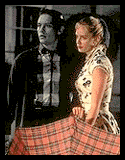 who would be his romantic partner. He refuses because he knows that, according
to script, it is another young man who is supposed to get the cookies and end up
with that particular girl. Despite his attraction for the young woman, his
strong sense of maintaining the status quo, not rocking the boat, causes him to
try to refuse the cookies. It takes a great deal of forcefulness on the young
woman’s part to get him, reluctantly, to accept the cookies that he actually
does want. So, again, it is a young (significantly "colorized") woman who
tempts him into a change in the script.
who would be his romantic partner. He refuses because he knows that, according
to script, it is another young man who is supposed to get the cookies and end up
with that particular girl. Despite his attraction for the young woman, his
strong sense of maintaining the status quo, not rocking the boat, causes him to
try to refuse the cookies. It takes a great deal of forcefulness on the young
woman’s part to get him, reluctantly, to accept the cookies that he actually
does want. So, again, it is a young (significantly "colorized") woman who
tempts him into a change in the script.
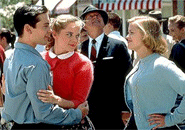 It is not that the young man does not have the makeup for accepting change. In
fact, even before his sister blatantly brings about change, and therefore color,
by rebelliously introducing sex, he has already sown the seeds of change,
although unconsciously, when he suggests to his boss, Mr. Johnson, that he think
for himself, instead of following a rigid script. This he does unconsciously
and out of selfish motives in that he by nature is different from the character
he is supposed to portray and so he does not play his role exactly as it is
"supposed" to be played. Specifically, because he is not really the robot
character he has replaced, he ends up being late for his job – which heretofore
was a totally unheard of event.
It is not that the young man does not have the makeup for accepting change. In
fact, even before his sister blatantly brings about change, and therefore color,
by rebelliously introducing sex, he has already sown the seeds of change,
although unconsciously, when he suggests to his boss, Mr. Johnson, that he think
for himself, instead of following a rigid script. This he does unconsciously
and out of selfish motives in that he by nature is different from the character
he is supposed to portray and so he does not play his role exactly as it is
"supposed" to be played. Specifically, because he is not really the robot
character he has replaced, he ends up being late for his job – which heretofore
was a totally unheard of event.
The Hundredth Monkey
It is also significant that it is the young that are the first ones in the town
to become "colored." As in the hundredth monkey phenomenon, it is first the
young, especially females, who are open to new experiences, ways, and ideas.
Then it is adult females – in this movie exemplified by Betty Parker, the mother
of Bud and Mary Sue -- who are next to consider alternatives and new ways.
Adult males are the last to turn to color, but among them it is the sensitive of
heart, exemplified by the artist/soda-jerk character, Mr. Johnson, who "turn on"
initially.
Last to become colorized (to be open to change and thinking for oneself) are
the "authorities" of the town, in this instance, those on the Chamber of
Commerce. And among these the most recalcitrant of all is their leader, Big
Bob, played by J.T. Walsh, in his final film role before his passing away.
Though Big Bob displays a pleasing and affable persona on the surface (for this
read "good old boy"), there is an insidious Hitleresque quality to him which
provides the suspense at the climax of the movie where he presides over the fate
of the artist, Mr. Johnson, and the "young prince," David/Bud.
With the support of the Chamber of Commerce, we know Big Bob has the power to do
whatever he will with the two 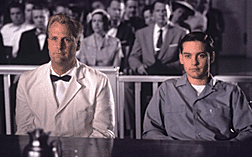 on trial. And since the events preceding the trial has included mob actions
which have included a book burning, the attack and destruction of the malt shop,
and the cornering, physical intimidation, and physical attack of "coloreds" by
gangs – images common to modern times which has seen these sorts of events in
actuality occurring in the civil rights and anti–Vietnam-War movements, and
currently in democracy as well as anti-America demonstrations in third-world
countries – the fate of the prisoners is imagined to include the ultimate
penalty of death.
on trial. And since the events preceding the trial has included mob actions
which have included a book burning, the attack and destruction of the malt shop,
and the cornering, physical intimidation, and physical attack of "coloreds" by
gangs – images common to modern times which has seen these sorts of events in
actuality occurring in the civil rights and anti–Vietnam-War movements, and
currently in democracy as well as anti-America demonstrations in third-world
countries – the fate of the prisoners is imagined to include the ultimate
penalty of death.
Indeed, this ominous possibility is promoted by the actions of the soda-jerk
Artist who, at the trial, pitifully pleads for a compromise. This is pitiful
since we know that his art is his life, that it is the one thing that has truly
enriched his life and made it worth living. We know of its importance in that,
even after the attack on his malt shop, he defied the "rules" laid down by the
town’s authorities which outlawed art and color by working with the Prince
through the night to produce a colorful mural on the outside wall of his shop
depicting the current events of the town and the feelings swirling about inside
its residents – an act which is reminiscent of antiwar demonstrators, who got
fired upon at Kent State, of civil rights demonstrators, who police attacked
with dogs, and of Tiananmen Square demonstrators, who were rolled over by tanks,
shot, and killed. Since this character, recently so courageously defiant, is
intimidated into pleading for a compromise in which he would be willing to use
only certain colors or where he would submit for approval by the Chamber’s
leader his ideas for painting beforehand (a compromise which his body language
and facial expressions show – wonderfully acted by Jeff Daniels – is one near up
against the very death of his soul), we know he fears for the loss of his
physical life.
The compromise is too much like the compromises we have witnessed being
offered and come to expect being offered to some of the Tiananmen Square and
other political prisoners of recent times wherein they are required to do
something along the lines of admitting their guilt, apologizing to the State for
the trouble they have caused it, and promising to never again to engage in such
activities (and only in the most benevolent of circumstance being allowed to
continue anything like their former activities but if so only under the
supervision and with the approval of authorities with veto power over their
proposed actions).
Civil Rights Movement
So Big Bob and the Chamber of Commerce represent in the current social framework
the Religious Right (sometimes referred to as the "religious wrong" and
sometimes about which it is noted that the Religious Right is neither). Big
Bob's Chamber of Commerce represents Republicans and those in general in our
society who have succumbed to the rewards and threats of the World War Two
Generation to live a regimented robotlike unfeeling passionless life; to become
one of J. D. Salinger’s "phonies," to abide by their misconstrued idea of
"family values," and above all to "behave" and not do anything to rock the boat
of the status quo which might threaten the privileges of those currently
enjoying power and wealth handed down, mostly, by heredity.
It is highly significant that in the courtroom scene the "colored" would be
sitting in the balcony, above the black-and-white men. One might say this
represents their status as being an elevated state, something to aspire to, and
yet not on the level where matters are decided. But even more so, this scene is
important in that it is a near exact replication of the courtroom scene in "To
Kill a Mockingbird," wherein the balcony of the courtroom is filled with Blacks,
another kind of "colored." This makes it clear that when the movie is dealing
with the conflict between the adult males of the town and the "coloreds" it is
referring to the Civil Rights movement.
The events in China's Tiananmen Square almost ten years ago so affected and
still affects some of us here in America because we know at some level that we
have experienced it before. What happened in China a decade ago is so much like
what happened here almost three decades ago around the Vietnam War
demonstrations, although more subtly. Let me explain.
For one thing, the images of the demonstrations in China, e.g., the lone man
standing in front of the tank, were so like those of Sixties demonstrations,
e.g., Sixties youth blocking the paths of soldiers and placing flowers in their
gun barrels.
And the result of both was the same: In both cases the opposition, the youth
movement, crushed (violently in China, subtly and behind the scenes in the US)
at the command of an octogenarian generation, clinging desperately to power as
much as to their waning physical frames.
We see the same pattern of violent versus subtle played out in the US as well
where we no longer assassinate our president as we did with JFK, we character
assassinate instead, as currently with Clinton. One might say the WWII
generation in America has gotten more finesse, with practice, in its beating
back sociocultural change not to their liking and that the Chinese geriatric set
hasn't as much practice with it as yet.
Nevertheless the results in both countries are the same. They involve the
ultimate victory of sociocultural change in both instances being delayed until
the dying off of an elderly generation in power – a generation refusing to die
or hand over the controls at the proper time like the generations before them.
But time is running out for the octogenarians on either side of the Pacific.
The eventual defeat of the WWII Generation (their dying off) is portrayed in
"Pleasantville" by Big Bob, head of the Chamber of Commerce, ending up fleeing
the scene in the courtroom. There are many ways his defeat could have been
played out in the movie. I think it is highly significant that he runs away,
never to be seen again, just as in the current context the dying off of the WWII
Generation is a literal leaving of the scene, not an outright defeat, or some
other means of change of power.
Beyond Pleasantville
With these factors in mind, what might we expect in the coming years, as the
Sixties Generation finally gets their turn.
We know that it will not be what the WWII Generation has been serving up
during their forty-plus years’ reign. At least we think we know what it will
not be, for even of that we cannot be totally certain since the WWII Generation
has -- like the endings of horror flicks, which leave always a hint or part of
the monster living on somehow, thus setting up a possible sequel -- left behind
part of itself in the form of the Eighties Generation clones and the Fifties
Generation. And these folks ain't going away any time soon!
Yet, however much we cannot know the future, and despite the seeds of WWII
Generation values left incubating in the minds of Eighties and Fifties
Generation members, we can speculate that the vision of "Pleasantville" will
hold out. Just as in the movie when after everyone has experienced color there
is no semblance of a wish to return to a black-and-white world, so also we might
hope that as our society turns more and more away from war-making, selfishness,
race- and sexism, ecological destruction, and all the other WWII Generation
evils left behind, and turns more and more toward economic prosperity,
peace-keeping, loving our children and having honest relationships, and the
reclaiming of our natural environment and ecological balance, there will be
fewer and fewer who wish to turn back the times to the unreal black-and-white
world of the "Blue Meanies."
We see evidence of this in the great support for Clinton currently. His
sixty-some percent level of support certainly is not comprised only of
Baby-Boomers. Sixties Generation values are infectious because they offer so
much hope. Blacks of all ages support Clinton and they also would not wish a
return to the black-and-white world that included discrimination and violence
against them. Women of all ages, for the same reasons, would not be expected to
wish a return to a less individualistic state, to a subservient state. And the
young will always be idealistic if they are shown any ideals, which is what we
can expect the Sixties Generation to do, as they continue taking their seats in
the parliament of sociocultural creation.
We are beginning to see examples of this change all around us: Al Gore’s
recent speech in Malaysia – it is fitting he would speak out on behalf of the
demonstrators – he being of the Sixties Generation; the conversion, under
Sixties Generation Clinton, of our military from war-wagers to peace-keepers.
The evidence is there for all with eyes to see. And with no inclination to see
it, no amount of listing of the evidence will bring them into view.
Still we might note some other analogies from the movie "Pleasantville" which
can provide insight as to what may be on the horizon or at least be considered
food for speculation. Whereas the black-and-white Pleasantville ends at the
town’s borders and turns round again to the center of town, the post-color
Pleasantville roads continue going, connecting Pleasantville with the rest of
the world. Thus, with color and by inference imagination and thinking for
oneself, Pleasantville has become part of a larger world, one in which
Pleasantville citizens can participate and in which they can travel and take up
residence. This represents the global village, the coming together of the
interests of all nations – as Clinton says, the emerging "global economy." But
perhaps most of all this connection to a larger world represents those factors
of modern telecommunications and travel that have made the world open to the
eyes of all, which is the real reason the Iron Curtain fell, the real reason
apartheid was overthrown, the real reason peace is coming to the Mideast and
Ireland, and may yet be causative in bringing democracy to places like China and
Korea. And the most potent analogy of all: the World Wide Web, bringing
together all peoples of the world into a collective consciousness sharing ideas
and together shaping a world, not just a neighborhood, with true democratization
of information, uncontrollable by any wealthy elite of any country or any
generation.
Finally, the image at the end of "Pleasantville" is the most apt for what we
may next expect. The only thing we know for sure is that it will be different.