
ASHLAND OREGON SHAKESPEARE FESTIVAL
Presents:
-Synopsis
compiled from The Tudor Guild's "The
Story of Shakespeare's Henry IV, Part I "
by Marchette Chute
Pictures from OSF 1998 Program
 Henry IV,
Part One begins one year after Richard II dies. Henry has just
gained the thrown with the help of Douglas of Scot and other
"rebel" factors who have supported him in exchange for
a split of England. Shakespeare captures the burgeoning uprising
against Henry IV from Scotland and Wales, and from these
"rebel" factors who feel they are not getting their
fair share of the property promised to them.
Henry IV,
Part One begins one year after Richard II dies. Henry has just
gained the thrown with the help of Douglas of Scot and other
"rebel" factors who have supported him in exchange for
a split of England. Shakespeare captures the burgeoning uprising
against Henry IV from Scotland and Wales, and from these
"rebel" factors who feel they are not getting their
fair share of the property promised to them.
But the play is also about young Hal (Prince Henry V soon to become one of England's most memorable kings) and his quest for identity. OSF, setting Shakespeare's play in nineteen sixties England, portrays this quest using Hal's metamorphosis from "punk" to "hunk."
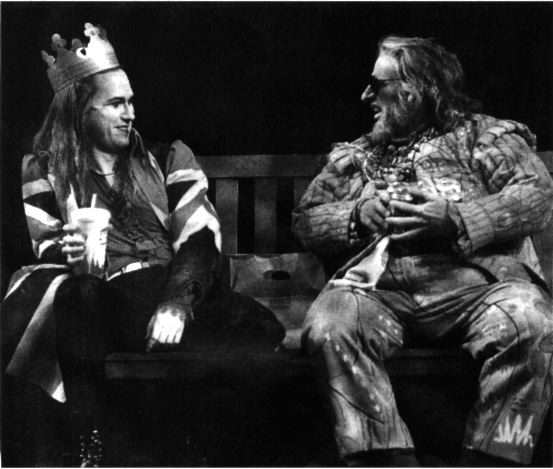
The play weaves three stories: 1) the king and country's wellbeing, 2) the honor of the military protege, Hotspur, and 3) Hal's "coming to age" among the motley crew of Falstaff and company (shown in the picture above).
The first
scene of the play is set in London in Henry's castle. Quite
concerned about uprisings in Scotland and Wales and perturbed
that he must put off expeditions to the Holy Land in order to
protect his own kingdom, Henry broods over the possibility of
battle. Hotspur (Harry Percy) has done an adequate job preventing
Scottish attacks on England, but the young militant will not give
up his Scottish prisoners to Henry, and Henry demands an
explanation. (Could this be the start of a civil war?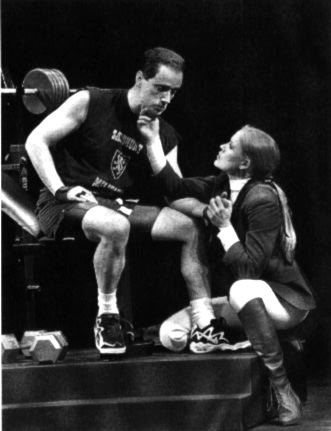 )
)
Ironically,
Henry although vexed at Hotspur, admires Hotspur's strength of
will and eagerness to fight-- (OSF paints him as a stud muffin
body-builder)
traits his own wayward son Hal lacks. Hal is more interested in
taverns than battle grounds, and would prefer a good ale and a
romp with fat, drunken, witty Falstaff to an expedition any day.
Henry is a bit ashamed of his son, and we can sense even in the
beginning of the play that Hal is unsure of how to please his
father without jeopardizing his own identity.
Falstaff and Hal, companions who taunt each other constantly, plan a robbery together--but Hal has a joke for Falstaff: in disguise, he will rob Falstaff after Falstaff robs the rich merchants passing Gad's Hill on their way to London. The plan is a success, and Falstaff later recounts how he had a "magnificent battle" as he adds more and more men to the band who stole his money. Hal and Poins finally let him in on the joke; and uncomfortable with the truth, Falstaff rationalizes: "Was it for me to kill the heir apparent?"
 Meanwhile,
Hal is beginning to question his role of prince as partier: can he spend much longer in
taverns drinking away his responsibilities? He decides he can't
let his "loose behaviour" last forever; he tells the
audience he is ready to behave as a prince should. And he is just
in time for the battle.
Meanwhile,
Hal is beginning to question his role of prince as partier: can he spend much longer in
taverns drinking away his responsibilities? He decides he can't
let his "loose behaviour" last forever; he tells the
audience he is ready to behave as a prince should. And he is just
in time for the battle.
But before we
see Henry and Hal reunited again, the scene switches to the
rebels who've thus far supported Henry's quest for kingdom. Now,
however, they are mapping out a plan to split England's property
among themselves. Hotspur and a Welsh warrior, Glendower, both
hot-headed, spat over the matter, and when Mortimer tries to keep
the peace, Hotspur cannot be appeased and cries out that he is
not getting an equal share of England. Hotspur calms down and has
a good sing with his wife (one of the only females in the play);
alas, it is the last time they will be together for he will soon
ride off into his death.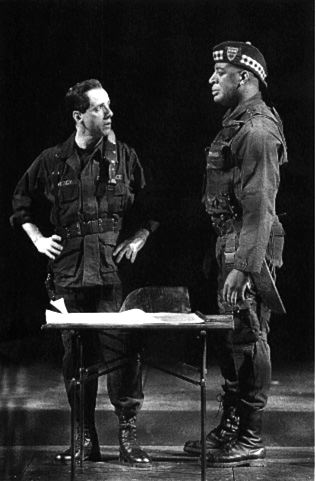
Back to the kingdom, (after rehearsing with Falstaff) Hal finally attempts to reconcile with his father, telling Henry that he will be proud of his son in warfare. Henry accepts his pleas, putting him in charge of part of the royal army. Hotspur, whose ill father does not send the soldiers he requested, is feeling more jilted by the minute. Hotspur's uncle, Douglas the Scot (right, Hotspur and Douglas), visits Henry to address the fact that even though he and his family have supported Henry, Henry turns his back on him now that he has the throne. Henry offers them a general pardon if the family will lay down their arms. Hal is convinced, correctly, that Hotspur will not comply.
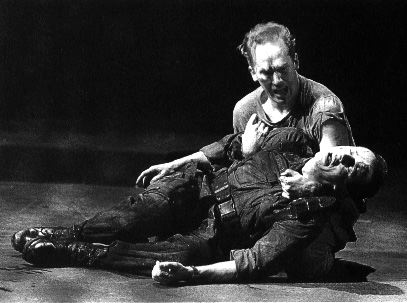 In a
bloody battle, Hotspur (who as we predicted will not
surrender), is killed by Hal (rather symbolically): Hal embraces Hotspur's corpse in a
moment of truth--he has become the warrior that Hotspur
once was. Falstaff yet
again reveals his cunning cowardice, pretending to be dead to
escape confrontation. And after the battle, Good King Henry,
offers Douglas his freedom. Stay tuned for Henry IV; Part
Two!
In a
bloody battle, Hotspur (who as we predicted will not
surrender), is killed by Hal (rather symbolically): Hal embraces Hotspur's corpse in a
moment of truth--he has become the warrior that Hotspur
once was. Falstaff yet
again reveals his cunning cowardice, pretending to be dead to
escape confrontation. And after the battle, Good King Henry,
offers Douglas his freedom. Stay tuned for Henry IV; Part
Two!