 |
July 8, 1998:
President Clinton discusses the
state of
race relations in a NewsHour
special.
April 1, 1998:
A report on the
minority admissions in Berkeley.
Aug. 18, 1997:
U.C. Berkeley opens its doors to 270
new law school students this year.
Only one of them is African American.
May 20, 1997:
A report on the impact of a federal
court decision on
affirmative action programs at the
University of Texas.
Jan. 10, 1997:
Deval Patrick discusses affirmative
actions,
California's Proposition 209, fair
lending, and race relations in America.
Dec. 13 ,1996:
An update on
California's Proposition 209, the
constitutional amendment that would end
the state's affirmative action programs.
Browse the
NewsHour's coverage of
Education and
Race Relations. |

|
|
|
|
|
|
|
SPENCER MICHELS: Within an
hour's drive of each
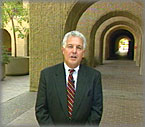 other,
three prestigious San Francisco Bay area law
schools are coping with the problems of
achieving diversity in their student bodies.
Stanford University, here in Silicon Valley;
Hastings Law School in San Francisco; and Boalt
Hall at the University of California at Berkeley
all have similar goals, but differing
approaches. other,
three prestigious San Francisco Bay area law
schools are coping with the problems of
achieving diversity in their student bodies.
Stanford University, here in Silicon Valley;
Hastings Law School in San Francisco; and Boalt
Hall at the University of California at Berkeley
all have similar goals, but differing
approaches. |
|
|
Coping with Prop 209. |
| PETE WILSON: Are we going to treat
Californians equally and fairly, or are we going
to continue to divide Californians by race?
SPENCER MICHELS: Former Governor Pete Wilson
made diversity an issue in 1995, when he and
businessman Ward Connerly urged their fellow
regents of the University of California to ban
affirmative action. After contentious debate,
the regents ended the use of race, gender, or
ethnicity in university admissions. Then a year
later, California voters, after a bitter
campaign, enacted Proposition 209, that
eliminated racial preferences in public
education, employment, and contracting. Under
this double mandate, state universities had to
change admission policies that had given an edge
to minorities. In the first year of the new
policy, starting in 1997, U.C.'s Boalt Law
School reported that just one African-American,
a deferred admission, was in the entering class
of 271 students. Fourteen blacks had been
admitted, but none had chosen to attend
Berkeley. For law school dean Herma Hill Kay,
the political climate made her task difficult.
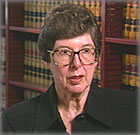 HERMA
HILL KAY: I think that there was a feeling that
California in general had turned its back on
minority applicants. People felt that they
didn't have to come here if they weren't welcome
here. And one of the things that we tried very
hard to do was to turn that perception-- which
we thought was wrong-- around, and make clear
that we do welcome minority applicants, and we
want people to come here. HERMA
HILL KAY: I think that there was a feeling that
California in general had turned its back on
minority applicants. People felt that they
didn't have to come here if they weren't welcome
here. And one of the things that we tried very
hard to do was to turn that perception-- which
we thought was wrong-- around, and make clear
that we do welcome minority applicants, and we
want people to come here.
SPENCER MICHELS: The dean appointed Professor
Robert Cole to head a task force on changing the
admissions policy, with the goal of obtaining a
diverse student body without violating the new
rules. |
 |
|
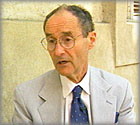 PROFESSOR
ROBERT COLE: You cannot have a first-class law
school in this country without racial and ethnic
diversity. It's just absolutely essential, both,
because it improves the quality of the
education, and because people are going to go
out and be in positions of leadership, they have
to be educated through a more diverse student
body. PROFESSOR
ROBERT COLE: You cannot have a first-class law
school in this country without racial and ethnic
diversity. It's just absolutely essential, both,
because it improves the quality of the
education, and because people are going to go
out and be in positions of leadership, they have
to be educated through a more diverse student
body.
HERMA HILL KAY: Professor Cole recommended,
and the school adopted, an admissions policy
emphasizing individual achievement and placing
less value on undergraduate grades and law
school admission test, or LSAT scores, regarded
as barriers to some minority students. Boalt Law
School also began sending recruiters to some
less prestigious undergraduate colleges than
before, without actually targeting any one race.
They talk to people, they tell them about the
school. They also make contacts with the college
counselors. We produced a video last year called
"Welcome to Boalt Hall" that we sent to college
counselors and we sent to students we admitted.
 STUDENT:
(on video) You should come to Boalt because
something important is going on here. STUDENT:
(on video) You should come to Boalt because
something important is going on here.
SPENCER MICHELS: But Boalt's attempt at
change didn't come fast enough for some
students.
MICHAEL MURPHY, Student Association
President: We were concerned with what we
perceived to be hesitance on the part of the
faculty and administration to really take some
leaps.
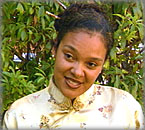 SONYA
ENCHIL, Students of African Descent: If I was
the dean of this law school and this had come
down, I would have not complied with the
decision and allowed a plaintiff to sue, and
this is what the law is about. SONYA
ENCHIL, Students of African Descent: If I was
the dean of this law school and this had come
down, I would have not complied with the
decision and allowed a plaintiff to sue, and
this is what the law is about. |

|
|
What is diversity? |
| SPENCER MICHELS: For others, like students
in Boalt's Federalist Society, the school is
going too far. Second-year student Dave Weiner
is vice president. DAVE WEINER: I think it's
terrifying when you say diversity is based on
skin color and not on viewpoint, and that one's
skin color and viewpoint are one and the same.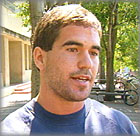 Yeah, of course we like to see people from more
diverse backgrounds, of course. But the thing
is, do we then discriminate against people from
other backgrounds to achieve that goal? I don't
think that's right. I think that's what Berkeley
stood for in the 1960's. I think that's what
we're trying to create, is a society where
people aren't judged.
Yeah, of course we like to see people from more
diverse backgrounds, of course. But the thing
is, do we then discriminate against people from
other backgrounds to achieve that goal? I don't
think that's right. I think that's what Berkeley
stood for in the 1960's. I think that's what
we're trying to create, is a society where
people aren't judged.
SPENCER MICHELS: Twenty-three-year-old Sylvia
Barbosa, a native of Peru and the daughter of
working-class parents, was admitted to this
year's Boalt Hall class after three years at a
junior college and 18 months as an undergrad at
Berkeley. Before she decided to attend, she was
wooed by student clubs and alumni, and she was
awarded a new race-based scholarship. The
scholarship money was put up by an upscale San
Francisco law firm, working with the local bar
association. The grants, totaling $400,000,
targeting minority students, are legal, since
the firms are private and not covered by Prop.
209. The efforts on all fronts appear to be
paying off. When school opened last August, nine
African-Americans joined the new class, although
one of them is no longer enrolled. That's 3
percent. And 23 Latinos are attending, compared
to 14 last year, for a total minority enrollment
of 11 percent. Berkeley's admission policies,
and its use of essays as part of the
application, were greeted with some skepticism
by Ward Connerly, the regent who championed
ending affirmative action.
WARD CONNERLY: If the result has been
obtained through a genuine adherence to the
policies of the Board of Regents and the dictate
of the California Constitution, as reflected by
Proposition 209, then they've done a good thing.
If they've cheated in any way-- and we really
don't know, and I will assume that they have
not-- if they have cheated in any way by looking
at those essays and finding code words for black
and Latino, then we are basically in the same
place we were before the regents took this up.
SPENCER MICHELS: Connerly's concern is that
admissions be based strictly on merit.
 WARD
CONNERLY: Diversity is clearly desirable, I
think. But it should not be the objective,
because once it becomes the objective, then you
start trying to influence the outcome, and I
think that's wrong. WARD
CONNERLY: Diversity is clearly desirable, I
think. But it should not be the objective,
because once it becomes the objective, then you
start trying to influence the outcome, and I
think that's wrong. |
 |
| |
Opportunities for the disadvantaged. |
| |
SPENCER MICHELS: At Hastings Law School in
San Francisco, the outcome is prescribed by a
policy adopted nearly 30 years ago. About 20
percent of places in each class are reserved for
students whose education, economic status,
social experience, or physical disability puts
them at a disadvantage. Hastings is a University
of California affiliate with its own governing
board, and therefore not subject to the regents'
rules. Dean Mary Kay Kane is implementing a
policy that began in 1969.
 MARY
KAY KANE: We thought it was still very important
to provide opportunities for disadvantaged
individuals, of whom many would be minorities,
but some would not be minorities. And so we
revamped our program and set up something which
we call LEOP, which is our special admissions
and academic support program. MARY
KAY KANE: We thought it was still very important
to provide opportunities for disadvantaged
individuals, of whom many would be minorities,
but some would not be minorities. And so we
revamped our program and set up something which
we call LEOP, which is our special admissions
and academic support program.
SPENCER MICHELS: LEOP stands for "Legal
Education Opportunity Program," and Hastings
says it is not race-based, and therefore doesn't
violate Prop. 209.
 MARY
KAY KANE: So we have dodged a bullet to the
extent that we didn't have to scramble, we
didn't have to change what we were doing; we
could sort of continue our efforts. MARY
KAY KANE: So we have dodged a bullet to the
extent that we didn't have to scramble, we
didn't have to change what we were doing; we
could sort of continue our efforts.
SPENCER MICHELS: Besides allowing Hastings to
admit students who have overcome hardship, the
LEOP program supports them once they have been
admitted.
AKILI NICKSON, Hastings student: If you want
help from your peers, if you want extra practice
exams, you can go to LEOP and ask for the help,
and it's there. And it's not just for blacks or
women. You can be a white Anglo-Saxon Protestant
and still come to LEOP and ask for help. And you
can still be in a program. That's one thing I
like about LEOP, is it's not a race-based
program.
 PAUL
CORSCA, Hastings student: When I first came into
law school, you don't know the experience you're
about to have. And this causes a lot of stress,
and it also can be emotionally draining and kind
of counterproductive. So I went through the
orientation recently, and it gave me tools and
plans, and an idea of what I'm going to
experience. PAUL
CORSCA, Hastings student: When I first came into
law school, you don't know the experience you're
about to have. And this causes a lot of stress,
and it also can be emotionally draining and kind
of counterproductive. So I went through the
orientation recently, and it gave me tools and
plans, and an idea of what I'm going to
experience.
DIVYA BHARADWAJA: It has helped me to learn
how to act in law school; it's a drama here, and
it has given me the --basically given me my
script. |
 |
| |
Affirmative-action admissions? |
| |
SPENCER MICHELS: Over the past three years,
between 10 and 15 percent of the Hastings
student body has been made up of
African-Americans and Latinos, with the numbers
dropping a little after the passage of Prop.
209. At the Stanford Law school, 17
African-Americans and 25 Latinos are part of
this year's class. That's 24 percent of the 180
students enrolled, a figure that has gone up
slightly over the last three years. This
university is private, and not subject to Prop.
209 or the California regents. Stanford seeks
diversity of various sorts in its admissions
process, according to law school dean Paul
Brest.
SPENCER MICHELS: But race is one of the
factors?
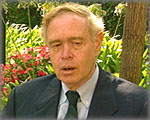 PAUL
BREST: Race is absolutely one of the factors. PAUL
BREST: Race is absolutely one of the factors.
SPENCER MICHELS: So if you had a class that
didn't have African-Americans in it, or
Chicanos, this would be upsetting, right?
PAUL BREST: We would think that we could not
give the student body as a whole the kind of
professional education we do if we didn't have
members of those minority groups.
SPENCER MICHELS: As one of the nation's top-
rated law schools, Stanford attracts
applications from many highly qualified
minorities, increasing the chances for a diverse
class. The applicants are judged not just on
their scores, but on their life experience.
Janice Strong is a 39-year-old single mother and
a third-year law student.
JANICE STRONG, Stanford Law School: I didn't
start college until I was 34. Before that, I was
raising kids. I was a business owner, so I by no
means was destitute, but I decided to quit
everything that I had. I went to community
college.
SPENCER MICHELS: She transferred to Stanford
undergrad, and then applied to law school
without high test scores.
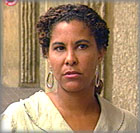 JANICE
STRONG: They still took me because of my life
history and who I am, because affirmative action
isn't just color, it's a life story, it's a life
history; because my grades are good, I'm in good
standing, and I'm living proof that the merit
argument means nothing. JANICE
STRONG: They still took me because of my life
history and who I am, because affirmative action
isn't just color, it's a life story, it's a life
history; because my grades are good, I'm in good
standing, and I'm living proof that the merit
argument means nothing.
SPENCER MICHELS: Stanford's policies are
outside the purview of the state and of regent
Ward Connerly. Nevertheless, Connerly says
considering race in admissions anytime is
unfair.
WARD CONNERLY: The reverse of saying, "we
want more blacks and Latinos," is saying, "we
want less Asians and whites." That's the
reality. It is a zero-sum game. If they want to
discriminate-- and that's essentially what we're
taking about; we can call it "diversity
building," or whatever we want to call it-- if
they choose to discriminate, that is their
business. I wish they wouldn't, and if they're
using government money, we should slap them and
take the money away if they in fact are doing
that.
SPENCER MICHELS: Stanford officials do worry
that the Supreme Court could in fact ban
affirmative action in schools that receive
federal grants. So far, that has not happened.
The deans of Stanford, Hastings, and Boalt Hall
law schools say their efforts to attract
minorities will continue, and California's new
Democratic governor also is pushing to ensure
diversity at state colleges and universities.
|
|

|
|
California law schools look for new ways to achieve
diversity in the wake of the passage of Proposition
209, which eliminated affirmative action from the
state's public education system.

|
|
|
|

 Leadership Focus