|
AP
AMERICAN GOVERNMENT |
||||
|
VOCABULARY |
||||
|
DIVIDED GOVERNMENT UNIFIED GOVERNMENT GRIDLOCK ARTICLE II ELECTORAL COLLEGE SOLE/SHARED POWERS COMMANDER-IN-CHIEF TREATY POWER APPOINTMENTS CABINET DEPARTMENTS PYRAMID STRUCTURE CIRCULAR STRUCTURE AD HOC STRUCTURE WHITE HOUSE STAFF |
EXECUTIVE ORDER
BULLY PULPIT EXECUTIVE PRIVILEGE SIGNING STATEMENTS VETO POWER POCKET VETO/IMPOUNDMENT LINE ITEM VETO SUCCESSION IMPEACHMENT 11TH AMENDMENT 12th AMENDMENT 22nd AMENDMENT 25th AMENDMENT PARDON |
BUREAUCRACY CIVIL SERVICE SPOILS SYSTEM MERIT SYSTEM ENTITLEMENT DISCRETIONARY SPENDING MASS MEDIA Court Cases: TRAIN v NEW YORK CITY CLINTON v NEW YORK CITY US v NIXON CLINTON v JONES |
||
|
WEEK 9 |
||||
|
LESSON |
IN CLASS |
HOMEWORK |
||
| WEDNESDAY |
PSAT |
WATCH: The Democratic Debate,
8:30 pm, October 13, 2015
The debate from Nevada will
be broadcast live on CNN and MSNBC.
Assignment: watch and consider what the candidates are saying
about national security, economic policy, immigration, civil
rights, and other important issues.
Consider how they respond to these questions and be
prepared to discuss both content (WHAT they say) and appearance
(HOW they say it) in class on Thursday!
|
||
|
THURSDAY |
Debrief Unit 3 Test
|
Review:
The Democratic Debate you were assigned to watch at 9:00 pm,
October 13, 2015 |
||
|
FRIDAY |
DISCUSSION:
The Democratic Debate, Episode I
Activity:
In groups, review and discuss the main highlights of the debate.
Addressing the following questions:
|
Watch:
Article II
for Dummies |
||
|
WEEK 10 |
||||
|
LESSON |
IN CLASS |
HOMEWORK |
||
|
MONDAY Lesson 3 |
ESSENTIAL QUESTION: What
are the constitutional powers and duties of the President?
Assignment:
GRQ Unit 4
A great reference is the official US Senate Annotated
Constitution linked here!
You may work in groups,
but answers must be In Your Own Words.
This WILL be used
for the GRQ quiz on Tuesday. |
Read:
Wilson 14th, Chapter 10 pp. 238-241, 243-249 Presidential
Elections |
||
|
TUESDAY |
ESSENTIAL QUESTION: How
do you get elected President?
Carousel Exercise: Groups of students will create a list of the steps to run a successful campaign for President of the United States; the list will be no more than 10 steps. Groups will then move around the room analyzing the other posted lists—using a check mark for a task which they also had on their list, an exclamation mark for an important task, a question mark for an unclear task, and an x for an irrelevant or missing task. The entire class will discuss and create a formal 10 step list based on their analysis.
Quiz: Open GRQ quiz on Article II |
Read:
Wilson 14th,
Chapter 14 pp. 345-350
The Electoral College
|
||
|
WEDNESDAY |
Report to the Media Center.
ESSENTIAL QUESTION:
What is the Electoral College and how does it function?
Activity:
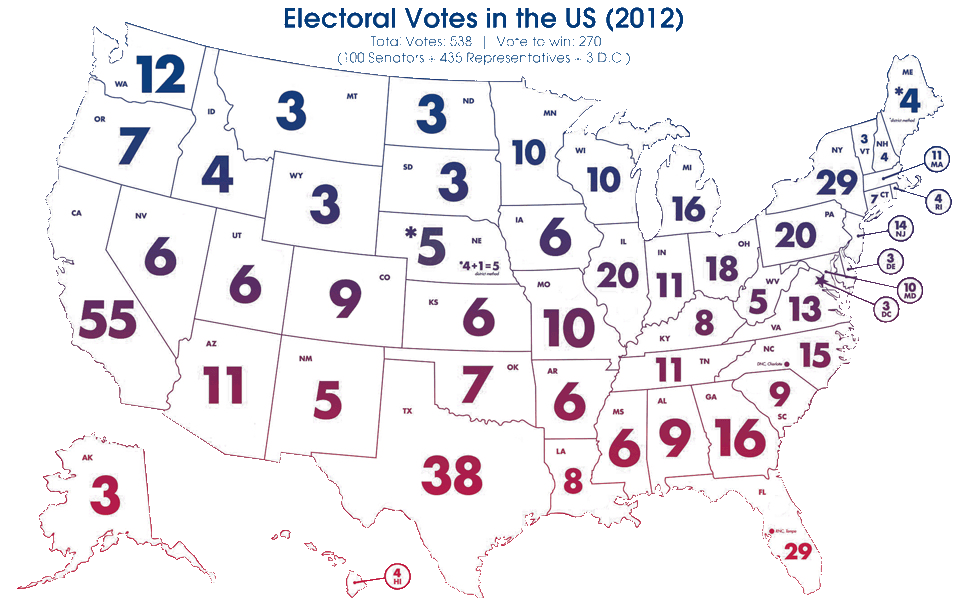
Electoral College Game
Work in pairs to complete
two complete Electoral College Challenges.
Use your resources wisely to win states popular votes and
collect enough electoral votes to claim the presidency. Consider
the following questions:
·
According to your electoral map, what are the
FOUR states with the largest number of electoral votes
·
What strategy do you intend to use in order to
get 270 electoral votes? Will you focus your resources on
winning the biggest but most difficult states or will you build
up your ‘war chest’ by capturing the electoral votes and
resources of smaller states before contesting the largest
states?
·
Identify one state where your party already has
an advantage. Why do you think your party has an advantage in
that state? Has your party won that state in past elections?
·
Who won the election?
·
Why do you think this candidate won the election?
Did their strategy pay off?
·
Compare your electoral map to the real results
from past campaigns online. What election seems to be the
closest parallel to your results?
|
Read:
Wilson 14th,
Chapter 14 pp. 338-344 Presidential Powers
|
||
|
THURSDAY |
ESSENTIAL QUESTION: What are the Constitutional and Implied powers of the President?
Quick Notes: Unit 4 Part 2 Executive Powers |
Read:
West Wing: The State Dinner |
||
|
Friday |
ESSENTIAL QUESTION:
What are the Constitutional Responsibilities of the
President?
Watch:
West Wing The State Dinner
Be prepared to answer a short quiz based on the questions listed
during the video, and discuss the answers.
Video Questions:
Answers must be In Your Own Words. This MUST be turned in BEFORE the end of class today--any assignment turned in late will be penalized 1 point. |
Read:
Wilson 14th, Chapter 15 pp. 381-391, 397-404
The Bureaucracy
Makeup:
Watch
Democracy in American #7: The Modern Presidency and answer the
assigned questions on the
worksheet in complete sentences.
Answers must be In Your
Own Words.
This MUST be turned in
within 24 hours of your absence--any assignment turned in late
will receive 50%. |
||
|
WEEK 11 |
||||
|
LESSON |
IN CLASS |
HOMEWORK |
||
|
MONDAY Lesson 8 |
ESSENTIAL QUESTION: How
does the President enforce the laws?
·
Federal Bureaucracy
·
The 8 Steps in Public
Policy
Quiz: Socrative Quiz on Quicknotes 4.1-4.2 Quick Notes: Unit 4 Part 3 The Bureaucracy |
|||
|
TUESDAY Lesson 9 |
ESSENTIAL QUESTION: What is the relationship between the
President and Congress?
Watch:
West Wing Shutdown
Be prepared to answer a short quiz based on the questions listed
during the video, and discuss the answers.
Video Questions:
Answers must be In Your Own Words. |
Read:
Wilson 14th, Chapter 14 pp. 400-401 Impeachement
Makeup:
Watch
Democracy in American #8: The Bureaucracy
and answer the assigned
questions on the
worksheet
in complete sentences.
Answers must be In Your Own Words.
This MUST be turned in within 24 hours of your absence--any
assignment turned in late will
be penalized.
|
||
|
WEDNESDAY Lesson 10 |
ESSENTIAL QUESTION: What is an impeachable offense?
Impeachment Activity:
You have been selected by the Speaker of the House as a member
of the House Select Committee on Impeachment.
Your job is to investigate charges against the President,
and report out a resolution to the Speaker.
If your committee feels there is not enough evidence to
charge the President, your resolution will recommend not
pursuing impeachment; however, if your committee feels it does
have enough evidence, you will recommend specific charges of
impeachment and the full House will then debate and vote on each
charge.
To recommend impeachment, you must believe your committee has
enough evidence to prove one or more of the following:
Treason,
Bribery,
or other
High
Crimes and Misdemeanors.
These charges do not have to be proven "beyond a reasonable
doubt”, the burden of proof must only be "clear and convincing”
enough for 2/3rds of the Senate.
Assignment:
Each committee must complete the
House Select Committee Impeachment Recommendation
Answers must be In Your Own Words. |

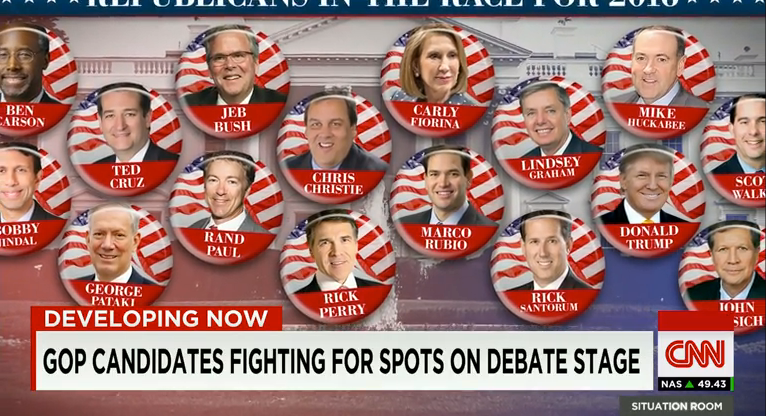
WATCH:
The Republican Debate 9:00 pm, October 28, 2015
The debate from Boulder, Colorado, on CNBC, and will only
consist of the top 10 candidates in national polls.
Assignment:
watch and consider what the candidates are saying about
national security, economic policy, immigration, civil
rights, and other important issues.
Consider how they respond to these questions and be
prepared to discuss both content (WHAT they say) and
appearance (HOW they say it) in class tomorrow
|
||
|
THURSDAY Lesson 11 |
DISCUSSION:
The Republican Debate, Episode III
Activity:
In groups, review and discuss the main highlights of the debate.
Addressing the following questions:
|
 |
||
| FRIDAY | Teacher Work Day | |||
|
WEEK 12 11/2 - 11/3 |
||||
|
LESSON |
IN CLASS |
HOMEWORK |
||
|
MONDAY |
ESSENTIAL QUESTION: How do you write an effective AP American
Government DBQ?
Review Practice Unit 4 AP Essays
Assignment:
In groups, Read for the Rubric, Organize your Essays, and
OUTLINE the possible ideas and conclusions which would receive
credit under the COMPLETE-CORRECT-CONNECT guidelines. You will be responsible for one of the following four essays:
|
Review for Unit 4 Test
Review:
Unit 1, 2, 3, and 4: Use
online chapter notes, GRQs, and
Textbook site practice section quizzes.
ALL TESTS ARE CUMULATIVE!
ALL UNIT 4 FORMATIVE REASSESSMENTS ARE DUE; NO MORE REASSESSMENTS FROM UNIT 4 WILL BE ACCEPTED AFTER TODAY. |
||
|
Tueday |
|
Bring: Pencil for Unit 4 test |
||