 |
Friedrich Hayek (1899-1992) |
|
|
|
|
If any twentieth-century economist was a Renaissance man, it
was Friedrich Hayek. He made fundamental contributions in
political theory, psychology, and economics. In a field in
which the relevance of ideas often is eclipsed by expansions
on an initial theory, many of his contributions are so
remarkable that people still read them more than fifty years
after they were written. Many graduate economics students
today, for example, study his articles from the 1930s and
1940s on economics and knowledge, deriving insights that
some of their elders in the economics profession still do
not totally understand. It would not be surprising if a
substantial minority of economists still read and learn from
his articles in the year 2050. In his book Commanding
Heights, Daniel Yergin called Hayek the “preeminent”
economist of the last half of the twentieth century.
Most of Hayek’s work from the 1920s through the 1930s was in the Austrian theory of business cycles, capital theory, and monetary theory. Hayek saw a connection among all three. The major problem for any economy, he argued, is how people’s actions are coordinated. He noticed, as Adam Smith had, that the price system—free markets—did a remarkable job of coordinating people’s actions, even though that coordination was not part of anyone’s intent. The market, said Hayek, was a spontaneous order. By spontaneous Hayek meant unplanned—the market was not designed by anyone but evolved slowly as the result of human actions. But the market does not work perfectly. What causes the market, asked Hayek, to fail to coordinate people’s plans, so that at times large numbers of people are unemployed? One cause, he said, was increases in the money supply by the central bank. Such increases, he argued in Prices and Production, would drive down interest rates, making credit artificially cheap. Businessmen would then make capital investments that they would not have made had they understood that they were getting a distorted price signal from the credit market. But capital investments are not homogeneous. Long-term investments are more sensitive to interest rates than short-term ones, just as long-term bonds are more interest-sensitive than treasury bills. Therefore, he concluded, artificially low interest rates not only cause investment to be artificially high, but also cause “malinvestment”—too much investment in long-term projects relative to short-term ones, and the boom turns into a bust. Hayek saw the bust as a healthy and necessary readjustment. The way to avoid the busts, he argued, is to avoid the booms that cause them. Hayek and Keynes were building their models of the world at the same time. They were familiar with each other’s views and battled over their differences. Most economists believe that Keynes’s General Theory of Employment, Interest and Money (1936) won the war. Hayek, until his dying day, never believed that, and neither do other members of the Austrian school. Hayek believed that Keynesian policies to combat unemployment would inevitably cause inflation, and that to keep unemployment low, the central bank would have to increase the money supply faster and faster, causing inflation to get higher and higher. Hayek’s thought, which he expressed as early as 1958, is now accepted by mainstream economists. In the late 1930s and early 1940s, Hayek turned to the debate about whether socialist planning could work. He argued that it could not. The reason socialist economists thought central planning could work, argued Hayek, was that they thought planners could take the given economic data and allocate resources accordingly. But Hayek pointed out that the data are not “given.” The data do not exist, and cannot exist, in any one mind or small number of minds. Rather, each individual has knowledge about particular resources and potential opportunities for using these resources that a central planner can never have. The virtue of the free market, argued Hayek, is that it gives the maximum latitude for people to use information that only they have. In short, the market process generates the data. Without markets, data are almost nonexistent. Mainstream economists and even many socialist economists now accept Hayek’s argument. Columbia University economist Jeffrey Sachs noted: “If you ask an economist where’s a good place to invest, which industries are going to grow, where the specialization is going to occur, the track record is pretty miserable. Economists don’t collect the on-the-ground information businessmen do. Every time Poland asks, Well, what are we going to be able to produce? I say I don’t know.” In 1944 Hayek wrote The Road to Serfdom to warn his fellow British citizens of the dangers of socialism. His basic argument was that government control of our economic lives amounts to totalitarianism. “Economic control is not merely control of a sector of human life which can be separated from the rest,” he wrote, “it is the control of the means for all our ends.” To the surprise of some, John Maynard Keynes praised the book highly. On the book’s cover, Keynes is quoted as saying: “In my opinion it is a grand book.... Morally and philosophically I find myself in agreement with virtually the whole of it; and not only in agreement with it, but in deeply moved agreement.”Although Hayek had intended The Road to Serfdom only for a British audience, it also sold well in the United States. Indeed, Reader’s Digest condensed it. With that book Hayek established himself as the world’s leading classical liberal; today he would be called a libertarian or market liberal. In the book’s postscript, “Why I Am Not a Conservative,” Hayek distinguished his classical liberalism from conservatism. Among his grounds for rejecting conservatism were that moral and religious ideals are not “proper objects of coercion” and that conservatism is hostile to internationalism and prone to a strident nationalism.In 1974 he won the Nobel Prize “for pioneering work in the theory of money and economic fluctuations and for penetrating analysis of the interdependence of economic, social and institutional phenomena.” This award seemed to breathe new life into him, and he began publishing again, both in economics and in politics. Selected Works
|
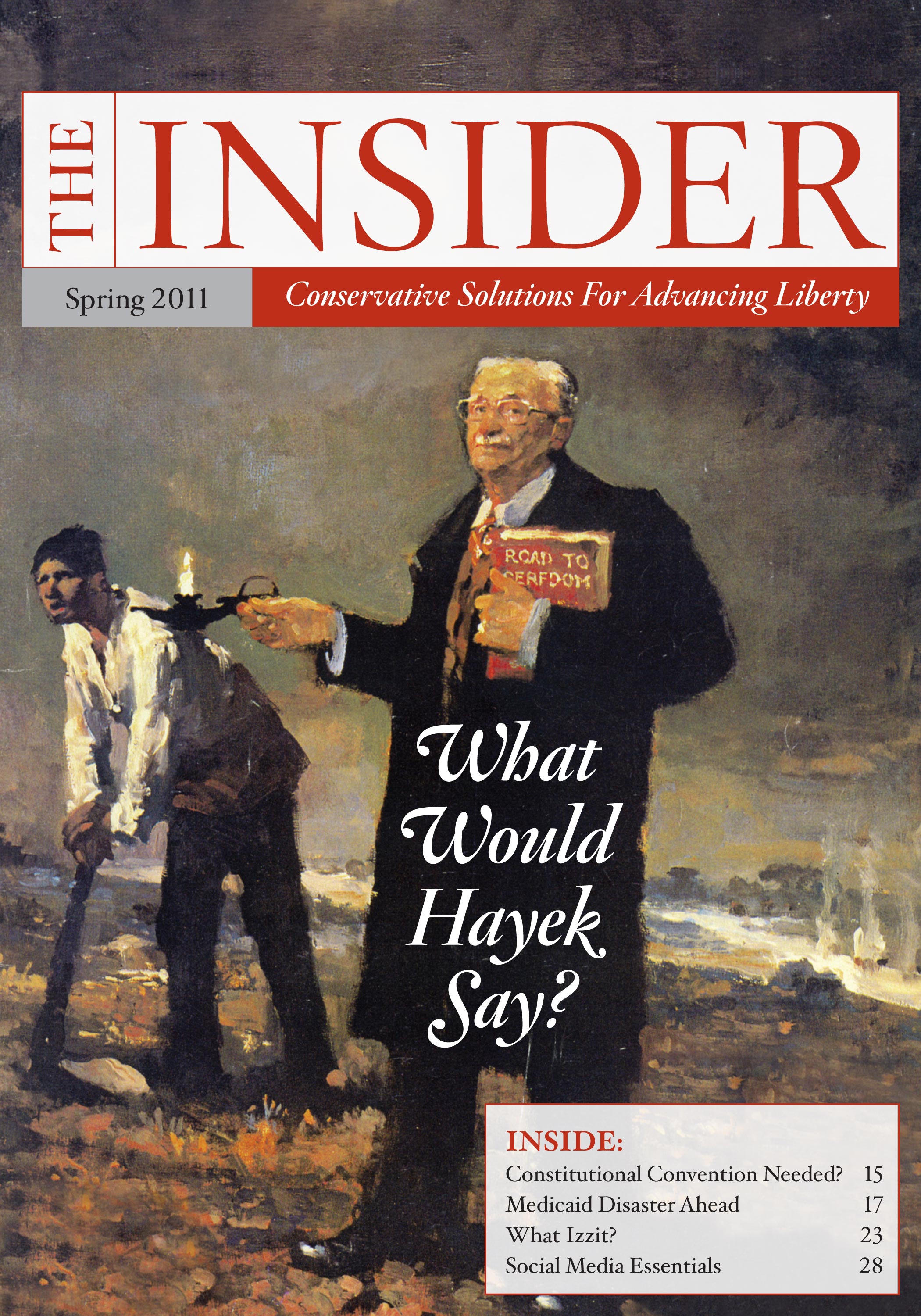
excerpt from
The Road to Serfdom |
1935. Prices and Production. 2d ed. Reprint. New
York: Augustus M. Kelley, 1975.
1944. The Road to Serfdom. Chicago: University of
Chicago Press.
1948. Individualism and Economic Order. Chicago:
University of Chicago Press.
1960. The Constitution of Liberty. Chicago:
University of Chicago Press. Reprint. Chicago: Henry
Regnery, 1972.
1973. Law, Legislation, and Liberty. Chicago:
University of Chicago Press.
1976. Denationalization of Money. London: Institute
of Economic Affairs.
1988. The Fatal Conceit. Chicago: University of
Chicago Press.
|