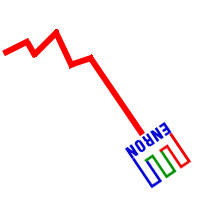
Enron was formed in 1986 out of a merger of natural gas pipeline companies, Houston Natural Gas and InterNorth. Kenneth Lay, a PHd in economics and a champion of deregulation and the free market, engineered the merger as head of Houston Natural Gas and he was named Chairman and Chief Executive Officer (CEO) of the new company.
In 1996, Lay promoted Jeffrey Skilling to President and CEO of Enron, and Andrew Fastow, a former banker, to Chief Financial Officer (CFO).
Over the years, Lay, Skilling, and Fastow would advocate a business philosophy that de-emphasized hard assets such as plants and pipelines in favor of trading in deregulated markets. They transformed Enron from a company that delivered actual gas and oil to one that dealt in contracts; as Business Week put it, the company became "more akin to a brokerage house than to a power company."
Enron became the lead market-maker for the new, deregulated natural gas industry; and since deregulation worked well for natural gas, which increasingly became the nation's fuel of choice, Enron's new role was highly profitable. After gas came deregulation of electricity, and as power deregulation became the rage across the US, Enron took on a key role as a broker for wholesale electricity. Soon the company was looking for new worlds to conquer and moved into other markets: water supply, bandwidth on fiber-optic cables, data storage, advertising space, at one point even seriously considered "trading weather."
In 1986, Enron had sales of $7.5 billion. By 1993, sales were just under $8 billion. In 1995, two years later the company's net worth took off, and between 1999 and 2000, Enron's sales had increased by 151% to $101 billion. In 2000, Enron became the seventh largest corporation in America.
The next year it went bankrupt.
There is a general impression that Enron was a good corporation that went bad. It was "the best energy company in the world," according to its top executives Kenneth Lay and Jeffrey Skilling.
Bethany McLean of Fortune magazine first started the house of cards tumbling down with an innocent question about Enron's quarterly statements, which did not ever seem to add up. What did Enron buy and sell, actually? Electricity? Natural gas? It was hard to say. The corporation basically created a market in energy, then manipulated it and gambled in it.
McLean discovered that at the time Lay and Skilling made their claim the company was virtually bankrupt and had been worthless for years. The senior executives of Enron had inflated its profits and concealed its losses through bookkeeping practices so corrupt that the reputation of Enron's accounting firm Arthur Anderson was destroyed in the aftermath. The executives had also systematically looted the retirement funds of the company's employees to buy a little more time to sell out their own stocks for hundreds of millions of dollars in profits.
The most shocking accusation against the company involves the fact that Enron may have cynically and knowingly created the California energy crisis. There was never a shortage of power in California. Between 30% and 50% of California's energy industry--up to 76% at one point--was shut down by Enron as the company drove the price of electricity higher by nine times. There are even tape recordings of Enron traders on the phone with California power plants asking plant managers to "get creative" in shutting down plants for "repairs" to manufacture artificial shortages.
Even worse, according to economist Paul Krugman, most of the Enron's worst sins seem to have been lawful: the partnership ties, the tales of profit and growth enhanced for dramatic effect, the taxes avoided by sending revenues to the Cayman Islands, the freezing of employee 401(k)s in the company's own stock, the auditing firm with about half its fees gained from other accounting services provided to Enron, and so on. Even Kenneth Lay's last minute stock sales may not have violated SEC regulations, because Lay was selling the stock to repay personal loans from the corporation, insider-trading restrictions did not apply.
According to Krugman, the real lesson of the Enron catastrophe is that the concerns that led to regulation in the first place--monopoly power and the threat of market manipulation--are still real issues today, and if there was ever a corporation that needed more regulation, that corporation was Enron.
Yet there are still those who blame the Enron catastrophe on "too much regulation." According to PJ O'Rourke, regulation creates a moral hazard. Most Americans don't understand finance, but it's regulated so they feel safe.
"The problem is that government regulations are too good." he says, "Government regulation dulls the senses that you would take into an unregulated free market situation. You feel too safe, so you don't do the necessary research."
Government regulatory agencies strive to create honest dealings, fair trades, and a situation in which no one has an advantage over anyone else. But, says O'Rourke, human beings aren't honest: all trades are made because one person thinks he's getting the better of the other, and the other person thinks the same. In spite of that, everyone comes out ahead in any transaction, providing they have done their homework in order to limit their risks.
O'Rourke believes that government regulation of the marketplace isn't bad; but control by reputation in the marketplace is better. Enron may not have broken the law, but it broke the rules of ethics. The long-term solution is that regardless of whether the company had survived, no one would have ever wanted to deal with Enron again.
End of reputation, end of profits, end of problem.
From this perspective, regulation would be better if its goal were not to ensure honesty in finance, but to provide details, and get all the dirty laundry out in public. To inform the public rather than protect it--and yet in a free country that is the job of the media, not the government. And muck-raking by the media is driven by a need for profits. A free market solution to a free market problem.
Your assignment is to choose which position you take in this debate: does the market need more regulation or less?

-
This brief should be 5 paragraphs; a minimum of 2 sentences, no more than 5 sentences per paragraph.
-
All sentence must be complete sentences.
-
The first paragraph of this Brief will be the Introduction.
-
The first sentence of this Brief will be the THESIS. The Thesis is a clear NORMATIVE (subjective) statement of the position the brief will take on the issue using the vocabulary and concepts from economics:
-
Does the collapse of Enron argue for MORE government intervention or LESS regulation?
-
-
The second sentence in the Introduction will be the OUTLINE for the rest of the brief listing the three supporting topics which will be presented to back up the position supported by the Brief.
-
The next three paragraphs will be Support paragraphs. Each support paragraph will begin with a Topic sentence, and will include at least one POSITIVE (objective) FACT taken from the online articles or the textbook which backs up the THESIS.
-
For the brief, use facts from the video, online articles, and textbook, page 349; do NOT bring in outside facts.
-
All facts in this Brief MUST be cited.
-
A Brief should NEVER be in first person.
-
A Brief should ALWAYS be IN YOUR OWN WORDS (IYOW); you may NOT cut and paste from the internet or any other source or you will receive a zero and this will be reported to the Honor Council.
-
Your brief should ALWAYS be printed out, not hand-written.
-
Your Brief is due at the beginning of the class on the assigned due date; assignments turned in after class will be penalized one point per day late.