A brief (Latin "brevis", short) is a
written legal document that is presented to a court
arguing why the party to the case should prevail.
The brief establishes the basis for the argument of
each party, explaining why the court should decide
in their favor based on legal precedent and factual
evidence.
The structure of Briefs
follow a similar structure: presentation of issue,
presentation of facts, presentation of legal and policy
arguments and presentation of possible outcome. The
brief always begins with a summary of the party's argument, usually in only one sentence;
then presents the relevant
facts and legal standards that the court
should use in evaluating its decision; this
may
include policy arguments, statistics, and an
exploration of the consequences of the possible decision.
The Brief concludes with synopsis of the legal and policy arguments explaining
why the party should win the case.
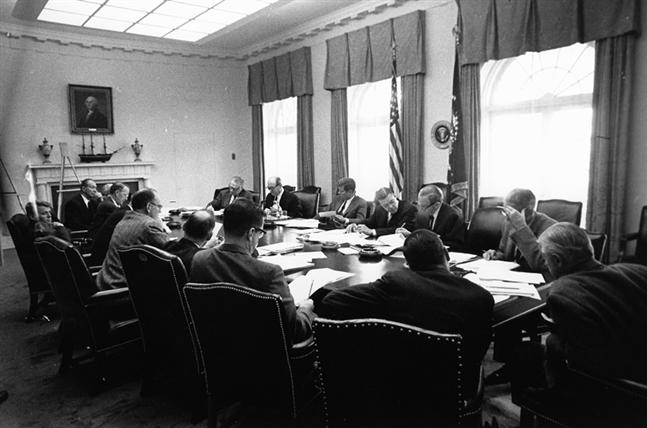
The use of briefs has found its way into business and
politics as well. When leaders are considering important
decisions, they often have the case 'briefed' for them with
advisors listing the arguments for and against particular decisions
and analyzing possible outcomes; the most famous example
being President John Kennedy's briefing by his Executive
Committee on possible actions against Cuba during the
missile crisis of 1962.
The Brief you will be using in this course follows a
defined format:
The number of paragraphs in your Brief will be
FIVE--no more and no less.
The first sentence of the first paragraph will be the
thesis statement. The next sentence or sentences
will highlight the three main supporting
subtopics.
The minimum number of sentences in an opening
paragraph is TWO.
The second through fourth paragraphs are all
similar in format.
They begin with a topic sentence which is a restatement
of one of the three supporting ideas presented in the
first paragraph. This is followed by supporting
sentences which contain the factual information which
backs up the Topic sentence. The minimum number of
sentences in a support paragraph is TWO.
Although it is not necessary, each of the support
paragraphs is usually joined together by a transition
word, phrase or sentence. Transitions help the reader to
follow the flow of the logic and sequencing.
The final paragraph
restates the main thesis idea and reminds the reader of
the three main supporting ideas that were developed.
It is
important to restate the thesis and three supporting
ideas in an original and powerful manner as this is the
last chance the writer has to convince the reader of the
validity of the information presented. Because the
purposes of the first and fifth paragraph are so similar
that some writers construct them at the same time. They
will edit them, as necessary, as they do with each and
every part of the essay. The minimum number of sentences
in a support paragraph is TWO.
YOU WILL
NOT BE GRADED ON THE NUMBER OF
PARAGRAPHS IN YOUR BRIEF
YOU WILL
NOT BE GRADED ON THE NUMBER OF
SENTENCES IN EACH PARAGRAPH
YOU WILL
NOT BE GRADED ON THE NUMBER OF WORDS
IN EACH SENTENCE
YOU WILL
NOT BE GRADED ON THE NUMBER OF
SYLLABLES IN EACH WORD
YOU WILL
NOT BE GRADED ON THE NUMBER OF
LETTERS IN EACH SYLLABLE.
YOU
WILL BE GRADED ON THE
CLARITY,
RELEVANCE, AND
PERSUASIVENESS OF YOUR
BRIEF

 Leadership Focus