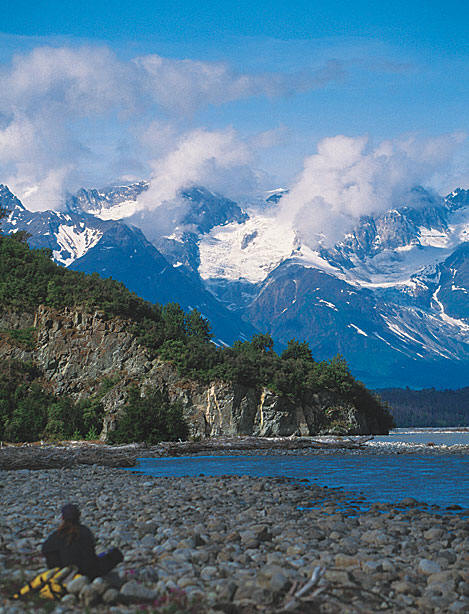
On any given day when you wake up in the morning, how
many times have you wondered what life is like in the
Arctic? If you answered none, then you have given the
answer that many politicians and their oil-developing
buddies
in D.C. want you to. That way, they can get away with
drilling for oil in the protected Arctic National Wildlife
Refuge (ANWR) off the North Slope of Alaska without anyone
making a big fuss. If no one knows about the
irreversible ecosystem disaster caused by drilling in such a
delicate environment, the no one will complain, right?
Oil developers and their government representatives claim
that drilling operations will bring jobs to the poor
constituents of the Alaskan North Slope. A similar
argument was made by Pacific lumber companies as they
clear-cut across the coast in the recent past. Although
drilling may bring jobs, it won't be for very long,
according to a study from the U.S. Geological Survey.
They estimate that the oil reserves under ANWR may only hold 3.2
billion barrels of oil, or a 6 month supply.
Or maybe you have heard that drilling in ANWR would free
us from dependence on imported oil. A recent U.S. Department of Energy (DOE) assessment says
there is "considerable uncertainty regarding both the size
and quality of the oil resources that exist in ANWR." Even
if 7.7 million barrels a day could be recovered (as
estimated in oil company study), "the current upper
limit to ANWR oil production is the transportation capacity
of TAPS" (Trans Alaska Pipeline System), or
2.136 million barrels per day. To put this in context,
the U.S. burns
21
million barrels per day.
President
Bush argues that Alaskan oil will help ease the power problems
experienced in California. What he didn't tell you is
that nearly 90% of power in California is fueled by natural
gas, not oil. Nor did he mention that it would take
ten or more years of production before any oil from ANWR
makes it to the commercial market; DOE says that the maximum potential capacity -
accessing all the oil that's available to be pumped - would
not be realized until 2026. That's ten years of
no air conditioning for those folks in California who are
waiting for that oil to solve their problems.
And ANWR isn't our only option for domestic drilling
either. There are millions of acres already open to drilling
where oil companies have not yet explored. As Mom used to
say, finish what's on your plate before you ask for seconds.
On the other hand, Economist Gernot
Wagner explained why any drilling in the US won't lead to lower
oil and gas prices anyway. What's mainly driving high oil prices
today, he said, is increased demand. And the increase, in
large part, is due to the newly mobile millions around the
world who've been lifted out of poverty in the last few
decades--particularly in China and India.
World oil demand between 2010 and 2015
will increase by over 7 percent, and 30 percent by 2030. The
U.S. only has 3 percent of the world's oil reserves, and
one-fifth of that is in federal offshore waters.
So even if we were able to tap into the full 3 percent--Off-shore
and Alaskan drilling, it
would scarcely make a dent in the demand-supply balance. Then there is this inconvenient fact: OPEC would have
the final say on whether increased U.S. production lowered
world prices. OPEC easily could scale back total
production by the same amount to wipe out any price effects.
They did it just this week in response to falling oil
prices.
ANWR oil would be too little
too late. Drilling will not reduce fuel prices, will not
create long-term employment, and will not make
us more energy independent. It is not a solution to our
nation's energy problems. The only way to achieve these
goals is to reduce our dependence on oil - foreign or
domestic - through fuel economy, a
cap on carbon emissions, and focusing on new energy
technologies.
If drilling for oil in ANWR could possibly do us some
good, then perhaps there might be validity in the argument
that we should do it - even if it did bring harm to wildlife
and ecosystems. But to harm ecosystems for no benefit at all
is just plain stupid - and there's no question that it would
do harm. Oil spills in nearby Prudhoe Bay are common and the
consequences are devastating.
Oil companies make lofty claims that drilling for oil in
the arctic comes with little environmental and ecological
damage, yet hard evidence suggests otherwise. On April 15th of this year, nearly 93,000 gallons
of crude oil and salt water erupted from a corroded pipeline
in Prudhoe Bay, 100 miles to the west of the coastal plains
of ANWR. There are an estimated 409 spills from
Prudhoe Bay and the TranAlaskan Pipeline every year, releasing toxins
such as acids, waste oils and crude oils into the rivers and
onto the tundra. Accidents like this happen at an
alarmingly high rate; they will inevitably occur also at ANWR. Knowing this, it is ironic that Athens'
Congressional Representative John Linder claims “there is a
general misconception that opening [ANWR] for oil
exploration will harm the environment. American
operators have consistently demonstrated that development
can occur without compromising the environment.”
Yet the “American operators” that want to open ANWR for
drilling - British Petroleum, Exxon, Chevron and Arco -
leave a trail of leaks, accidents, violations and explosions
in their wake. In Prudhoe Bay alone, a BP
subcontractor was fined $15 million for injecting hazardous
waste into groundwater, while Arco is potentially
responsible for 3 toxic waste sites in the area.
Chevron has been charged with 65 violations of the Clean
Water Act for illegally disposing of waste products in oil
production areas. As Nathan Manuel of the Public
Interest Research Group has said, “Behind the oil
industries' rhetoric lurks a long list of corporate
irresponsibility.”
Drilling in ANWR will unavoidably and irreparably damage
the ecosystem of that area. The coastal plain of ANWR
is a vital breeding ground for polar bears, grizzlies,
Arctic wolves, caribou, the shaggy musk ox, migratory birds,
and many others. Life becomes rather cumbersome for
these nomadic animals when they have to cross pipelines,
hazardous waste sites, gravel pits, well rigs, and other
ruins of the industrialized landscape. Studies show
that over 22,000 acres of tundra wetlands and floodplains,
the heart of Arctic life, have suffered direct losses since
the opening of the oil fields in the area.
Nor does it make sense to argue that the area opened for
drilling would be very small. First of all, these areas tend
to expand. The nearby Prudhoe Bay oil fields were originally
supposed to comprise 2100 acres, but today they spread over
640,000 acres. Plus, as wildlife expert Michael Bean
notes, "The effects of development extend well beyond the
physical limits of that footprint." Drilling in a wildlife
refuge is a slippery slope. What's next? Drilling in
wilderness areas? National Parks? Your backyard? What's the value of a
protective designation if the land isn't protected?
The Arctic National Wildlife Refuge is too fragile of an
ecosystem to be sacrificed for a short-term and speculative
supply of oil.