Thomas Frank
January 31, 2009
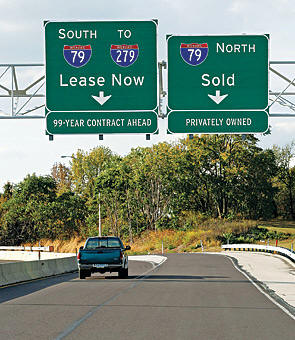
Back in the days when the market was a kind of secular god and all the world thrilled to behold the amazing powers of private capital, the idea of privatizing highways and airports and other bits of our transportation infrastructure made a certain kind of sense.
Private businesses did everything better than the state, we were told. And that meant even tasks as inherently public as maintaining bridges and roads.
And so, during the Bush years, promoting these public-private partnerships became one of the great causes of the U.S. Department of Transportation. It was nothing less than a "revolution," Transportation Secretary Mary Peters exclaimed last June on her blog the Fast Lane. It was a "quiet revolution," she wrote, on which the administration planned to "turn up the volume."
But something happened on the road to privatopia, with so many brilliant schemes of the last few decades melting away in this harsh new day of failing banks and plummeting asset prices. Recent events have even pushed the ugly word "nationalization" into the conversation, with our brightest pundits choking over those alien syllables.
Thus was highway privatization stripped of its positive reputation. It is no longer one of those things that you need urgently to do because all the cool European kids are doing it.
The thing now is to seem concerned in a vaguely social-democratic way. Ikea is calling on consumers to "Embrace Change." The new Pepsi campaign, shouting "Hope" and "Yes You Can," mirrors the Obama-for-president effort. And a group of infrastructure-privatization boosters, including Merrill Lynch and Morgan Stanley, have recast their project as a sort of "private stimulus." As one of the group's members told the Wall Street Journal last week, private infrastructure investment is "really a perfect fit with Obama's objectives."
How so? Well, state governments are in dire circumstances these days, scarcely able to afford the upkeep on the roads and bridges they inherited from our statist ancestors. Indeed, one scarcely ever sees the word "infrastructure" without the inevitable qualifier, "crumbling." And few are willing to raise the gasoline taxes which pay for the repairs.
So the thing to do is give up. Lease those roads and bridges out. Let a private company collect the tolls, widen the lanes, and fill the potholes. They can make it work, and when they do, they will create jobs.
Besides, the private-sector entrepreneurs insist, if we don't take the money, someone else will. It's a harsh, competitive world out there, and governments all over the world are racing one another to turn their infrastructure into investment opportunities. Americans must act "before private funds are attracted elsewhere."
At the core of all this is a fundamental issue: Is building roads one of those things that only the Federal Government should do, or is there a better way? Forty-five percent of the money spent on American roads comes to the states from the Federal Government, but Congress hasn't raised the gas tax, its main source of highway funds, since 1993. And that's just fine by people who find the free market more efficient than anything the government can accomplish.
The debate is more than philosophical. Even before the Minnesota bridge collapse, commuters in crowded corridors from Atlanta to northern Virginia knew that transportation infrastructure needed investment and that supply hasn't kept pace with demand. It hasn't helped that many state politicians have been just as reluctant as Congress to raise gas taxes, or that thanks to the surging price of materials like petroleum and steel, the cost to build highways has jumped 43% since the beginning of 2004.
But there are other devils lurking in the details: non-compete clauses that prevent transportation agencies from building new roads, resistance to adding new exits for a hospital or courthouse, and the inability of governments to use roads for economic development to attract businesses to impoverished areas. Some officials also get nervous about locking themselves into long leases; Colorado officials already regret offering a 99-year lease for the Northwest Parkway. Others are turned off by the idea that roads are only for those who can afford to use them.
"Private highways should be the last option," says Texas state senator John Carona, "not the first."
The most common gripe is populist: tolls often skyrocket unpredictably under private owners--who raise and lower the tolls based on the amount of traffic on the road without fear of being penalized in the voting booth. That's how privatized roads deliver double-digit profits for investors and often lead to upgrades like unlimited speed zones, superb maintenance, electronic tolling and helicopter accident clearance. And this is often with the blessing of elected officials, who avoid the political costs of raising tolls or taxes themselves.
But there's good reason to be reluctant to privatize. It doesn't take an MBA to figure out that we didn't build our Interstate highways in order to create opportunities for capitalists. The purpose was public service.
Transferring them to the private sector, at the very least, complicates this mission. But there's a downside to the quick cash: planned toll hikes that are usually quite aggressive. Chicago's Skyway could see car tolls rise from $2 in 2005 to $5 by 2007. Investment firm Goldman-Sachs estimates that if privatized pricing schemes were applied to New York's Holland Tunnel, it should cost $185 to travel through it instead of the current $6, and the toll on the Virginia Turnpike could be as much as $553 instead of the current $22.75. These toll hikes usually guarantee enormous profits for the buyers. For example, the investors in the $3.8 billion deal for the Indiana Toll Road, struck in 2006, will break even in year 5 of the 75-year lease, on the way to reaping as much as $21 billion in profits, estimates Merrill Lynch & Co.
But the revenue from the higher tolls inflicted on all citizens will actually benefit only a handful of private investors, not the entire public, and will almost certainly guarantee pain for lower-income citizens. At worst it will effectively close some roads to the part of the population that can't afford the extraordinary tolls that private ownership will surely bring.
"You have to ask yourself if
you want roads that used to be considered a public service to be
rationed by income class," says Princeton University economics
professor Uwe E. Reinhardt.
Privatization has other indirect effects on the working class as
well. Skyway toll takers in Chicago used to be full-time city
employees with good benefits. Now most are part-time independent
contractors without such benefits as sick leave and health care.
Brian Rainville, executive director of the Teamsters Union, helps
manage the union's pension fund. When he listened to a recent pitch
from a pension consultant about infrastructure funds, it sparked a
realization: the returns he might generate for his pensioners could
be canceled out by the union's shrinking number of contributors.
"It's pretty obvious that it's not sound fiscal policy for the
pension fund to undercut the people it's serving," Rainville says.
And what about all the new private investment in infrastructure? Wear and tear on the remaining public-sector roads will also certainly increase as traffic is driven off the toll roads, and there's also reason to worry about the quality of service on deals that can span 100 years. The newly private toll roads are being managed well now, but owners could sell them to other parties--some from outside the United States--that might not operate them as capably in the future. And already, the experience outside of toll roads has been mixed: The Atlanta city water system, for example, was so poorly managed by private owners that the government reclaimed it.
The poster child for private roads is California SR 91. But it also is worth noting that SR 91 was never actually exposed to the rigors of the market. It was built within the median of an eight-lane freeway. This allowed the private company to avoid the problems of building a new road - buying property, preparing the land, and creating access roads. This was a tremendous subsidy to the private contractor.
Under the non-compete clause in the lease, the private contractor and the state also agreed that public highways near SR 91 would not be maintained or improved until the year 2030. In other words, the state was to allow the state highway to crumble for decades, forcing the public onto the private toll road. But California found it could not leave the roads to deteriorate and endanger drivers’ lives. When the state fixed the nearby roads, the private owner sued for breach of contract, and the public learned the true cost of the private road. California Attorney General Bill Lockyer has recently described the privatization of Hwy. 91 as a “polite form of highway robbery.”
A congressional investigation found that 14 of the 15 tollways examined included non-compete clauses in their contracts “under which the public sector agrees to varying degrees not to build any new roads or improve any of the existing roads that may result in additional capacity within a predetermined distance of the newly constructed road for a certain period of time.” Where these did not exist, there were “understandings” the state would not build a competing road. The problem is that when there is no “non-compete” provision, the private sector is not interested in funding toll roads.
And even if your governor's heart is set on immediately extracting the long-term value of a highway, privatization isn't the cheapest way to do it. Deals like the Chicago Skyway and Indiana Toll Road, which lease existing assets, may tap the private sector's operating prowess and political immunity in raising tolls, but critics see them as long-term mortgages to solve short-term fiscal problems. Public borrowing is costly these days, true, but interest rates on municipal bonds are still considerably lower than those borne by corporate debt. Allowing a private rather than a public entity to take over your toll road merely means that your tolls will have to be that much higher to cover their more expensive debt.
Tim Carson, vice chairman of the Pennsylvania Turnpike commission and a public-finance lawyer argues that the government can wring plenty of cash out of toll roads by essentially behaving like private companies themselves and charging market rates for usage. The express lanes of the public sections of the Pennsylvania Turnpike, for example, carry some of the highest tolls in the nation--at peak hours, nearly a dollar a mile--which may annoy drivers but help pay for the state's transportation needs, and are still less expensive than any comparable private toll plan. The Pennsylvania Turnpike commission has produced a plan to introduce congestion-based tolls to other state-owned roads in the state.
Perhaps it's best to go back to the ideological beginning of public infrastructure. One of the reasons our roads and bridges are falling apart is public hostility to tax increases -- gasoline taxes in particular. This attitude, in turn, is largely the product of the generalized distrust of government that conservatives have stoked for decades.
So we've starved the beast for years, and now the utterly predictable consequences have come to pass. But the ideologues responsible aren't really to blame. Governments have failed not because the right undermined them for decades. They've failed because it is their nature to fail. The answer is to throw ourselves on the mercy of the market -- to embrace this last, worst outsourcing scheme of them all.
And once you've signed on to that, they've got a 99-year lease on a bridge they'd like to sell you.
Thomas Frank is the author of The Wrecking Crew, What's the Matter with Kansas? and One Market Under God. The founding editor of The Baffler and a contributing editor at Harper's, he is also a Wall Street Journal weekly columnist. He has received a Lannan award and been a guest columnist for the New York Times. Frank lives in Washington, D.C.

-
This brief should be 5 paragraphs.
-
All sentence must be complete sentences.
-
The first paragraph of this Brief will be the Introduction.
-
The first sentence of this Brief will be the THESIS. The Thesis is a clear NORMATIVE (subjective) statement of the position the brief will take on the issue using the vocabulary and concepts from economics:
-
Should highways be provided and maintained by private companies operating for profit in a free market or is the nation's transportation system a necessity which should be built, maintained, regulated for everyone by the government?
-
-
The second sentence in the Introduction will be the OUTLINE for the rest of the brief listing the three supporting topics which will be presented to back up the position supported by the Brief.
-
The next three paragraphs will be Support paragraphs. Each support paragraph will begin with a Topic sentence, and will include at least one POSITIVE (objective) FACT taken from the online articles or the textbook which backs up the THESIS.
-
For the brief, use facts from the assigned online articles, and your textbook; do NOT bring in outside facts.
-
You MUST use BOTH articles.
-
All facts in this Brief MUST be cited using (author's name) format.
-
A bibliography using proper MLA format citations should be at the end of your brief.
-
A Brief should NEVER be in first person.
-
A Brief should ALWAYS be IN YOUR OWN WORDS (IYOW); you may NOT cut and paste from the internet or any other source or you will receive a zero and this will be reported to the Honor Council.
-
Your brief should ALWAYS be printed out, not hand-written.
-
Your Brief is due at the beginning of the class on the assigned due date; assignments turned in after class will be penalized one point per day late.