I. Fundamentals of the Market System
A. Adam Smith (TEXT pg. 29)
1. The Wealth of Nations, 1776
B. Self-interest
1. Self interest is the driving forces in a market system.
a. Entrepreneurs try to maximize profits or minimize losses
b. consumers try to maximize income and maximize satisfaction
c. As each tries to maximize profits, income, satisfaction, the economy will benefit
C. Private Property
1. Private property enables individuals and businesses to obtain, control, use, and dispose of their own property (land and capital)..
2. Private property rights encourage investment, innovation, exchange of assets, maintenance of property, and economic growth.
3. Property rights extend to intellectual property through patents, copyrights, and trademarks.
D. Freedom of choice.
1. Freedom of enterprise means that entrepreneurs and businesses have the freedom to obtain and use resources, to produce products of their choice, and to sell these products in the markets of their choice.
2. Freedom of choice means:
a. Owners of property and money resources can use resources as they choose.
b. Workers can choose the training, occupations, and job of their choice.
c. Consumers are free to spend their income in such a way as to best satisfy their wants (consumer sovereignty).
E. Competition among buyers and sellers
1. Large numbers of sellers mean that no single producer or seller can control the price or market supply.
2. Large number of buyers means that no single consumer or employer can control the price or market demand.
3. Both Producers and Consumers can enter or leave markets freely and easily.
F. Markets
1. A market system conveys the decisions of the many buyers and sellers of the product and resource markets.
2. A change in the market price signals that a change in the market has occurred.
3. Those who respond to the market signals will be rewarded with profits and income.
4.
According to the price mechanism more
buyers than sellers means prices go up, more sellers than buyers mean
prices fall.
1. According the Adam Smith, th market system promotes maximum efficiency, and therefore the government cannot increase the overall effectiveness of the market system, it can only get in the way.
II. Characteristics of the Market System
A. Reliance on technology and capital goods
1. Competition, freedom of choice, self-interest, and the potential of profits provide the incentive for capital investment.
2. Advanced technology and capital goods uses the more efficient roundabout method of technology.
B. Specialization
1. Worker Specialization
a. People can take advantage of differences in abilities and skills through the division of labor.
b. Specialization saves time involved in shifting from one task to another.
2. Geographic Specialization
a. Nations and Regions take advantage of localized resources to increase productivity and trade.
C. Use of Money
1. As a medium of exchange: money substitutes for barter, which requires a coincidence of wants.
2. As a measure of value: a universally accepted standard of cost and price
3. As a store of value: money can be kept as savings rather than spent and still maintain its original worth
III.
The Market System at Work
A. The market system is made up of millions of individual decision makers who make trillions of decisions all of which are attempting to maximize their individual or business self-interest.
B. The market is a mechanism by which the consumers and producers can come together to respond to each other’s desires and wants in an efficient way.
C. The four fundamental questions must be answered by all economic systems.
1. What goods and services will be produced?
2. How will these goods and services be produced?
3. Who will get the goods and services?
4. How will the system produce more?
D. What will be produced?
1. In order to be profitable, businesses must respond to consumers’ (individuals, other businesses) wants and desires.
2. When businesses allocate resources in a way that is responsive, businesses will be profitable and efficient.
3. If producers in an industry are receiving profits, additional producers will move into the market to give consumers what they want
4. If producers in an industry are experiencing losses, some of these producers will leave the market, again giving consumers what they want.
5. Consumer sovereignty is the key to determining the types and quantities of the various products that will be produced. “Dollar votes” for a product when purchases are made and “dollar votes” against a product when products are ignored will determine which industries continue to exist and which individual products survive or fail.
6. Businesses are not really “free” to produce what they wish. They must match their production choices with consumer choices or face losses and eventual bankruptcy. Profit-seeking firms must consider the allocation of the “dollar votes” when they make their production decisions.
7. Resource demand is a “derived” demand, i.e., it depends on the demand for the products produced by the resource.
E. How will the goods and services be produced?
1. The market system encourages and rewards those producers who are achieving productive efficiency, i.e., least-cost production.
2. Least-cost production techniques include: locating firms in the optimum location considering resource prices, resource productivity, and transportation costs, available technology, and resource prices in general.
3. The most efficient technique will be the one that produces a given amount of output with the smallest input of scarce resources when both inputs and outputs
F. Who will get the goods and services?
1. The answer to this question is directly related to how the income is distributed among the individuals and the households and the tastes and preferences of consumers.
2. Products go to those who are willing and able to pay for them.
3. The productivity of the resources, the relative supply of particular resources, and the ownership of the resources will determine the income of individuals and households.
4. The resource markets, which determine income, are linked to this decision
G. How will the system get more?
1. Accommodating changes in consumer tastes and the guiding function of prices:
a. An increase in demand for some products will lead to higher prices in those markets.
b. A decrease in demand for other products will lead to lower prices in those markets.
c. Increased demand leads to higher prices that induce greater quantities of output. The opposite is true for a decrease in demand.
d. Higher prices lead to more profits and new firms entering the market.
e. Lower prices lead to losses and firms leaving the industry.
2. The market system promotes technological improvements and capital accumulation.
a. An entrepreneur or firm that introduces a popular new product will be rewarded with increased revenue and profits.
b. New technologies that reduce production costs, and thus product price, will spread throughout the industry as a result of competition.
c. Creative destruction occurs when new products and production methods destroy the market positions of firms that are not able or willing to adjust.
H.
Competition and the “Invisible Hand”:
1. Competition is the mechanism of control for the market system. It not only guarantees that industry responds to consumer wants, but it also forces firms to adopt the most efficient production techniques.
IV. The Circular Flow (TEXT pp. 52-53)

A. Households
1. Attempt to Maximize Utility (Satisfaction) by purchasing goods and services in the Product Market
a. Most of household income goes to consumer spending
b. Saving is a small fraction of personal income
2. Attempt to Maximize Income in the Resource Market by selling their
a. Labor for Wages
b. Land for Rent
c. Capital for Interest
B. Businesses
1. Related definitions:
a. Plant: physical establishment where production or distribution takes place (factory, farm, store).
b. Firm: business organization that owns and operates the plants. (The legal entity.)
c. Industry: a group of related firms, producing the same or similar products.
d. Conglomerate: a firm that owns plants in different industries or markets.
e. Multinational: firms that own production facilities in two or more countries and sell globally.
V. Business Organizations (TEXT pp. 341-348)
A. Legal forms of businesses
1. Sole proprietorship: a business owned by a single individual.
a. Advantages: easy to set up; proprietor is his/her own boss; because profit is proprietor’s income, there is an incentive to operate the business efficiently.
b. Disadvantages: financial resources are limited and insufficient; the proprietor is responsible for all of management functions; the proprietor is subject to unlimited liability.
2. Partnership: two or more individuals own and operate the business in a partnership agreement.
a. Advantages: easy to organize; greater specialization; better access to financial resources than proprietorships.
b. Disadvantages: some of the same shortcomings of the proprietorship; possible difficulties in sharing management responsibilities; still limited financial resources; problems if one of the partners leaves; still unlimited liabilities.
3. Corporation: a legal entity distinct from its individual owners. The organization acts as “legal person.”
a. Advantages: improved ability to raise financial capital (money); defining and comparing stocks and bonds; limited liabilities; corporations have a permanence that is conducive to long-run planning and growth.
b. Disadvantages: red tape and expense in obtaining a corporate charter; unscrupulous business owners sometimes avoid responsibility for questionable business activities.
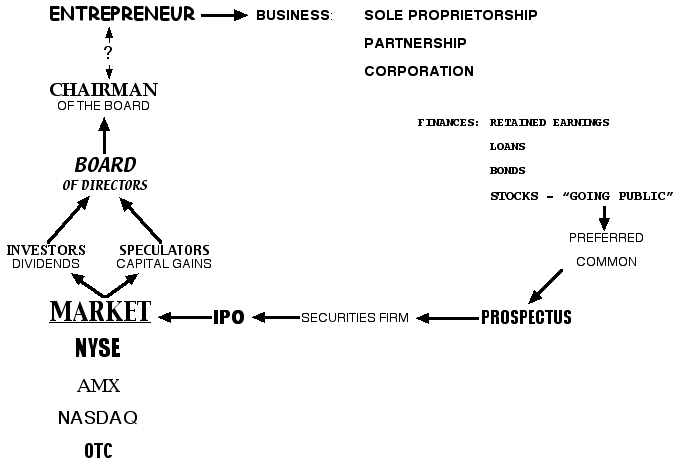
B.
The Financing of Corporate Activity
1. Reinvestment: Internally out of undistributed profits.
2. Commercial Paper: Borrowing from banks
3. Issuing Bonds: an IOU sold to individuals in which the corporation promises to pay the holder a fixed amount in the future plus annual interest
4. Going Public: Issuing Stocks
a. Common stock is a share of ownership in the corporation and gives the holder a voting right and share of dividends.
b. A major advantage of corporate form of organization is the ability to finance operations through sale of stock
C. Differences between stocks and bonds:
1. Bondholder is not an owner, only a lender.
2. Bonds are less risky usually because of certain factors.
a. Bondholders can claim interest payments before stockholder dividends are calculated.
b. Interest is guaranteed as long as company is healthy, whereas dividends depend on profits.
VI.
The Economic Functions of the Stock Market
A. The stock market allows nearly anyone to participate in the risks and opportunities of corporate America. Real returns for the past two centuries have averaged 7 percent per year.
B. How the Stock Market Works for Savers and Investors
1. Savers invest in the stock market as a strategy to build wealth.
2. Investors can buy a diverse portfolio of shares and hold them over long periods of time, substantially reducing risk.
3. Small investors can purchase stock in an equity mutual fund, a corporation that buys and holds shares of stock in many firms.
4. Equity mutual funds have reduced the risk of stock ownership and attracted large amounts of funds into the market, helping to push stock prices upward.
C. How the Stock Market Works for Corporations
1. To raise money, a corporation can a) use retained earnings, b) borrow money, or c) sell stock. Buyers can, if they wish, later resell shares on the stock market.
2. Each share of the stock is a fractional share in the firm’s future net revenues.
3. People buy the stock of a corporation to get future dividends paid from corporate earnings and gains derived from increases in share prices.
4. The decisions of a firm’s executives influence the firm’s stock price. When investors (and their advisors and fund managers) believe that the decisions of corporate managers will increase the firm’s future income, they will buy more of the stock, driving its price up. When investors believe that bad decisions are being made, the reverse happens and the stock’s price falls.
5. Corporate board members are usually stockholders, and top managers are often given stock options. The value of the stock options will rise sharply as the firm’s stock price increases. This helps bring the interest of corporate decision makers into harmony with other stockholders.
D. How the Stock Market Works for the Economy
1. The stock market benefits stockholders, helps discipline corporate decision makers to be more efficient, and to undertake productive projects.
2. The price of a corporation’s shares constantly sends signals to the listed corporation’s board of directors and managers. Changing stock prices reward good decisions and penalize bad ones.
3. To increase the firm's value, the firm must undertake productive projects.
E. Stock Prices
1. Underlying the price of a firm’s stock is the present value of the firm’s expected future net earnings, or profit.
2. The value of a share depends on (1) the expected size of future net earnings, (2) when these earnings will be achieved, and (3) the interest rate by which the investor discounts the future income..
F. Stock Analysis
1. Stockholder who purchase stock for long term gain from dividends and capital gains are investors; stockholder who purchase stock for short term gain from capital gains are speculators.
2. Speculators are primarily concerned with the value and volatility of the stock itself; investors are more concerned with the health and growth of the company the stock represents.
3. Speculators use Technical analysis of the quantitative aspects of the stock's price over time to go long or sell short.
a. Quantitative analysis looks at the historical trends of the company's stock in terms of prices and dividends
4. Investors use Fundamental analysis of both the historical quantitative and qualitative aspects of a company to buy shares in a company.
a. Qualitative analysis looks at the business, management, and philosophy of the company as a whole to predict future trends.
b. Value stocks are held by investors for the long term accumulation of consistent dividends; growth stocks are held by investors in anticipation of long term capital gains from increase in the price of the company's stock.