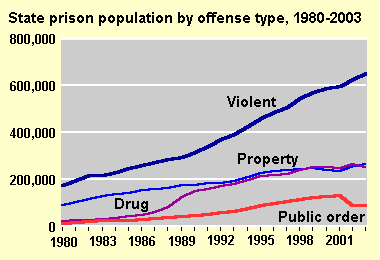
The differences between the economic way of thinking and the non-economic way of thinking can be illustrated by examining the different approaches to reducing crime. For years sociologists and psychiatrists conducted most of the studies that examined why people commit crimes. Most studies maintained crime resulted from such factors as social problems, poverty, slum environments, broket families, youth unemployment, poor education, and racial discrimination. They concluded that the way to prevent crime was to change these conditions. For example, anti-poverty programs, better education, and increased employment could reduce the crime rate. Sociologists and psychiatrists viewed punishment as unimportant in determining whether people did or did not commit crimes. They maintained that criminals were sick and not rational. Economists who have analyzed crime and criminal behavior take a different line. They regard crime as a rational choice among alternatives. In this view, people commit a particular crime or turn to a life of crime because they believe the advantages outweigh the disadvantages, a calculation that may be made in non-monetary as well as in monetary terms. The economic approach maintains that crimes—apart from those of passion or compulsion—are committed as the result of rational calculation. An economist might believe that personal characteristics or the social and family background may be the wellsprings of criminal behavior, yet these factors do not explain why such behavior actually does or does not take place. Since sociological approaches to the phenomena of crime and its prevention have not been notably successful, the simpler, clear-cut economic approach commands attention. At the very least, the hypothesis of economists provides some new insights, and it may even provide the groundwork for more fruitful policies of crime prevention.
Economic reasoning suggest two ways of lowering the crime rate. First, society can lower the benefits of committing crimes by providing economic opportunities for potential criminals to improve their lives. For example, an effective jobs program for low-income people should decrease the crime rate. Second, society can increase the cost of committing crimes. This can be done by increasing the certainty and severity of punishment. Most studies show that catching and convicting more criminals is more effective in deterring crimes than just making the punishment more severe. However, increasing both the certainty and the severity of punishment will lower the crime rate. Does it make any difference which view of crime is correct? Gordon Tullock and Richard McKenzie state the case for an economic approach to crime: “Ideas influence the real world. The fact that most specialists in the study of crime have believed, written, and taught that punishment does not deter crime has had an effect upon public policy. Legislatures have been more reluctant to appropriate more money for prisons than they otherwise would have been; judges have tended to feel that imprisonment had little effect on crime, and hence at the intellectual level in any event, were less willing to put people in jail for long periods of time. Further, the shortage of prisons so induced has made it impossible to keep people in jail for long periods of time for serious crimes. As a result, halfway houses—which are very inexpensive—parole, and probation have been resorted to on a very large scale, and this has sharply reduced the cost of committing a crime. This in turn leads to a rise in the crime rate that leads to further clogging of limited facilities, and hence to further reductions in the cost of committing a crime. The rising crime rate in the United States to a very considerable extent can be blamed upon our intellectual community of sociologists and psychiatrists.” (c)1996 OPI, Inc. All rights reserved.
|

 Economic Focus