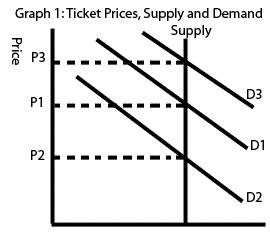
Are you willing to pay just about anything to watch your favorite sports team play its archrival? Some pro teams are making sure that you do. The New York Mets recently told fans they would have to pay up to twice as much next year to watch the crosstown Yankees or home-run king Barry Bonds as they would to see a sad-sack team. Hockey’s Ottawa Senators jacked up prices 20% this season for games against the hated Toronto Maple Leafs and Stanley Cup champion Detroit Red Wings. The Pittsburgh Penguins have tacked on $5 to weekend game prices, and $5 to weeknight skates against three of their most high-profile opponents. Known as “variable pricing,” the practice of charging different prices for the same seat is fairly common in the airline industry and Broadway. But it’s a curveball in the tradition-bound sports business, where ticket pricing for decades was unchanged. The same seat for a regular-season game cost the same amount, regardless of date or opponent. “It’s always been that you don’t want someone paying $100 or $200 to find himself sitting next to someone who’s paying 30 bucks,” says Rick Burton, who directs a sports-marketing center at the University of Oregon. But that fear is waning as teams scrap for every dollar during a sports-business slowdown. Soaring player salaries and debt payments tied to stadium construction are outstripping revenue for many teams. Years of ticket-price increases and creeping fan disgruntlement also are cutting into attendance: Major League Baseball suffered a 6% drop at the gate last year. That’s where variable pricing comes in. Sports-industry executives say the strategy can actually be a clever way for teams to boost ticket prices under the guise of giving fans a break. Baseball and hockey are the biggest users of the new pricing models because of the sheer number of home games per team—81 in baseball and 41 in hockey—and because of labor and financial woes that have left teams in worse shape than in basketball or football. In principle, such pricing is a simple way of boosting revenue by capitalizing on the sure things on the schedule. Despite charging extra to see the Yankees last summer, baseball’s Colorado Rockies drew a franchise-record attendance for a three-game series against the star-powered New York team. The Penguins brought in an extra $1 million in ticket revenue last season thanks to their weekend-game surcharge, a boost that helped the team break even just a few years after emerging from bankruptcy court. “If you can get more revenue in for games that are better attractions, so be it,” says Tom Rooney, president of Team Lemieux, which operates the Penguins. The new plans carry some risk and complications. The plans require teams to gauge the quality of opponents months before the season starts, “and that valuation can change very quickly,” says Bernie Mullin, a senior vice president at the NBA, which has steered its teams away from the strategy. Indeed, the Mets included the Philadelphia Phillies in their “value plan”—but the Phillies soon afterward became a better draw by signing slugger Jim Thome. Assuming that fans will turn out for the best games despite a price increase could be a mistake. In November, the Ottawa Senators had nearly 2,500 empty seats for a game against the Montreal Canadiens, which carried a 10% surcharge; that game is usually a sellout or close to it. The team also fell short of a sellout a few weeks later against rival Toronto, a matchup that usually draws a capacity crowd. Senators fan Steven Duford says he skipped both games because of the price increases. “I do not agree that I have to pay extra to see certain teams,” he says. “I don’t pay less for teams that usually don’t draw.” That sort of thinking has led some clubs, including the San Francisco Giants, to avoid inflating prices when marquee opponents come to town. Under the Giants’ tiered pricing plan, season-ticket holders pay the lowest prices. Next in line are single-game tickets to midweek games. And the priciest are single-game tickets for Opening Day games, weekends and holidays. The price disparity among the packages range from $1 per game for bleacher seats to more than $20 per game for long-term box season tickets. The Giants’ main goal: Take advantage of fan demand without drawing distinctions among opponents—or alienating season-ticket holders, who account for more than two-thirds of sales. The plan is “reinforced value for our season-ticket holders that they have best pricing in ballpark,” says Tom McDonald, the Giants’ senior vice president for marketing. Giants President Larry Baer says the plan netted an additional $1 million in ticket revenue last season, helping the heavily indebted club finish with a slim profit of around $100,000. While Mr. Baer says his team’s plan has worked, he cautions against pushing ticket discrepancies further. “Fans don’t want to get the feeling the club is in it for every last dollar,” he says.
©Pearson Education, Inc. publishing as Pearson Prentice Hall. © 2005 Dow Jones & Company, Inc. All Rights Reserved
|
 Economic Focus