Here in the JA Titan Strategy Guide you’ll find a
host of methods to strategize and fine-tune your
decisions so that your company’s performance is
consistent and strong. This guide contains both a
strategy basics section and sections covering the
individual decisions for Pricing, Production,
Marketing, R&D and Capital Investment numbers.
Careful implementation of these blended strategies
through each quarter will ensure game success.
Fun With Free-Market
Fundamentals
Playing the Numbers Game
You should determine your Titan price/volume
strategy before you begin the game. Decide whether
you want to sell fewer Holo-Generators
at a high price, a moderate number of
Holo-Generators at a
middle price, or a high volume of
Holo-Generators at a low
price. Reflect on your choices: Every number you put
into the game will have consequences for profits and
available cash.
The six decisions you make each quarter are
interdependent. For example, if you choose a high
price, you may want to be careful how high you set
your production level. Higher prices result in less
demand for your product—a caution against making
drastic changes without seeing which way the winds
of demand blow. You’ll see that price has a
substantial influence on demand, but you can also
hedge your bets by investing heavily in marketing
and R&D, which can give you an extra edge.
Charitable Giving—donations from your company to
worthy causes—will also influence market share (and
thus company performance). Market timing and your
own resources will naturally influence all funding
decisions, but be sure to
consider all counsel from your advisors.
It’s Money That Matters
If you lower your price too much, you may not have
enough revenue to cover your costs. Charging ten
cents for a glass of lemonade that takes twelve
cents’ worth of lemons is a sour deal. Pay careful
attention to your gross margin and overall profits.
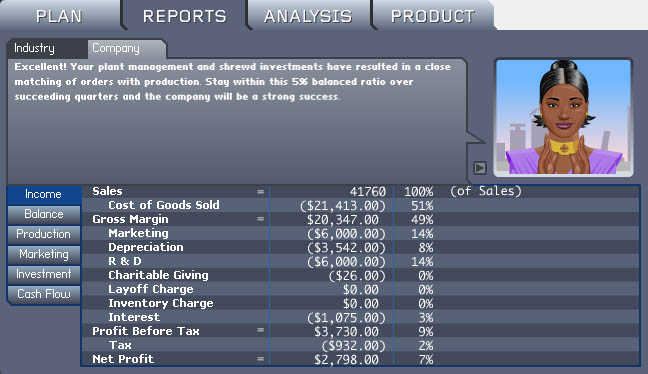
Each quarter's profits or losses are compiled to
calculate the retained earnings. You’ll be able to
see these figures in the Company Report: the numbers
don’t lie, even if you’d like to lie about them.
Companies typically borrow to expand. If you
choose to expand your capacity, watch your line of
credit. Don't expand too rapidly or you may exhaust
your ability to borrow and you’ll incur the burden
of high interest costs. You don’t have to buy a
Corvette when you could get across town with a
compact. Conversely, high risks can lead to high
rewards, but it’s usually the disciplined hitters
that make contact with the ball, not those that
swing wildly at every pitch.
Remember that you can make a better
Holo-Generator by
investing in R&D. Sometimes the “latest and
greatest” can sway a market. You could gain a
competitive edge if you are a high-price
Holo-Generator provider
and want to create increased demand for your product
by outfitting it with cutting-edge components.
Demand for your product might be knocked down a
notch by a price increase, but you can recoup it by
increased spending on R&D. However, if other
companies have bigger Marketing/R&D budgets, and are
selling their Holo-Generators
for much less, you might lose market share.
Of course, with increased demand, you have to
be ready to change other allocations—such as
production—as well.
Reporting for Duty
Look to the Industry Report to provide you
with three essential pieces of information: your
competitors' product prices, changes in the economic
environment, and Performance Indexes.
The Company Report is especially helpful for
tracking inventory. If you increase production, but
don't sell your Holo-Generators,
your inventory level will increase and you will
incur an inventory charge—a blight on the bottom
line. Your solution might be to lower prices and/or
increase marketing to increase sales. Tinker with
these factors to see how the market reacts.
Inventory Inventiveness
If your inventory levels are too high, don't
halt production unless you want to incur a layoff
charge! After all, if you aren't producing
Holo-Generators, you
have to lay off workers. You have to be careful of
drastic moves, which could have drastic effects. A
solution might be to gradually reduce production and
decrease price and see what effect these decisions
have on your bloated inventory. In simple terms:
too much inventory is
bad
producing more than you
sell creates inventory
reducing production
causes a layoff charge
reducing prices will
help you sell more products
sell more than you
produce to reduce inventory
Sometimes your moves might seem like a roll of
the dice, but in Titan, clever allocation strategies
let you roll those dice in your favor.
Check Your Competition
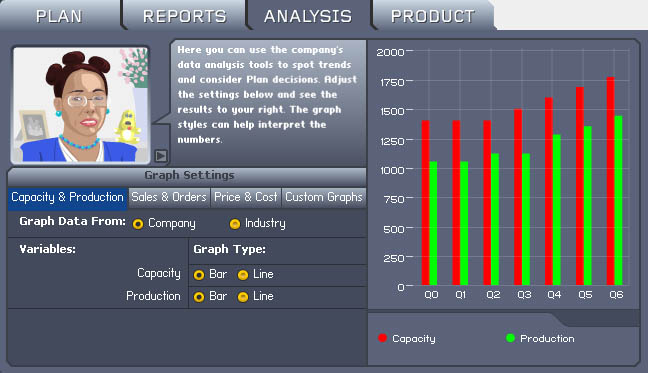
Once you get into the groove of the game, use
the graphing feature to track trends. It gives you
an at-a-glance comparison of your key statistics
with those of your competitors. If you’re trouncing
them, don’t rest on your laurels—one bad quarter
could be your undoing. If you’re slacking in the
race, tighten up your thinking—see what they’ve done
to do you in, and do it to them.
Decisions, Decisions
A couple of technical considerations:
Double-check your
figures on the decision form before you click
“Submit Plan.” A mistake here may cost you the
game.
In a timed game you can
go back and resubmit decisions as many times as
you'd like before the quarter closes.
Beyond the Basics
OK, you’ve gleaned all the goodies from the
basics table. Those are just appetizers—go on to the
main courses of Pricing, Production, R&D, Marketing
and Capital Investment.
How much do we spend
to promote our brand? Marketing brings in more orders
but costs a lot. Your Marketing might also help your competitors, but
theirs might help you!
How big
do we want our factory in the future? Invest equal to
depreciation to keep your factory the same size. Invest more than
depreciation to increase your capacity (by 1 unit for each $40 of
investment).
How much
quality and new features do we want in our product?
More R&D makes a better product and brings more orders but takes time
and costs a lot.
The Price Is Right ... or Is It?
All of your company policies and procedures
aren’t going to mean doodley
if your Holo-Generators
don’t sell, and they won’t if you don’t determine
their proper pricing. The two reports are
key: The Company Report
is essential to making proper pricing and production
decisions; the Industry Report gives you feedback on
how your competitors’ decisions affected your
results. It also provides some clues on how the
economy may perform in the next few quarters.
Generally, you want to set a unit price that
ensures the sales of most, if not all the
Holo-Generators your
plant produces. There could be some strategic gain
in building an inventory of unsold product that can
be sold in future quarters, and that’s addressed in
the “Dynamic Dance” section below.
Consider raising the price as orders increase,
so that the rising demand can result in bigger
profits. However, you don’t want to slam a growing
market with price-gouging, so subtlety in raising
your price is in order. Bad market reaction to
higher prices could be a painful lesson.
Shaving Prices, Saving Customers
If you are consistently carrying too much
inventory, lowering prices is one method to clear it
out. It’s a given that lower prices increase
quantity demanded, but intrinsic to that is that the
lower price also results in less profit. Pity, eh?
You’ll want to frequently visit the Company
Report to see how your price setting relates to
orders you receive. The Industry Report displays
your competitors’ prices—you might need to adjust
yours if you see that a competitor is trying to grab
a market edge by some high- or low-pricing gambit.
Take what you learn from initial quarters to
set pricing for quarters to come. You’ll develop a
keener sense of market flux, and maybe even pad your
company’s pocketbook.
Produce, but Stay Loose
Holo-Generator
production, like all the factors that affect Titan
performance, should be responsive to market factors
and past results. You want your factories producing
at the maximum efficiency—selling what you make—and
you want to balance production costs, so that
spending is in line with selling. As with other
allocations, the Company and Industry reports can
sharpen the production picture.
The
Dynamic Dance of Make, Sell, Make, Sell
Ideally, you want to sell all of your
Holo-Generators at the
highest price the market will bear. (Keep in mind,
there are occasional market tides that won’t float
the profit boat no matter your pricing.) There is a
penalty for producing more than you can sell—an
excess inventory fee that subtracts from your
retained earnings. Except in special cases, you want
to minimize inventory. An exception might be when
you want products to sell in a future quarter
without increasing factory capacity.
In the Company Report you can view factory
capacity, which is the maximum number of generators
that can be produced in the next quarter. Adding
that capacity to inventory tells you what’s
available to sell.
That ever-useful Company Report also notes the
factory costs in producing each
Holo-Generator. Smart cookies like you
probably don’t need to be reminded that the lower
that cost, the better.
The Beauties of Efficiency
Eighty percent is the magic number: Operate at
that efficiency and you are producing generators at
the lowest cost. Exceed that figure and there won’t
be time for maintenance and repairs, which raises
costs per unit and—naturally—lowers profits. Even
machines have to breathe now and then. Produce below
the 80% optimal figure and you have equipment and
employees sitting idle. That decreases your
efficiency and increases the unit cost of
production.
Today’s Almost-Painless Math Lesson
To find your lowest-cost production level,
multiply your Holo-Generator
factory’s capacity by .80. That’s your production
target. To paraphrase, be frugal and multiply.
Marketing: the Golden Wrapper of Winning Words
Though some cynics might characterize it as
putting an evening gown on a noontime pig, marketing
does create demand for a product. Money allocated to
marketing can work a bit differently than in other
areas because other companies can gain from your
marketing and you can benefit from theirs.
That’s because regardless of who pays for the
advertising, more consumers and businesses will
learn about Holo-Generators.
If you put more dollars behind your marketing
pitches, more consumers should get the word on the
special, can’t-live-without features of the
Holo-Generator that you
produce.
First (and Somewhat Obvious) Rules of
Marketing
If you spend less on marketing than you did in
a prior quarter, your company can pocket the
difference. But spending less might result in
selling less. Thus, a successful marketing strategy
results in profits greater than your marketing
investment. You can fine-tune your marketing methods
by clicking on the Marketing Sub-Decisions button on
the main screen. Choose from a range of allocation
options (from direct marketing to TV ads) to pitch
your products. Some options will only be available
if you’ve allocated enough money to your general
Marketing funding. Note
how the specific allocations affect sales and be
ready to adjust for future quarters.
Capitalizing on Your Capital
Capital Investment is the money you use to expand
your production capability. These expenditures:
add to the total amount of
equipment you own
replace and repair
existing machinery,
purchase more efficient
equipment, and
expand the physical size
of the factory
It’s the old—but compulsory—price of doing
business. But you’re getting what you pay for: Every
Capital Investment dollar above your Depreciation
figure increases your production capacity (the
number of Holo-Generators
you can produce in a quarter).
Since it takes time to purchase, install and test
new equipment, the effect of any capital investment
decision you make will be delayed one quarter. Look
at it like this: popcorn tastes better when it’s
popped—but before you drown
in misguided metaphors, just know here that your
investments should be worth the wait.
An Appreciation of Depreciation
If you want to maintain your factory’s current
Holo-Generator capacity,
you need to spend at least the amount listed for
Depreciation. (Depreciation represents the value of
equipment lost each quarter due to wear and tear.)
Any amount you spend above your Depreciation will
increase your factory capacity. Conversely, any
amount you spend below Depreciation will decrease
capacity, and you’ll incur layoff charges.
To boldly go where bullet points rarely venture:
Capital Investment matches
Depreciation, your
factory stays as is.
If Capital Investment is
more than Depreciation, you increase production
capacity (your factory grows).
If Capital Investment is
less than Depreciation, your factory
shrinks, which
decreases your production capacity and causes
layoffs.
Big Factories, Smaller Prices
Larger factories produce
Holo-Generators at a lower cost per unit—a
result of the old “economies of scale” concept. It
costs $40 in Capital Investment to increase your
factory’s capacity to produce just one more
Holo-Generator.
Following that ratio, it costs $400 to produce 10
more Holo-Generators.
R&D: Little Initials, Big Potentials
Investment in Research and Development is a
forward-thinking proposition: The future growth of
your company is connected to spending on R&D. By
investing in R&D, your next generation of
Holo-Generators will
have new features and advancements, and have greater
market appeal. You can chart the impact of your R&D
investment in the Company Report.
To This Quarter—and Beyond!
Don’t be too results-antsy about R&D—market
research and product development are long-term
processes, and their effects are distributed over
several quarters. Money invested in these two areas
will increase sales in future quarters, though not
independent of your pricing strategy. For example,
R&D increases might raise demand +10%, but high
prices might pull demand down -25%, with a net
effect of -15% demand. Here are key points:
R&D spending in Q3 will
have an impact on demand in Q4.
The impact of R&D
spending persists over time, so you will still
receive some R&D spending effect several
quarters down the line.
R&D spending has a
positive effect on demand, though price is a
stronger factor in gaining market share.
R&D spending raises
demand industry-wide, just like marketing
spending. The percentage of that extra demand
you get is directly proportional to what
percentage of the industry R&D spending you’re
responsible for. Outspending all the other
companies on R&D can boost interest in your
company’s Holo-Generators.
Clicking on the R&D
Sub-Decisions button on the main screen gives
you the chance to select specific
Holo-Gen features
(at specific prices) to research. There you can
also allocate R&D money to focus groups to spot
demand for a feature in advance. Being
first-to-market with a new feature can put you a
small step ahead.
Reduced spending on R&D can reduce your
expenses, but as seen above, increased spending can
increase demand, and boost those ever-pleasurable
profits. So, beware the bane of short-term benefits:
if your company does not invest in R&D, your product
will not improve. Once your R&D-heavy competitors
produce some snappy new Holo-Generator
that’s high on the bells-and-whistles scale, you
might never catch up.
Can the Theories and Cut to the Chase
There—you are armed with the armchair knowledge that
can make or break a company owner’s career. Leave
that chair and get out on the factory floor; touch
your Holo-Generators;
talk with your marketers, your researchers, and your
money managers. Then go test your wits in the
marketplace. It can be a cruel world, but the
rewards make it all worthwhile. Prosper!




 Here in the JA Titan Strategy Guide you’ll find a
host of methods to strategize and fine-tune your
decisions so that your company’s performance is
consistent and strong. This guide contains both a
strategy basics section and sections covering the
individual decisions for Pricing, Production,
Marketing, R&D and Capital Investment numbers.
Careful implementation of these blended strategies
through each quarter will ensure game success.
Here in the JA Titan Strategy Guide you’ll find a
host of methods to strategize and fine-tune your
decisions so that your company’s performance is
consistent and strong. This guide contains both a
strategy basics section and sections covering the
individual decisions for Pricing, Production,
Marketing, R&D and Capital Investment numbers.
Careful implementation of these blended strategies
through each quarter will ensure game success.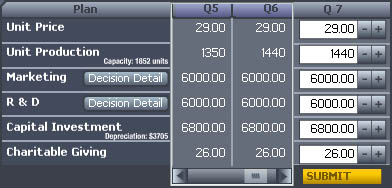
 If you lower your price too much, you may not have
enough revenue to cover your costs. Charging ten
cents for a glass of lemonade that takes twelve
cents’ worth of lemons is a sour deal. Pay careful
attention to your gross margin and overall profits.
Each quarter's profits or losses are compiled to
calculate the retained earnings. You’ll be able to
see these figures in the Company Report: the numbers
don’t lie, even if you’d like to lie about them.
If you lower your price too much, you may not have
enough revenue to cover your costs. Charging ten
cents for a glass of lemonade that takes twelve
cents’ worth of lemons is a sour deal. Pay careful
attention to your gross margin and overall profits.
Each quarter's profits or losses are compiled to
calculate the retained earnings. You’ll be able to
see these figures in the Company Report: the numbers
don’t lie, even if you’d like to lie about them.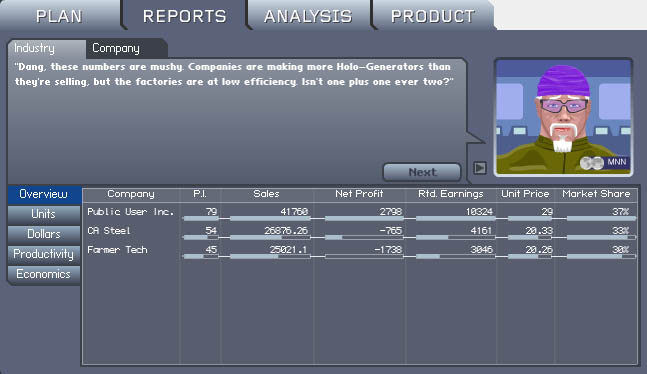


 Investment in Research and Development is a
forward-thinking proposition: The future growth of
your company is connected to spending on R&D. By
investing in R&D, your next generation of
Investment in Research and Development is a
forward-thinking proposition: The future growth of
your company is connected to spending on R&D. By
investing in R&D, your next generation of