|
Head of State
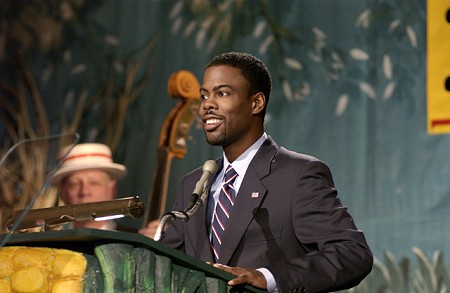
BY CHRISTOPHER NULL / November 25, 1985 Two months before the 2004 presidential election, a major party loses both its presidential and vice presidential candidates in a midair collision. Seeking a replacement candidate, the party settles on Mays Gilliam, an obscure Washington DC alderman who has saved a woman and her cat from a burning building. Gilliam seems to have no chance of victory against Vice President Brian Lewis, whose claim to fame is he's Sharon Stone's cousin, and whose motto is: "God bless America--and no place else." Of course party boss Senator Bill Arnot doesn't really want Gilliam to win--Arnot wants to exploit him as a token black candidate who will lose, but will consolidate the party's hold on the minority vote. Mays is a patsy, a designated loser whose defeat will clear the way for the ambitious, unscrupulous senator to lead the party to victory in the next election. Even after getting over his fear of being assassinated, Mays is still reluctant to run, believing he will not be able to live up to the expectations of representing the entire African-American population. "You just represent yourself," he tells his white advisor, Martin Geller, "I represent my whole race." Obviously, Gilliam wants to avoid making any mistakes. So, surrounded and smothered by professional political handlers provided by Arnot, he plays it safe with bland stump speeches extolling his love for whatever audience he's addressing whether he's speaking to dairy farmers in Wisconsin, churchgoers in Memphis, or cowboys in Texas. As planned, Gilliam gets no traction in the polls . . . until his brother Mitch persuades him that if he can't win, then he has nothing to lose. His strategy from that point is obvious: instead of trying to please everyone, he speaks out for what he believes. Mays turns off his teleprompter in Chicago and lets loose with a populist tirade that gets the crowd pumped, exhorting his listeners to be mad about what's wrong: "How many of you work two jobs, just to have enough money to be broke? How many nurses work in hospitals they can't afford to get sick in? How many of you have credit so bad they won't take your cash? That ain't right!" And with that as his new campaign slogan , suddenly Gilliam's a contender. As as Mays begins to rise in the polls, Lewis runs a series of ridiculous attack ads including one asserting that his opponent supports cancer. Gilliam decides to fight back, but is uncomfortable using various attack ads recommended by his advisors--such one in which a KKK member endorses his opponent. As voting day draws closer, Mays eventually finds out the reason why he was chosen as the party candidate, fires the disloyal campaign operatives, and then arranges a debate on the issues with his opponent in which he intends to win the crowd--and the election--by speaking plain truths about American life.
copyright 2006, rogerebert.com
|