When the novelist Joyce Cary went out to Nigeria to
join the British colonial civil service in 1913, there
was no question in his mind, and in the minds of most
British, that he was doing a good thing, representing
the world's greatest democracy in an African backwater
much in need of improvement. When Cary wrote
Mister Johnson, the fourth of his African novels, in
1939, some questions had begun to arise. The novel is
about those questions.
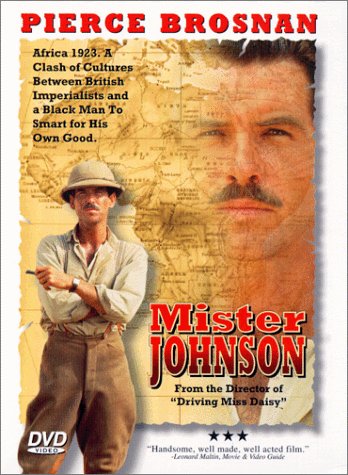
"Mister Johnson," now directed by Bruce Beresford in his
first film since "Driving Miss Daisy," tells the story
of an African civil servant, known to all as Mister
Johnson, who works as a clerk in the office of the
British district administrator. Mister Johnson, played
by Maynard Eziashi in a performance of great humor,
grace and desperation, has adopted the values of Britain
so enthusiastically that he even thinks of himself as
British, and wears a white tropical suit and leather
dress shoes even in the summer's fierce heat. He speaks
of "our" standards and "our" institutions, and places
his trust in his district officer while failing to
understand that the purpose of British law in Nigeria is
to protect the British and subdue Africans like himself.
He is a cheerful man, this Mister Johnson, hurrying
through the district, flirting with the pretty girls,
reprimanding laggards for not being up to his standards,
and working efficiently for his boss, Harry Rudbeck
(Pierce Brosnan). It is Brosnan's obsession to build a
great road into the wilderness and connect his outpost
with the capital. Perhaps he sees himself as a local
version of an empire-builder of the earlier generation,
Cecil Rhodes, who dreamed of an all-British route all
the way from Cape Town to Cairo.
There is, alas, not enough money for the road, and it
looks like work will have to be halted until Johnson
suggests to Rudbeck that they juggle the books a little,
robbing Peter to pay Paul, until the next year's budget
comes through. Rudbeck agrees, but when the deception is
discovered it is Johnson who must be dismissed for the
bookkeeping infraction.
Loss of his position and status is a serious blow for
Johnson, who has a good many debts to pay. But he soon
finds another job, working as a clerk for Sargy Gollup
(Edward Woodward), the hard-drinking British owner of
the local general store. Gollup has a drunken love-hate
relationship with Africans, whom he sometimes beats "for
their own good," and the desperate Mister Johnson agrees
with him - partly because he has no other choice, but
also because in his increasingly confused mind, he
identifies with him.
There is obviously going to be a tragedy, and it is
equally obvious that it is Johnson who is going to
suffer, despite all of the glories of British justice
that he so admires. There is a genuine sadness in the
scenes where Johnson forgives Harry Rudbeck for the
sentence he has to carry out, and even sympathizes with
him and tries to cheer him up.
There is also, of course, a savage irony in the fact
that Rudbeck knows Johnson got into trouble in the first
place by taking the rap for him. One of the subtleties
of the film is the way this is never quite spelled out -
not even by Rudbeck to his wife, Celia (Beatie Edney).
Rudbeck maintains silence about his own guilt even while
outwardly continuing to be a humane and reasonable
administrator, and the film's last scenes take on a
terrible sadness because of this silence.
I have seen "Mister Johnson" two times, and both times I
admired its sense of time and place, and the thoughtful
performances of Eziashi, Brosnan and Woodward.
Beresford's screenwriter is the novelist
William Boyd, whose own novels, especially
An Ice-Cream War, are set in British East Africa a
few decades later. What they are doing here is quiet and
rather tricky. They're not banging the audience over the
head with the injustice of what happens to Johnson, but
trying to re-create a moment in colonial history when
many people both white and black believed in the
rhetoric of official idealism, even while it was rotting
from within.
The result is a very subtle film, one where the ideas
are sometimes in danger of being overwhelmed by the
sheer exuberance of Eziashi's performance. After seeing
the film, I found myself asking what it was really about
- was there a message, or only a careful reconstruction
of a moment in history? There is a message, I now
believe, but so subdued that some viewers may leave the
film thinking it has said the opposite of what Beresford
and Boyd intended - that it mocks, rather than
celebrates, the martyrdom of Mister Johnson.
The movie, like the Cary novel, allows us to find its
truth in our own way.
|
|
The
Cast
directed by Bruce Beresford.
101 minutes.
1997.
|
|