|
I.
Four market models will be addressed in Chapters 7-9.
A.
Pure competition entails a large number of firms, standardized
product, and easy entry (or exit) by new (or existing) firms.
B.
At the opposite extreme, pure monopoly has one firm that is
the sole seller of a product or service with no close substitutes;
entry is blocked for other firms.
C.
Monopolistic competition is close to pure competition, except
that the product is differentiated among sellers rather than
standardized, and there are fewer firms.
D. An
oligopoly is an industry in which only a few firms exist, so each is
affected by the price‑output decisions of its rivals.
|
PERFECT COMPETITION
- INFINITE NUMBER OF FIRMS
- VERY EASY ENTRY INTO MARKET
- STANDARD PRODUCT
|
MONOPOLISTIC COMPETITION
- MANY FIRMS
- EASY ENTRY INTO MARKET
- DIFFERENTIATED PRODUCT
|
OLIGOPOLY
- A FEW FIRMS
- DIFFICULT ENTRY INTO MARKET
- DIFFERENTIATED PRODUCT
|
MONOPOLY
- ONE FIRM
- IMPOSSIBLE ENTRY INTO MARKET
- STANDARD PRODUCT
|
|
PRICE TAKER
DEMAND IS PERFECTLY ELASTIC AT MARKET PRICE
RISK TAKER
|
PRICE MAKER
RISK TAKER
|
PRICE MAKER
RISK AVOIDER
|
PRICE MAKER- DEMAND IS VERY CLOSE TO
PERFECTLY INELASTIC
RISK AVOIDER
|
- PRODUCTIVE EFFICIENCY
- P = ATC
- ALWAYS IN LONG RUN
- EP = 0
- FAIR RETURN
- ALLOCATIVE EFFICIENCY
- P = MC
- NATURAL EQUILIBRIUM
- SOCIALLY OPTIMAL
- ALWAYS
- X EFFICIENCY
- MINIMUM POSSIBLE LONG
RUN ATC
- ALWAYS IN LONG RUN
|
- PRODUCTIVE EFFICIENCY
- P = ATC
- ALWAYS IN LONG RUN
- EP = 0
- FAIR RETURN
- ALLOCATIVE EFFICIENCY
- X EFFICIENCY
- MINIMUM POSSIBLE LONG
RUN ATC
- ALWAYS OVERKAPITALIZED
IN LONG RUN
|
- PRODUCTIVE EFFICIENCY
- P > ATC
- NEVER IN LONG RUN
- EP > 0
- ALLOCATIVE EFFICIENCY
- X EFFICIENCY
- USUALLY IN LONG RUN
- HIT AND RUN COMPETITION
- SHORT RUN COLLUSION
|
- PRODUCTIVE EFFICIENCY
- P > ATC
- NEVER IN LONG RUN
- EP > 0
- ALLOCATIVE EFFICIENCY
- X EFFICIENCY
- NEVER
- CONTESTABLE MARKET?
- HIT AND RUN COMPETITION?
- NON-PRODUCTIVE COSTS
- LAWSUITS
- LOBBYING
- LYNCHING
|
II.
Pure Competition:
Characteristics and Occurrence
A.
The characteristics of pure competition:
1.
Many sellers means that there are enough so that a single
seller has no impact on price by its decisions alone.
2.
The products in a purely competitive market are homogeneous
or standardized; each seller’s product is identical to its
competitors’.
3.
Individual firms must accept the market price; they are price
takers and can exert no influence on price.
4.
Freedom of entry and exit means that there are no significant
obstacles preventing firms from entering or leaving the industry.
5.
Pure competition is rare in the real world, but the model is
important.
a.
The model helps analyze industries with characteristics
similar to pure competition.
b.
The model provides a context in which to apply revenue and
cost concepts developed in previous chapters.
c.
Pure competition provides a norm or standard against which to
compare and evaluate the efficiency of the real world.
B.
There are four major objectives to analyzing pure
competition.
1.
To examine demand from the seller’s viewpoint,
2.
To see how a competitive producer responds to market price in
the short run,
3.
To explore the nature of long‑run adjustments in a
competitive industry, and
4.
To evaluate the efficiency of competitive industries.
III.
Demand from the Viewpoint of a Competitive Seller
A.
The individual firm will view its demand as perfectly elastic.
1.
Figure 7.1 illustrates this.
2.
The demand curve is not perfectly elastic for the industry:
It only appears that way to the individual firm, since they must
take the market price no matter what quantity they produce.
3.
Note from Figure 7.1 that a perfectly elastic demand curve is
a horizontal line at the price.
B.
Definitions of average, total, and marginal revenue:
1.
Average revenue is the price per unit for each firm in pure
competition.
2.
Total revenue is the price multiplied by the quantity sold.
3.
Marginal revenue is the change in total revenue and will also
equal the unit price in conditions of pure competition.
IV.
Profit Maximization in the Short-Run
A. In
the short run the firm has a fixed plant and maximizes profits or
minimizes losses by adjusting output; profits are defined as the
difference between total costs and total revenue.
B.
Three questions must be answered.
1.
Should the firm produce?
2.
If so, how much?
3.
What will be the profit or loss?
C.
Marginal‑revenue—marginal‑cost approach (Figures 7.2, 7.3,
7.4).
1.
MR = MC rule states that the firm will maximize profits or
minimize losses by producing at the point at which marginal revenue
equals marginal cost in the short run.
2.
Three features of this MR = MC rule are important.
a.
Rule assumes that marginal revenue must be equal to or exceed
the minimum of average variable cost, or the firm will shut down.
b.
Rule works for firms in any type of industry, not just pure
competition.
c.
In pure competition, price = marginal revenue, so in purely
competitive industries the rule can be restated as the firm should
produce that output where P = MC, because P = MR.
3.
Using the rule on Figure 7.2, compare MC and MR at each level
of output. At the tenth
unit MC exceeds MR. Therefore, the firm should produce only nine
(not the tenth) units to maximize profits.
4.
Profit maximizing case:
The level of profit can be found by multiplying ATC by the
quantity, 9 to get $880 and subtracting that from total revenue
which is $131 x 9 or $1179.
Profit will be $299 when the price is $131.
Profit per unit could also have been found by subtracting
$97.78 from $131 and then multiplying by 9 to get $299.
Figure 7.2 portrays this situation graphically.
5.
Loss-minimizing case: The loss‑minimizing case is illustrated
when the price falls to $81 (Figure 7.3).
Marginal revenue does exceed average variable cost at some
levels, so the firm should not shut down.
Comparing P and MC, the rule tells us to select output level
of 6. At this level the
loss of $64 is the minimum loss this firm could realize, and the MR
of $81 just covers the MC of $80, which does not happen at quantity
level of 7. Figure 7.3
illustrates this graphically.
6.
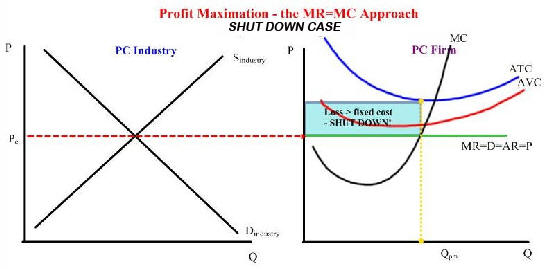
Shut-down case:
If the price falls to $71, this firm should not produce.
MR will not cover AVC at any output level.
Therefore, the minimum loss is the fixed cost and production
of zero. Figure 7.4
illustrates this situation, and it can be seen that the $100 fixed
cost is the minimum possible loss.
7. Applying the Analysis: The Still There Motel
V.
Marginal Cost and Short-Run Supply
A.
Marginal cost and the short‑run supply curve can be illustrated by
hypothetical prices such as those in Table 7.1.
At a price of $151 profit will be $480; at $111 the profit
will be $138 ($888‑$750); at $91 the loss will be $3.01; at $61 the
loss will be $100 because the latter represents the shut-down case.
1.
Note that Table 7.1 gives us the quantities that will be
supplied at several different price levels in the short-run.
2.
Since a short‑run supply schedule tells how much quantity
will be offered at various prices, this identity of marginal revenue
with the marginal cost tells us that the marginal cost above AVC
will be the short‑run supply for this firm (see Figure 7.5).
B.
Changes in prices of variable inputs or in technology will
shift the marginal cost or short-run supply curve in Figure 7.5.
1.
For example, a wage increase would shift the supply curve
upward (decrease in supply).
2.
Technological progress would shift the marginal cost curve
downward.
3.
Using this logic, a specific tax would cause a decrease in
the supply curve (upward shift in MC), and a unit subsidy would
cause an increase in the supply curve (downward shift in MC).
C.
Determining equilibrium price for a firm and an industry:
1.
Total-supply and total-demand data must be compared to find
most profitable price and output levels for the industry.
(See Table 7.2)
2.
Figures 7.6a and 7.6b shows this analysis graphically;
individual firm supply curves are summed horizontally to get the
total-supply curve S in Figure 7.6b.
If product price is $111, industry supply will be 8000 units,
since that is the quantity demanded and supplied at $111.
This will result in economic profits similar to those
portrayed in Figure 7.2.
3.
Loss situation similar to Figure 7.3 could result from weaker
demand (lower price and MR) or higher marginal costs.
D.
Firm vs. industry: Individual firms must take price as given, but
the supply plans of all competitive producers as a group are a major
determinant of product price.
VI.
Profit Maximization in the Long Run
A.
Several assumptions are made.
1.
Entry and exit of firms are the only long‑run adjustments.
2.
Firms in the industry have identical cost curves.
3.
The industry is a constant‑cost industry, which means that
the entry and exit of firms will not affect resource prices or
location of unit‑cost schedules for individual firms.
B.
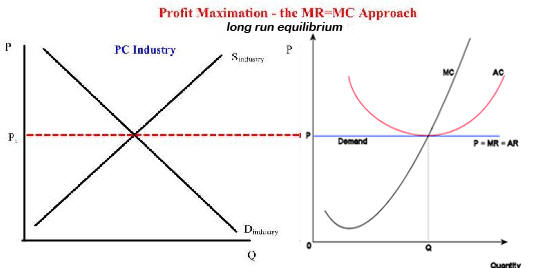
Basic conclusion to be explained is that after long‑run
equilibrium is achieved, the product price will be exactly equal to,
and production will occur at, each firm’s point of minimum average
total cost.
1.
Firms seek profits and shun losses.
2.
Under competition, firms may enter and leave industries
freely.
3.
If short‑run losses occur, firms will leave the industry; if
economic profits occur, firms will enter the industry.
C.
The model is one of zero economic profits, but note that this
allows for a normal profit to be made by each firm in the long run.
1.
If economic profits are being earned, firms enter the
industry, which increases the market supply, causing the product
price to gravitate downward to the equilibrium price where zero
economic profits are earned (Figure 7.7).
2.
If losses are incurred in the short run, firms will leave the
industry; this decreases the market supply, causing the product
price to rise until losses disappear and normal profits are earned
(Figure 7.8).
D.
Long‑run supply for a constant cost industry will be perfectly
elastic; the curve will be horizontal.
In other words, the level of output will not affect the price
in the long run.
1.
In a constant‑cost industry, expansion or contraction does
not affect resource prices or production costs.
2.
Entry or exit of firms will affect quantity of output, but
will always bring the price back to the equilibrium price (Figure
7.9a).
E.
Long‑run supply for an increasing cost industry
will be upward sloping as industry expands output.
1.
Average‑cost curves shift upward as the industry expands and
downward as industry contracts, because resource prices are
affected.
2.
As demand increases, costs will rise as firms enter, and the
new equilibrium price must increase if the level of profit is to be
maintained at its normal level.
Note that the price will fall if the industry contracts as
production costs fall, and competition will drive the price down so
that individual firms do not realize above‑normal profits (Figure
7.9b).
F.
Long‑run supply for a decreasing cost industry will be
downward sloping as the industry expands output.
This situation is the reverse of the increasing‑cost
industry. Average‑cost
curves fall as the industry expands and firms will enter until price
is driven down to maintain only normal profits.
VII.
Pure Competition and Efficiency
A.
Whether the industry is one of constant, increasing, or decreasing
costs, the final long‑run equilibrium will have the same basic
characteristics (Figure 7.10).
1.
Productive efficiency occurs where P = minimum AC; at this
point firms must use the least‑cost technology or they won’t
survive.
2.
Allocative efficiency occurs where P = MC, because price is
society’s measure of relative worth of a product at the margin, or
its marginal benefit.
The marginal cost of producing product X measures the relative worth
of the other goods that the resources used in producing an extra
unit of X could otherwise have produced.
In short, price measures the benefit that society gets from
additional units of good X, and the marginal cost of this unit of X
measures the sacrifice or cost to society of other goods given up to
produce more of X.
3.
If price exceeds marginal cost, then society values more
units of good X more highly than alternative products the
appropriate resources can otherwise produce.
Resources are underallocated to the production of good X.
4.
If price is less than marginal cost, then society values the
other goods more highly than good X, and resources are overallocated
to the production of good X.
5.
Efficient allocation occurs when price and marginal cost are
equal. Under pure
competition this outcome will be achieved in both the short and long
run.
6.
Dynamic adjustments will occur automatically in pure
competition when changes in demand or in resource supplies or in
technology occur.
Disequilibrium will cause expansion or contraction of the industry
until the new equilibrium at P = MC occurs.
7.
“The invisible hand” works in a competitive market system
since no explicit orders are given to the industry to achieve the P
= MC result.
|