
ECONOMICS U$A
THE FEDERAL RESERVE
To show how the responsibilities and powers of the Federal Reserve have been broadened over the years; and indicate how the Fed can control the money supply and influence the level of interest rates and inflation.
OBJECTIVES:
1. One of the most important functions of the Federal Reserve System is to ensure that the amount of money in the U.S. economy is consistent with non-inflationary growth.
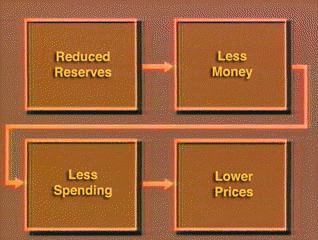
2. The Fed controls the amount of money in the economy by controlling the reserves in the banking system. This is done in three ways:
a) Most often the Fed injects or removes bank reserves by buying or selling government bondsæopen market operations.
b) The Fed can also encourage or discourage bankers in their attempts to borrow reserves by lowering or raising the discount rate, which is the interest rate the Fed charges for its loans to banks.
c) The Fed can change the required reserve ratio or the percentage of deposits that a bank must keep in its vaults as reserves.
3. If the rate of growth of the money supply is slowed, interest rates will initially rise and both economic activity and inflation will tend to slow down. The Fed cannot control how much the reduction in the growth of the money supply will affect economic activity, and how much it will affect inflation.
KEY ECONOMIC CONCEPTS:
Federal Reserve System, required reserve ratio, discount rate, open-market operations, money supply

|
Contemporary Issues
After the terrorist attacks of Tuesday, September 11, 2001, U.S. financial markets were closed until the subsequent Monday – in part, because the massive damage to the Wall Street area. Right before the markets re-opened, the Fed cut interest rates by 50 basis points (half a percentage point). What kind of a signal was the Fed trying to send with such a dramatic interest rate cut? In the event, the markets fell precipitously for a few days and then began to recover. Did the Fed’s move help or hurt? |
For a complete transcript of this video program download TVpdf#9
|
The Feds Discount Rate In 1913 President Wilson signed the Federal Reserve Act which created a Federal Reserve System, the lender of last resort for banks needing short term loans. One of the early tools of the Fed was the discount rate. The discount rate was the rate that is charged to member banks when they needed to come in to get additional reserves, and it is raised to restrain their borrowing lowered to encourage their borrowing. When the stock market crashed in October 24, 1929, banks failed by the thousands. The Federal Reserve, that was created to prevent such tragedy, only made things worse. Fearful that the US was not a safe harbor, foreign investors began to withdraw their gold deposits from American banks. For the banking system as a whole, if it experiences a significant reduction in reserves, from whatever source, it has to cut back on loans and the extension of credit unless it can get some relief. And only the Federal Reserve, acting as a central bank, can provide more relief. So in 1931, as the gold flowed out the system, to Europe and other countries, there was a loss in reserves and the central bank, the Fed, had to step in to make it up. The Feds raised its discount rates in order to force banks to push up the rate of interest paid to their depositors. The result foreign investors earned more interest and were enticed to leave their money in US banks. But high interest rates discouraged borrowing and choked off the flow of money to business. More businesses failed, more jobs were lost, and more banks collapsed. The country was pushed deeper into the Great Depression. Comment and Analysis by Richard Gill Theoretically, in a depression situation, the Fed should have been trying to increase the reserves available to the commercial banking system. When the Fed tried to stem the gold outflow by raising the discount rate in 1931 it was making it more difficult for commercial banks to borrow from the Fed, creating negative effect on reserves. Economists today believe that these policies of the Fed were a major factor in turning an ordinary economic downturn into a Great Depression. However, in the years immediately following the Depression, many economists believed that there was very little the Fed could have done anyway. They thought even if the Fed made more reserves available, the banks might be too scared to lend them out and businesses too frightened to borrow. |
|
The Fed vs the Treasury The Banking act of 1935 provided an important new tool for the Fed—open market operations. However, 15 years later the Fed found itself in open and direct conflict with the Treasury when it attempted to use this tool. The open market operations consist of purchase or sale of government securities. In WWII as part of its powers to conduct open market options, the Fed bought bonds from the Treasury to help finance the war. The Fed bought all the bonds the Treasury issued that were not bought by the public. As the economy began to expand after the war, the Feds were worried that an expansion of money and credit would lead to inflation. The Feds purchase of government securities was adding to the bank reserves, thus adding to this expansion in money. Then, in June of 1950, fighting broke out in Korea. It was a limited but very costly war, and it brought to a head the conflict between the Treasury and the Fed. The Treasury is a part of the Executive Branch. The Federal Reserve is an independent agent, so the Treasury was not able to mandate instructions to the Federal Reserve. But Treasury Secretary and President Truman wanted the Fed to join ranks and help finance the war, but the Fed did not. After much discussion, the Fed and Treasury developed the Accord of 1951 where the Federal Reserve would be free to control money and credit without having to buy government securities and the Treasury agreed to issue some non-marketable bonds that carried somewhat higher interest rates. Using open market operations in the 50s proved to be effective in combating inflation. The relationship with the Treasury became more equal and symbiotic. Comment and Analysis by Richard Gill The Fed was saying at the time of the Accord that the policy of purchasing government securities may have been appropriate in the Depression years, but was no longer appropriate to an economy that was beginning to show definite inflationary tendencies. |
|
The Fed and LBJ Lyndon B. Johnson wanted to create the Great Society. However, he wanted to fight the war in Vietnam and not make any major sacrifice of social programs at home. He didn’t want to raise taxes because it would bring the issue of the Vietnam War into sharp political focus. The economy was heating up and the seeds for inflation were sown. In 1965, the Feds decided to fight the threat of inflation by raising the discount rate. But raising the discount rate proved too small a step to keep inflation from growing. The war kept growing and when neither the administration nor Congress applied fiscal restraints, the Fed used an open-market operation. They sold government bonds to tighten up the nations money supply. The immediate effect was a dramatic rise in interest rates. Soon any business sensitive to changing interest rates was caught in a credit crunch. The full effect of the Fed’s solitary action caused inflation to drop dramatically, but at a cost: zero growth for the GNP. The Fed learned that monetary policy had significant power to subdue inflation but only at great cost. Comment and Analysis by Richard Gill By the mid to late 60’s everybody realized that monetary policy was important. Monetary policy, it seemed was a lot stronger tool than many had imagined. The Feds policy not only lowered prices in an inflationary time, but also lowered GNP. And not just lowered real GNP, but caused higher interest rates, and the virtual collapse of certain interest-sensitive industries like housing and commercial construction. |