| |
This week's assignment:
With the interview
process down to the final four,
Sean was
not a happy camper. "I'm just really bored
to tears with all the rubbish that
Allie and
Roxanne come out with 24/7." He vowed
revenge against the women who ousted his special friend
Tammy. "I'm going to destroy Synergy and
I'll take great pleasure when I see them walk back into the boardroom."
The corporations were assigned the task of creating new employee uniforms
for the Embassy Suites hotel chain.
Lee stepped up as PM for Gold Rush and
Allie took control of Synergy. Anyone guessing
the women would have the edge this week, thinking women are the true
fashionistas, was wrong. The men's designs were right on target, so much so
that the Embassy Suites executives plan to use them! Lee and Sean won by
listening to what the employees wanted and then delivering designs to their
specifications. The men delivered uniforms that were, in the employees'
words, "sophisticated, modern and comfortable to work in," including hip
cargo pants and vented armpits for the chefs.
The women, on the other hand, were more
intent on creating futuristic uniforms more suited to a Paris runway.
Instead of listening to what the employees wanted, they pitched their own
"high fashion" ideas. Their designs included culottes and stiff, puffy
sleeves. A feminine-looking design for the bell staff prompted a dismayed
Sean to quip, "I would be emasculated in that!" Worse, the front desk staff
specifically asked for pants, yet Synergy produced skirts. Staff critique
comments were "doesn't look comfortable, too edgy, not practical and
wouldn't look good on all body types."
In the boardroom
Lee and Sean's reward was an intimate dinner with
Ivanka and
Don Jr. Synergy's Allie and Roxanne also
spent some quality time with the Trumps—in the boardroom! Under the
merciless questioning of
Mr. Trump, good friends Allie and Roxanne
soon
turned on each other and the stench of
disloyalty turned the mogul's stomach. Finally, appalled by the friends'
willingness to trash one another to survive, Trump
fired them both.
|
Lessons Learned
-
The Good:
-
Teamwork. The men worked
together like a well-oiled machine. They bounced ideas off each
other and had fun while remaining focused on a common goal: to
win.
-
Listen and then deliver.
Both teams began on the same path, talking to Embassy Suites
executives. One point mentioned by one of the executives in
their discussion with Sean and Lee was that the employees should
be consulted about what they wanted, since they would be wearing
the uniforms every day. One can assume that both teams received
the same general information in their briefings. After all, it
was in the best interests of Embassy Suites to provide
information to each team that would yield the best possible
designs for the new uniforms. And, as a result of the
discussions with the executives, both teams interviewed various
Embassy Suites employees, but then, the paths of the teams
diverged. It became clear that while Allie and Roxanne may
have heard the employees, Sean and Lee did a better job of
listening to them. Perhaps it was because Sean and Lee felt less
confident in their skills as designers, while both Allie and
Roxanne boasted on camera about their own personal fashion
knowledge. Whatever the reason, Sean and Lee came away from
their interviews convinced that the employees wanted uniforms
that were not drastically different from what they were
currently wearing, but that there was room for more comfort and
functionality. Allie, starting out with similar information, at
least from the executives, decided that she knew better, and
that it was most important to make a fashion statement with the
new uniforms. The
bottom line: Trust
the consumer. One of the key causes of business failures is a
belief on the part of marketers that they know more about what
consumers want than the consumers do. The men understood that
what mattered in this task was delivering what the employees
wanted -- a comfortable, functional uniform. Lee wisely pointed
out, "these people have to wear them to work every day." This
task was won on this point.
-
The Bad:
-
Ask, don't tell! Allie and
Roxanne spent their time with the staff trying to sell and
impose their own ideas instead of listening to what their
customers wanted. When data gathering, you should follow this
old rule: You have two ears and one mouth; use them
proportionally.
-
Being out of touch with your
customer. We knew Synergy was in trouble in the beginning when
Allie said it was "more important to be stylish than
functional." She failed to connect to her customers with her
fashion-speak language -- the staff didn't know the word
"culottes." We can guess Allie has never worn an uncomfortable
uniform all day. To be successful in business, it is critical
that you speak the language and understand your customers'
world.
-
Denial. Allie began this
episode bragging about her mediation efforts from the previous
task. Talk about being out of touch with reality! This season,
we saw Allie consistently a) tell and b) patronize. During
difficult times, the best leaders stop and ask themselves, what
am I contributing to this situation? They learn from their
experiences and take responsibility for their own behavior.
-
No backbone. In
spite of the fact that she has two victories as a project
manager. Roxanne is not a particularly good leader. Roxanne
acquiesced and appeared to be intimidated by Allie throughout
this task. Despite her concerns about the pants vs. skirts
issue, she relinquished her authority to Allie, who was louder
and pushier. Roxanne was unable to stand up for what she knew
was right and contributed to her team's failure. Maybe Roxanne
felt that she would have an easier path to the finals if she
allowed Allie to bulldoze ahead, and Allie eventually
failed--but here's where viewing past seasons of the series
would come in handy for the candidates. At the start of every
task, Trump has announced, "This is week X of your 15-week job
interview." This week was week 13. If there are 15 weeks total,
we know from past seasons that the last episode, week 15, would
be a live finale. The next-to-last episode, week 14, would be
taken up by the final task pitting the two survivors against
each other. If there were four candidates left at the beginning
of week 13, it's pretty obvious that two people would have to go
at the end of week 13.
The bottom line: Roxanne had nothing to lose and
everything to gain from voicing her opinions strongly. If she
objected to Allie's ideas, she might as well have made her
opinions known, because if Synergy lost, it was likely that both
of them would be fired anyway. Beyond that, Roxanne, in spite of
her positive traits, has consistently come across as a follower
and not as a leader. Leaders speak up. Allie may have made
errors in judgment this week, but she has shown a lot more
take-charge potential than Roxanne has.
-
Sweet Revenge. Sean was
incredibly motivated to beat Synergy. In earlier tasks, Allie
and Roxanne treated Sean poorly. Treating people with respect,
honesty and integrity is the bottom line. The women didn't and
paid the price.
-
The Ugly:
-
Being rude and condescending
to the expert. There was no excuse for how Allie treated
their designer. She was bossy and discourteous. She called him
by the wrong name and told him his work was a "waste of time."
Alienating your most valuable resource is just plain dumb.
-
Friendship in business. There
is a fine line between friendship and business. Trump maintains
it rarely works out. Yet, most high-performing teams in the
workplace include people who truly enjoy working together.
Friendships in business can equate to powerful partnerships.
When managed well, the results can be powerful, but attention
must be paid to establishing clear boundaries, roles,
responsibilities and decision-making authority.
The women's failure to stand
up for their positions while maintaining professionalism,
self-respect and their relationship in the boardroom was
disappointing. Their "friendship" was not the least bit evident
in their childish boardroom display of accusations and talking
over one another. True professionals can have differences of
opinions and maintain their own views in a respectful way that
doesn't endanger a relationship.
Sizing Up the Finalists
For weeks, Lee and Sean have been the
two top-ranked candidates in these columns. It is fitting that they
should be in the finals. Beyond that, though, the choice between them is
very, very close.
Lee has three wins and one loss as a
project manager. Even though he missed two tasks due to religious
observances that took place during the filming of the episodes, he's the
only candidate to score three wins, and he's the only candidate who
served four times as project manager. In spite of his youth and relative
inexperience, being a recent college graduate, he has no fear
whatsoever, which should be attractive to Trump. He is not afraid to
take on leadership roles and he has a good sense for intelligent
risk-taking and deal-making.
Sean has two wins as a project
manager, with no losses. His main strength is creativity, which he
demonstrated in each of the last two tasks; both required design skills.
Compared to Lee, Sean is older, more experienced, and comes off as being
more emotional. He exudes a continental flair, due to his British
accent, and has a way with the ladies - having flirted first with
Roxanne and Allie, and then Tammy. He has been a good team player as
well as a leader. He brings a lot of enthusiasm to every task.
So, there are two areas in which there
is a major substantive difference between the two finalists. Lee has
stepped up to the plate more often as project manager than has Sean; but
Sean has more real-world experience. Realistically, though, Trump's
choice may well come down to the final task. The finalist who does the
best job with his task is the likely winner. When it comes to the final
task, Sean and Lee must pick their teams from the fired candidates. If
past seasons are a guide, each of them will get to pick three people.
Sean and Lee need to avoid the
"lightning rod" candidates, Brent and Lenny. Brent was a target from
week 1. Though he had some good ideas at times, he had too many annoying
tendencies that were divisive. It will be especially tough for Lee to
skip picking Lenny, because he and Lenny had established a friendship
earlier in the season. As weeks wore on, it became harder and harder to
figure out what attributes Lenny brought to the table. At the same time,
he can be pretty tough to deal with, and it's not a good idea to select
any loose cannons with so much riding on the final task.
Next, steer clear of the attorneys in
the group, who seem to have little, if any, business savvy. Aside from
Brent, these people are Roxanne, Pepi, and Stacy. Enough has been said
about Roxanne. Pepi and Stacy didn't show much capability and both made
early exits from the competition.
Eleven candidates remain. Of these
eleven, the most talented, and the ones Sean and Lee should consider,
are Allie, Andrea, Tammy, Michael and Tarek. On paper, the remaining
slot should go to Charmaine, but recall her decision a couple of weeks
ago that it was more important to get her hair done in the middle of a
task than to drum up business. Instead, let's pick Dan, a relatively
obscure candidate who could gain a lot from being a solid contributor in
the final task.
Of course, Trump could change
everything depending upon any ground rules he establishes for the
selection process, but we'll just have to wait and see.
Commentary
In the boardroom, Trump made a big
issue out of the fact that Allie and Roxanne had been friends through
the entire competition and then went after each other viciously in the
boardroom.
Trump's self-described
"disappointment" at this turn of events rings a bit hollow. He knows
that the viewers saw exactly what they expected to see - and what they
wanted to see - in the boardroom squabbling between Allie and Roxanne.
The bigger issue is the constant
challenge of how to balance personal friendships and management
responsibilities in the business world. Any manager who gets too close
to his/her employees runs the risk of having friendships cloud
management thinking when making decisions that affect the good of the
entire organization.
Managers have to be able to maintain a
bit of space between themselves and the people who work for them. They
can, and should, care about their people. However, becoming too friendly
on a personal level makes it hard for someone in a leadership position
to honestly evaluate performance, deliver constructive criticism, or
apply company policies fairly to all employees. On the other side of the
coin, when employees start thinking of the people they work for as
friends first and employers second, decisions made that do not favor the
employees will be seen as personal betrayals and not as business
decisions.
There was nothing at all surprising in
how Roxanne and Allie dealt with each other in the boardroom. They were
each trying to survive to the next round, and the survival instinct
trumped whatever friendship they might have had. Instead of the hug-fest
that preceded the boardroom scene, if would have been more honest, and
refreshing, if both Allie and Roxanne had acknowledged to each other
that their friendship would be placed on the back burner once they took
their seats in the boardroom.
The lesson for managers is to maintain
some distance, and some objectivity, in dealing with colleagues and
employees. Smart leaders don't rely on the workplace to satisfy their
need for personal friendships. They seek those in other venues. |
| The Report Card |
Gold Rush:
- Effort --
- Performance --
- Creativity --
|
|
|
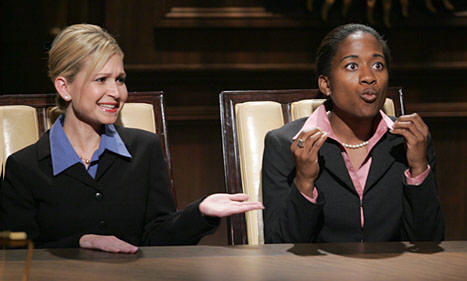
"I really am disappointed that
both of you walk into this room as close friends and then start
attacking each other." |
Synergy:
- Effort --
- Performance --
- Creativity --
|
|
|
|




|
|
