Jury tampering is the
crime of unduly attempting to
influence the composition and/or decisions of a
jury during the course of a
trial.The means by
which this crime could be perpetrated can include attempting to
discredit potential jurors to ensure they will not be selected
for duty. Once selected, jurors could be bribed or intimidated
to act in a certain manner on duty. It could also involve making
unauthorized contact with them for the purpose of introducing
prohibited outside information and then arguing for a
mistrial.
Although the
jury selection process is intended to weed out bias among prospective jurors,
it's an open secret that both sides look for bias -- in their own favor, of
course. There's an argument that juries would be more fairly selected by a
random process, and "Runaway Jury" is the poster child for that theory.
The new thriller
is about a jury consultant who tries to guarantee a friendly panel, and a juror
who does a little free-lance jury consulting on his own. The case involves a
widow who is suing a gun manufacturer because her husband was killed in an
office massacre involving an easily-obtained weapon. The widow has hired the
traditional, decent Wendell Rohr to represent her, and the gun manufacturer is
defended by a lawyer named Durwood Cable, who is the instrument of the evil,
brilliant jury consultant Rankin Fitch.
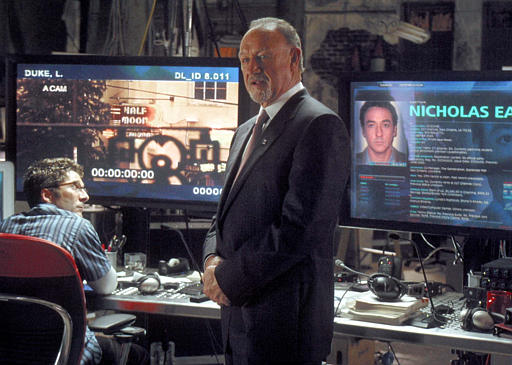
Fitch has been
hired by the reptilian head of the gun company to find a jury stacked in the
company's favor, and the most interesting sequence in the movie shows him doing
just that. Fitch stands in front of an array of computer and television
monitors, apparently able to summon at will the secrets of all the prospective
jurors. Although spying on dozens of jury pool members is probably not
legal--especially when information which could be used for blackmail is
obtained--Fitch presides over his screens like an orchestra conductor, seeing
into potential jurors' souls while offering pithy comments their weaknesses and
faults.
There is,
however, one juror who gets on the panel, despite Fitch's grave misgivings. This
is Nicholas Easter, a feckless young man who seems to come from nowhere and
appears to be trying to get off the jury (he feeds the judge a rambling
explanation about the videogame contest he's involved in). Easter's evasions
inspire the judge to lecture him on doing his duty, and puts indirect pressure
on both sides to accept him.
Easter, as it
turns out, is involved in a free-lance arrangement with his friend Marlee to
sell the jury to the highest bidder. He'll work on the inside, she'll handle the
negotiations, and then the highest bidder will get the verdict. Easter even
proves his power by leading a jury rebellion that leads to their defiant
reciting of the Pledge of Allegiance in the courtroom, forcing the judge to
treat them like an unruly grade school class.
This is an
ingenious plot device, saving the movie from being a simple confrontation
between good and evil, and adding a wild card forcing both sides to choose their
own morality. Will the decent Wendell Rohr pay in order to win the verdict
he believes his client deserves? Will the devious Durwood Cable add this expense
to the massive Fitch operation? Can Easter sway a jury that Fitch thinks he has
hand-picked for acquittal? These questions are so absorbing that we neglect to
ask ourselves how Easter could be so sure of being called up for jury duty in
the first place. On the other hand, we have here an frightening example of
a jury getting the case decided for it rather than deciding for itself based on
the evidence.
"There are some
things," said a famous Supreme Court Justice, "that are too important to be left
to juries."