“Paradise
Lost:” A Revival of the Spirit
by
Saif Patel
The Oxford
English Dictionary defines “cosmos”
as “the world or universe as an ordered and
harmonious system,” from the Greek,
“kosmos,” referring to an ordered
and/or ornamental thing. Though Pythagoras is
credited with first using this term to describe
the Universe, probably since he is also the one
most commonly cited for ideas of harmony and the Musica
Mundana, cosmos is generally a contrast to
“chaos”—“the first state of
the universe.” In explaining the theology
and cosmology of Paradise Lost, Milton
writes, “the heavens and earth/ Rose out of
Chaos,” describing the move from the
formless mass to the ordered whole. (I:9-10) As
much as this delineates the structure of the
world, however, its culmination seems to appear
in the Spirit, as Milton has conceived
it—the free, reasoning, integrated
Consciousness. Though many have found a hero in
the English epic from its dramatis personae—from
Adam to Satan to God/Son himself—the most
encompassing heroism seems that of Milton
himself, as a manifestation of this most supreme
of creations: the wholesome mind.
An instance in
which Milton's views on the sovereignty of the
Spirit appear in some of the conversations of the
Arch Fiend himself with his fellows—which is
quite ironic, considering that the story is an
extrapolation upon Christian Scripture. One of
Satan's “compeers” says, during a
discussion after their exile from Heaven:
Too well I see
and rue the dire event That, with sad
overthrow and foul defeat, Hath lost us
Heaven, and all this mighty host In horrible
destruction laid thus low, As far as Gods and
heavenly Essences Can perish: for the mind
and spirit remains Invincible, and vigour
soon returns,Though all our glory extinct,
and happy state Here swallowed up in endless
misery (I:135-140).
The invincibility
of “the mind and spirit” is something
which even the foes of God understand. Though the
fallen angels corrupt their “heavenly
Essences” with disobedience and revolt, they
still have a keen understanding of the powers of
perception, of personal reaction to one's
environment—“for neither do the Spirits
damned/ Lose all their virtue” (2:482-483).
Satan boldly speaks to his fellows, asking:
What though the
field be lost? All is not lost—the
unconquerable will . . And courage never to
submit or yield (I:105-108).
Like a true hero,
Satan refers to conquest and courage, a response
to the tyranny he and his cohorts have received
from the hand of God. It is this attitude—of
adventurous righteousness—which many cite as
sufficient to show the fallen Archangel to be the
hero of the work. However, working within the
confines of the Biblical account, Milton could
not reasonably—even if he
wished—display Satan as the outright
protagonist and epic hero. Therefore, it can only
be his qualities of trust in the Spirit, in his
own Consciousness as a fortress against the harms
surrounding him, that can represent the truly
heroic aspect. Satan is a deeply solipsistic
character, well aware of the world and his
situation in it. Though he becomes quite
fatalistic at times and denies possibilities of
recovery from his downfall, essentially, he knows
that the loss of Heaven as a place is always
permanent:
Infernal world!
and thou, profoundest Hell, Receive thy new
possessor—one who brings A mind not to
be changed by place or time. The mind is its
own place, and in itself Can make a Heaven of
Hell, a Hell of Heaven. What matter where, if
I be still the same. . . Here at least/ We
shall be free . . . we may reign secure; and,
in my choice, To reign is worth ambition,
though in Hell: Better to reign in Hell than
serve in Heaven. (I:251-263)
Whatever the reason
for their revolt, when Satan and his armies are
defeated by the Son, they lose their aspiration,
revert to the disintegrated empty air from which
they were made: “Exhausted, spiritless,
afflicted, fallen” (6:852). In contrast,
though Adam and Eve also fall like the Archangel,
the difference between Satan and Man is their
different choices in the application of their
autonomy and spiritual sovereignty, especially
after acting against God. Milton explains in his
argument for Book X:
Adam more and
more perceiving his fall'n condition heavily
bewailes, rejects the condolement of Eve; she
persists and at length appeases him: then to
evade the Curse likely to fall on thir
Ofspring, proposes to Adam violent wayes,
which he approves not, but conceiving better
hope, puts her in mind of the late Promise
made them.
The dividing line
between Man and Satan is demonstrated in Milton's
summary with his juxtaposition of the proposal of
“violent wayes” with “better hope
. . . in mind of the late Promise made
them.” Instead of desperate, destructive
means, like Satan and his minions, Adam and Eve
are thus able to remain hopeful and humble.
Adam even compares
himself to the fallen Archangel, calling himself
“miserable/ Beyond all past example and
future;/ To Satan only like both crime and
doom” (X:820-822). However, the pivotal
difference comes later, when the actual
consideration of possible
choices—freedom—relents to create in
Man hope, as opposed to Satan, who remains in
“desperate revenge.” An important
concept here is that of Predestination, with
which Milton himself vehemently disagreed, a
strong proponent of free will and its
acknowledgment. One of the devils in Pandemonium,
Belial, describes Satan's justifications for
rebellion: “we are decreed,/ Reserved, and
destined to eternal woe” (II:160-161). But
God charges this notion with sophistry, saying
that Foreknowledge had no influence on their
fault . . .
So without
least impulse or shadow of fate, Or aught by
me immutably foreseen, They trespass, authors
to themselves in all. . . I form'd them free
. . . Their nature . . ordain'd Their
freedom: they themselves ordain'd their fall
(III:118-128).
Satan later becomes
conscious of his freedom, cursing himself who
“Chose freely what [he] now so justly
rues,” but he cannot take this further to
repentance and pardon, for which “there [is]
no place/ Left . . .but by submission”
(X:70, 79-81). This he cannot embrace because of
his “disdain [for God] and dread of shame/
Among the Spirits beneath” (X:82-83). All of
this is due to the utter perplexity and discord
of Satan's situation; Belial sums this up in a
bitter paradox: “our final hope/ Is flat
despair” (II:142-143).
The difference
between Satan and Man emerges in the unfolding of
the plot. Instead of taking Satan's view of utter
despair and want of death and eternal
unconsciousness, Adam and Eve decide to take a
submissive place in God's plan. Diametrically
opposed to Satan's vengeful schemes to seek war
of “the offended Deity,” Man seeks
Peace—submitting to the Almighty because he
is almighty, hoping for “The Spirit of God,
promised alike and given/ To all believers”
(XII:519-520). Repentance and supplication are
things which Satan—in his
desperation—could never accomplish. Though
the Arch Fiend was strong of Spirit, it was
crushed in his attempts to act against Divine
Will, destroyed by the “Spirit and
Might” given to the Son by God himself.
Whether or not we
take a “side” in determining the true
victor(s)—Satan and his army in their
spiritual “martyrdom” or Adam & Eve
in their submission or the Son in his military
conquest—Milton's insistence on the inner
state as the final determinant of one's position
is apparent throughout. Though Satan loses the
battle, he is inwardly convinced of his own
inability to do otherwise in the face of such
extreme circumstances as his. Additionally,
though Adam & Eve know that Paradise is lost
as a place, their hope is to reach it as a state
of mind, to reside there in Spirit. And the
Son—though obviously the champion of the
battle—was decreed to be victorious by the
Almighty, and did not necessarily experience the
sort of spiritual change or adventure like the
other characters.
This ambiguity by
Milton—of not making the hero of his work
apparent—is too pervasive to have been
unintentional. Rather, it seems that Milton
wishes to share his own “heroism” in
composing such an epic to his culture—both
English and Christian—by taking the reader
on a trip through the Consciousness of each of
his constructed characters, exploring the
different facets of freedom and responsibility.
In fact, in his role as narrator, Milton says to
the Son:
Thee I re-visit
now with bolder wing, Escap'd the Stygian
pool, though long detain'd In that obscure
sojourn, while in my flight Through utter and
through middle darkness borne . . . I sung of
Chaos and eternal Night; Taught by the
heavenly Muse to venture down The dark
descent, and up to re-ascend (3:13-20).
Milton describes
his allegorical trek through the heavens and the
earth—an “obscure sojourn” quite
similar to that of Aeneas or Odysseus or
Achilles. Though he is blinded physically, Milton
explains—as narrator—that he, like
other blind prophets, is granted other boons to
recompense for his loss: with the year . . .
Seasons return; but not to me returns Day . . .
So much the rather thou, celestial Light, Shine
inward, and the mind through all her powers
Irradiate; there plant eyes . . . that I may see
and tell Of things invisible to mortal sight.
(3:40-55) . It is this “celestial
Light” which allows Milton to see things
which others cannot, which allows him to be like
“Thamyris . . . Maeonides . . . Tiresias,
and Phineus” (3:35-36).
Though many
arguments and counter-arguments can be made as to
who of the figures in Paradise Lost is its
hero, as a whole, it is the Spirit, the inward
wholesomeness, intellectual autonomy, and
strength of character of the individual which
appears as the most wide-ranging “epic
virtue” in the work, displayed by many of
the characters. Essentially, in this piece,
Milton takes the entire concept of an epic and
transforms it into an engaging experience, one
which is not at all an attempt at flattery and
sycophantic pandering to his own culture and
beliefs, but rather, one which takes the reader's
own Spirit to task. Centuries before Milton,
Thomas Aquinas wrote in his Summa Theologica:
“In the very gift of sanctifying grace, it
is the Holy Spirit whom one possesses, and who
dwells in man.” Milton's epic awakens anyone
who participates in this mental voyage from
whatever depths of gloom he may reside,
transforming the shapeless darkness therein into
the integrated Consciousness, the illuminated
Spirit, which formed the Son, but lives in us
all:
Hail, holy
Light, offspring of Heaven firstborn . . .
Before the Heavens thou wert . . . Won from
the void and formless infinite (3:1-12).
|
 This unit will use
the oldest, most personal form of writing, the letter, to
approach Beowulf, Chaucer's Canterbury Tales, and
Malory's Arthurian Legends. We will also look at some
more modern letters including Romantic poet, John Keats's
letter to Fanny Brawne and a letter from a Holocaust
survivor. Letters can be reflective, written to oneself
as a means of catharsis. They are often narrative,
written to tell a true story or fictional one. Always
expressive, they communicate our emotions, whether
outrage, love, approval, or shame. Letters can be a means
of seeking revenge, exposing wrongdoing or wrong
thinking, or they can be the means of a request ranging
from a small favor to the proposal of marriage.
Regardless of their nature, they offer an important
method of insight into their authors' minds and souls.
This unit will use
the oldest, most personal form of writing, the letter, to
approach Beowulf, Chaucer's Canterbury Tales, and
Malory's Arthurian Legends. We will also look at some
more modern letters including Romantic poet, John Keats's
letter to Fanny Brawne and a letter from a Holocaust
survivor. Letters can be reflective, written to oneself
as a means of catharsis. They are often narrative,
written to tell a true story or fictional one. Always
expressive, they communicate our emotions, whether
outrage, love, approval, or shame. Letters can be a means
of seeking revenge, exposing wrongdoing or wrong
thinking, or they can be the means of a request ranging
from a small favor to the proposal of marriage.
Regardless of their nature, they offer an important
method of insight into their authors' minds and souls.

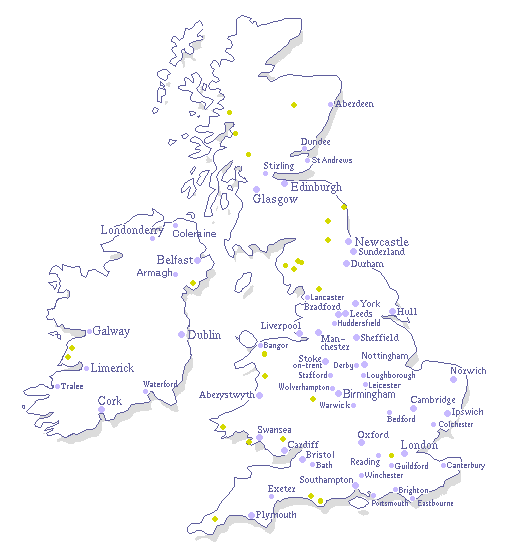 DESCRIPTION
OF ENGLAND:
DESCRIPTION
OF ENGLAND: