 |
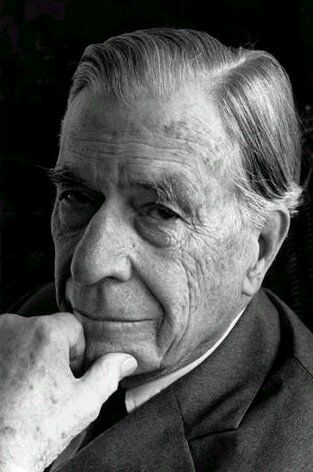
 John
Kenneth Galbraith John
Kenneth Galbraith(1908-2006) |
| John Kenneth Galbraith was
born in Canada and moved to the United States in the thirties. He earned
his Ph.D. in agricultural economics at the University of California at
Berkeley. He was one of the chief price controllers during World War II
as head of the Price Section of the U.S. government's Office of Price
Administration. In 1943 Galbraith left the government to be on the
editorial board of Fortune. In 1949 he became an economics professor at
Harvard, where he had been briefly before the war.
Galbraith was an adviser to President
Kennedy, Kennedy's ambassador to India, and president of Americans for
Democratic Action. He was president of the American Economic Association
in 1972. Galbraith is one of the most widely read economists in the United States. One reason is that he writes so well. He turns a clever phrase that often makes those he argues against look foolish. Galbraith's first major book, published in 1952, was American Capitalism: The Concept of Countervailing Power. In it he argued that giant firms had replaced small ones to the point where Smith's perfectly competitive model of capitalism no longer applied to much of the American economy. But not to worry, he argued. The power of large firms could be balanced by the power of large unions, so that consumers were protected by competing centers of power. Galbraith made his biggest splash with his 1958 book, The Affluent Society. In that volume he contrasted the affluence of the private sector with the poverty of the public sector. Galbraith attacked production that was geared to "conspicuous consumption" that only satisfied a few consumer's "bizarre, frivolous, or even immoral wants." Galbraith wrote: "If the individual's wants are to be urgent, they must be original with himself. They cannot be urgent if they must be contrived for him. And above all, they must not be contrived by the process of production by which they are satisfied.... One cannot defend production as satisfying wants if that production creates the wants." Galbraith's magnum opus was his 1967 book, The New Industrial State. Galbraith argued that the American economy was dominated by large firms. "The mature corporation," wrote Galbraith, "had readily at hand the means for controlling the prices at which it sells as well as those at which it buys." Galbraith wrote: "Since General Motors produces some half of all the automobiles, its designs do not reflect the current mode, but are the current mode. The proper shape of an automobile, for most people, will be what the automobile makers decree the current shape to be."
Galbraith was instrumental in developing President Roosevelt's proposed Second Bill of Rights, and continued to defend government intervention to correct market failures to the end of his life. Galbraith believed there was an excess accumulation of private wealth at the expense of public needs, and he warned that an unfettered free market system and capitalism without regulation would fail to meet basic social demands, declaring that overproduction of meaningless consumer goods was harming the public sector and depriving Americans of such benefits as clean air, clean streets, good schools, and support for the arts. Selected WorksThe Affluent Society. 1958. American Capitalism. 1952. The New Industrial State. 1967. |
