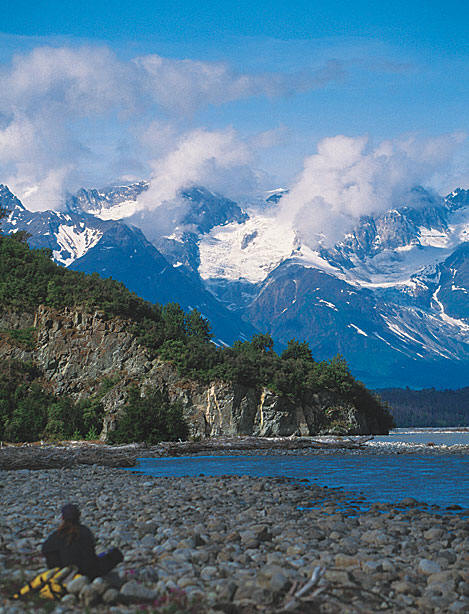
All economic decisions involve tradeoffs. In 1980 Congress designated
more than 100 million acres of land in Alaska as Natural Parks and
Wilderness areas, closing this land to mineral exploration.
From the perspective of Don Young, U.S. Congressman (R-Alaska), the cost
of this decision, means loss of jobs for US workers and a continuing
dependence on foreign oil and minerals.
However, environmentalists and Morris Udall, U.S. Congressman
(D-Arizona), viewed this as short-sighted. They argue that Alaska is the
last wild home for many species of plants and animals. While there might
be a short term economic gain, they believe the land should be preserved
for future generations.
The Alaskan Lands Issue is ultimately an issue of limits. The
first and most important lesson in all of economics is that we usually
can’t have everything we want. Our desires for material goods may be
virtually unlimited. Our resources for fulfilling those desires are not.
They are limited and scarce. More wilderness, less oil and minerals.
More oil and minerals, less wilderness.
What is the true value to society of our choices? Is it more worthwhile to fulfill the national need for valuable minerals and energy independence or to preserve our natural wilderness for future generations?
The controversy over the Alaska National Wildlife Refuge (ANWR) continues today: twenty years after the original act was passed, the US Congress once again debated whether to allow drilling for oil and minerals in the area.
After reading the article supporting the park and the article advocating drilling, your assignment is to choose which position you would have taken on the issue if had you been in Congress during the debate over preserving the National Wilderness in Alaska. Would you support the park or voted to allow drilling?
|
PRO: Drill Now! |
ANTI: Save the Park! |
|
|

-
This brief should be 5 paragraphs; a minimum of 2 sentences, no more than 4 sentences per paragraph.
-
All sentence must be complete sentences.
-
The first paragraph of this Brief will be the Introduction.
-
The first sentence of this Brief will be the THESIS. The Thesis is a clear NORMATIVE (subjective) statement of the position the brief will take on the issue using the vocabulary and concepts from economics:
-
Should should drilling be allowed in the Alaska National Wildlife Refuge? Why or why not?
-
-
The second sentence in the Introduction will be the OUTLINE for the rest of the brief listing the three supporting topics which will be presented to back up the position supported by the Brief.
-
The next three paragraphs will be Support paragraphs. Each support paragraph will begin with a Topic sentence, and will include at least one POSITIVE (objective) FACT taken from the online articles or the textbook which backs up the THESIS.
-
For the brief, use facts from the video, the assigned online articles, and your textbook; do NOT bring in outside facts.
-
All facts in this Brief MUST be cited.
-
You MUST use BOTH articles.
-
A bibliography using proper MLA format citations should be at the end of your brief.
-
A Brief should NEVER be in first person.
-
A Brief should ALWAYS be IN YOUR OWN WORDS (IYOW); you may NOT cut and paste from the internet or any other source or you will receive a zero and this will be reported to the Honor Council.
-
Your brief should ALWAYS be printed out, not hand-written.
-
Your Brief is due at the beginning of the class on the assigned due date; assignments turned in after class will be penalized one point per day late.