Marx seized on the labor theory of value to explain why labor is the source of all surplus value (profit) which is appropriated by the capitalists in order to accumulate more and more material goods. The problems of asymmetric information, inequitable distribution of wealth, imperfect markets, externalities, public goods, and increasingly severe business cycles would all contribute to the demise of capitalism.
Marx expected the new synthesis to be socialism. He believed that its organizations would grow out of the conditions of the time, and that a government by the working class would subsequently give way to a communal society operating under the slogan: "from each according to his ability, to each according to his need."
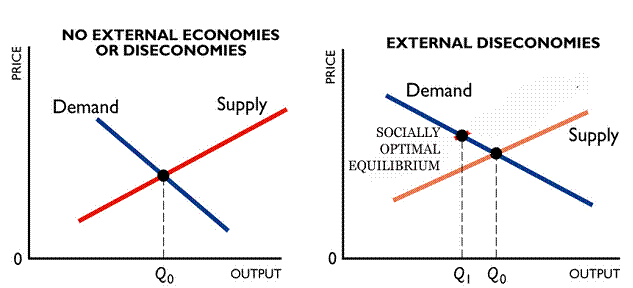
While there are no truly communal societies in the Marxist sense, it is generally agreed today that government should play a major role in redistributing income to benefit the poor, providing public goods like national defense, and offsetting the effects of external economies and diseconomies. There is great disagreement, however, regarding just how far government should go. Conservatives tend to see too much government interference as a real threat to personal freedom. Liberals counter that the price system, left to itself, will simply not provide all the goods and services that are socially optimal.
Both conservatives and liberals agree that government must do certain things. First, it must establish“rules of the game”—the legal, social, and competitive framework within which our price system operates. Second, it must ensure that markets remain reasonably competitive. And third, it must redistribute some income in favor of the ill, the handicapped, the old and infirm, the disabled, and the unemployed.
Government provides many public goods and services: national defense, highways, park services, and so forth. A public good is something that can be consumed by one person without diminishing the amount that can be consumed by others. Once such goods are produced or provided, there is usually no way to prevent consumers from benefiting from them, whether or not they contribute toward their cost. As a result, public goods must be financed through the tax system.
It is generally agreed that government should encourage the production of and services that entail external economies, and discourage production of those that entail external diseconomies. Government can do this by influencing output, taxing industries that create external diseconomies, for example, and subsidizing those that create external economies.
On the liberal side, John Kenneth Galbraith made his biggest splash with his book, The Affluent Society. In that volume he contrasted the affluence of the private sector with the poverty of the public sector, and attacked production that was geared to "conspicuous consumption" that only satisfied a few consumer's "bizarre, frivolous, or even immoral wants." Galbraith argued that the American economy was dominated by large firms which controlled prices and wages; and that it would be better for the government to control these for the public rather than allowing big corporations to do it for profit.
For conservatives, Milton Friedman argued in his book Free to Choose that although the market is not perfect, it is better at providing goods and correcting flaws than government. Friedman's theory of Public Choice asserted that government makes many decisions that are economically inefficient. Voters' rational ignorance may lead them to vote for a candidate without really researching whatever "package" of programs or policies that candidate endorses. Legislative policy may also be very short-sighted, may reflect the needs and pressures of special interest groups, and government agencies may operate in ways that actually reflect the interests of private corporations rather than the public.
LEARNING OBJECTIVES:
By the end of this chapter, you should understand:
Ø Marx believed the free market was not driven by risk-taking entrepreneurs who were rewarded with profit; he believed all value came from labor, and therefore any profit was actually surplus value of the workers which had been stolen by capitalists through the concept of private property to alienate workers.
Ø Marx identified six flaws in the free market economic system which would eventually lead to the system’s replacement by socialism: Public Goods, Imperfect Markets, Asymmetric Information, Externalities, Inequity, and Business Cycles.
Ø Marx advocated complete public ownership of the means of production and complete control of the economy by the government.
Ø John Kenneth Galbraith worked as an advisor to President Roosevelt and President Kennedy, and disagreed with Marx. Galbraith advocated treating the government like a referee: implementation of socialism through government spending, taxation, and regulation of the economy without direct government ownership.
Ø Galbraith believed the government should promote culture, provide public goods, and guarantee basic human rights such as the right to a job, a home, health care, and education.
Ø Milton Friedman advised President Reagan, and advocated the free market. He believed the government should only function as a repairman when markets did fail, but that in all cases preserving freedom of choice should be the government's most important priority.
Ø Friedman pointed out that there are numerous problems related to government intervention in the economy: rational ignorance, short-term thinking, inflationary bias, rent-seeking (special interest groups, earmarks, logrolling), bureaucratic capture, and deadweight loss.
Ø Most economists today agree that the government should at a minimum provide a legal and social framework, maintain competition, redistribute income, provide public goods, and correct externalities.
KEY POINTS:
I. The Role of Government and Shortcomings of the Invisible Hand
A. There are six major reasons why invisible hand may fail to allocate resources efficiently:
1. Imperfect competition
a. Monopolies may gain by restricting output and raising price. Too few units will be produced at too high a price.
b. Monopolies will hire too few workers and keep unemployment high in order to drive down wages.
2. Externalities
a. Failure to Fully Register Costs and Benefits.
b. Present when the actions of an individual or group harm the property of others without their consent such as Pollution.
c. Supply curve understates the true cost of production.
3. Public Goods
a. Goods that are jointly consumed--individuals can simultaneously enjoy consumption of same product or service and nonexcludable--consumption of the good cannot be restricted to only the customers who pay for it.
b. Because those who do not pay cannot be excluded, no one has much incentive to help pay for such goods. Each has an incentive to become a free rider, a person who receives the benefits of the good without helping to pay for its cost. But when a lot of people become free riders, too little is produced.
c. Examples of public goods: national defense, radio and television broadcast signals, and clear air.
d. Markets often do develop ways of providing public goods. Nonetheless, public goods often cause a breakdown in the harmony between self‑interest and the public interest.
4. Asymmetric Information
a. Either the potential buyer or potential seller has important information that the other side does not have. Lack of information, may cause a party to agree to an exchange they will later regret.
b. Brand names, franchises, and product warranties are ways the free market deals with information problems.
5. Inequitable Distribution of Income and Market Power
a. Wealth in capitalist societies tends to accumulated by the few; while the majority have little or no wealth beyond a subsistence.
6. Business Cycles
a. business cycles reflect the possibility that the economy may reach short-run equilibrium at levels below, or above full employment.
II. Political Philosophies
B.
John Kenneth Galbraith and the Liberals believe that the price
system, left to itself, will simply not provide the socially optimal
level of goods and services.
They see the government as a referee who uses direct action
to correct flaws in an imperfect market.
C.
Milton Friedman and Conservatives tend to see too much government
interference as inefficient and a threat to personal freedom. They
see the government as a repairman who fixes temporary problems in a
generally self-correcting market, and provides information to the
public to help them make wise choices.
III. What is Government?
a. An institutional process through which individuals collectively make choices and carry out activities.
b. The entity that has a monopoly over the legitimate use of force to modify the actions of adults.
IV. Differences and Similarities Between Market and Collective Action
A. Competitive behavior is present in both the market and public sectors.
B. Private sector action is based on voluntary choice; public sector (when democratic) is based on majority rule.
V. The Roles of Government
A. Protective Function of Government
1. The most fundamental function of government is the protection of individuals and their property against acts of aggression. Involves the maintenance of a legal structure (rules) within which people interact peacefully and have a process for the settlement of disputes.
B. Productive function of Government
1. Involves the provision of a limited set of goods that are difficult to supply a good through the market.
C. Distributive Function of Government
1. Involves correcting inequitable income distribution and provision of services through redistribution and a social welfare safety net.
D. Corrective Function of Government
1. Correcting Business cycles through taxation and spending.
VI. Liberals believe in positive rights
a. Roosevelt’s Second Bill of Rights
b. Right to a job, a home, health care, education, subsistence income
VII. Conservative Overview of Collective Decision Making
A. Public choice analysis applies the tools of economics to the political process. The goal is to provide insight concerning how the process works.
1. Self-interested behavior is present in both market and political sectors
2. Political officials: interested in winning elections. Just as profits are the lifeblood of the market entrepreneur, votes are the lifeblood of the politician.
B. Milton Friedman’s flaws of Socialism
1. Rational Ignorance Effect
a. Recognizing their vote is unlikely to be decisive, most voters have little incentive to obtain information on issues and alternative candidates.
b. Because of the rational ignorance effect, voters will be uninformed on many issues; such issues will not enter into their decision making process.
2. Rent Seeking
a. Actions by individuals and interest groups designed to restructure public policy in a manner that will either directly or indirectly redistribute more income to themselves.
b. Widespread use of the taxing, spending, regulating powers of government that favors some at the expense of others will encourage rent seeking.
c. Rent seeking moves resources away from productive activities. The output of economies with substantial amounts of rent seeking will fall below their potential.
3. Special Interest Effect
a. Special Interest Issue: One that generates substantial personal benefits for a small number of constituents while imposing a small individual cost on a large number of other voters.
b. Members of interest group will feel strong about an issue that provides them with substantial personal benefits. Such issues will dominate their political choices.
c. In contrast, the voters bearing the cost of special‑interest legislation will often be uninformed on such an issue because it exerts only a small impact on their personal welfare and because they are unable to avoid the cost by becoming better informed.
d. Politicians have a strong incentive to favor special interest even if action is inefficient.
e. Logrolling and pork-barrel legislation strengthen the special interest effect.
4. Shortsightedness Effect
a. Issues that yield clearly defined current benefits at the expense of future costs that are difficult-to-identify.
b. Political process is bias toward the adoption of such proposals even when they are inefficient.
c. Voters will tend to support those candidates whom they believe will provide them the most government services and transfer benefits, net of personal costs.
d. Politicians tend to prefer cutting taxes and increasing spending which results in permanent deficit spending, this tends to crowd out private investment and create deadweight loss.
5. Bureaucratic Capture
a. Bureaucrats are people that handle day-to-day operations of government
b. Bureaucrats seek promotions, job security, power, etc.
c. The interests of bureaucrats are often complementary with those of the corporations they are supposed to regulate.
6. Lack of Incentive for Efficiency
a. In the public sector, the absence of the profit motive reduces the incentive of producers to keep costs low; there is no bankruptcy process to weed out inefficient producers.
b. Public‑sector managers are seldom in a position to gain personally from measures that reduce costs.
c. Because public officials and bureau managers spend other people’s money, they are likely to be less conscious of cost than they would be with their own resources.
7. The Opportunity Cost of Government is the Sum of the Following
a. Opportunity cost of resources used to produce goods supplied through the public sector.
b. Cost of resources expended in the collection of taxes and the enforcement of government mandates
c. Excess burden (deadweight loss) of taxation.
II. Public Sector Vs. Market Sector: A Summary
A. These factors weaken the case for the free market:
1. Imperfect competition
2. External costs and benefits
3. Public goods
4. Asymmetric information
5. Business Cycles
6. Inequitable Distribution of Wealth
B. These factors weaken the case for government intervention:
1. Special Interest Effect
2. Shortsightedness
3. Bureaucratic or Regulatory Capture
4. Rational Ignorance
5. Deadweight Loss
6. Crowding Out