| |
This week's assignment:
The first task was revealed at
Random House Publishing. Each corporation would be adapting a well-known
fairytale using the best design and illustration resources at Random House.
In the end the corporations would read their finished, bound book to a
target audience made up of first grade children. Matchstick appeared to have
the advantage, a creative team working on a creatively centered project.
After the final reading to the first graders, Random House executives
conveyed to Martha that although both teams had done a good job, they felt
there was a clear winner, Primarius.
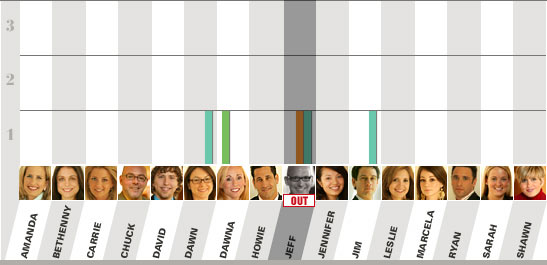
Team Matchstick fizzled with a dark version of "Hansel
and Gretel" with children who change their names and sneak out of the
house. Project manager Jeff was told "you just don't fit in" and
dismissed.
|
Lessons Learned
FIT
-
Connect with your audience.
Anyone who watched
the third season of The Apprentice with Donald Trump remembers the
formula for success: when in doubt, ask the customer. Stewart repeatedly
emphasized the importance of this skill, saying "knowing how you
connect with your customer is essential to the success of business." Primarius obviously heard her and got it.
To her credit, Dawna, the Primarius project
manager, assigned members of her team to recruit children to listen to
the team's prototype story. This bit of marketing research showed the
team how important it was to select a good storyteller—in this case,
Howie. The research also showed that the team had developed some good
ideas that were attractive to children.
The candidates on the Matchstick side appeared to be more interested
in talking about their ideas among themselves instead of considering
the needs of the target audience. When they finished their book
project, the book contained ideas and themes that would have made
either parents or children uneasy.
The bottom line? It's OK for businesspeople to be excited about their
own ideas for products and services, but in reality, the perceptions
of consumers about those ideas are most important.
-
Leverage your resources.
Primarius figured out they had a natural "Jack" in team member Howie
and selected him as their storyteller. His lively theatrical delivery
enchanted the children. This is a great example of leveraging your
resources and matching the right team member with the right task.
-
Authentic acknowledgement.
Primarius project manager Dawna genuinely conveyed her enthusiastic
belief in her team. She praised Howie, "you turned into Jack." Good
leaders demonstrate sincere appreciation and admiration of their team.
Praise is contagious and is often the spark that enhances optimal team
performance.
-
Sticking to her brand.
Stewart's firing style was consistent with her brand of etiquette and
good taste. Her firing tagline, "you just don't fit in," fits her
image. She softened the firing blow by handwriting a personal, cordial
note to the fired candidate, wishing him future success.
UNFIT
-
Know the values of your customer.
Parents don't want to read a gloom-and-doom story before sending
children off to sleep. Matchstick's leader, Jeff, went against the
advice of his team and stubbornly stuck to a theme of small children
changing their names and leaving home. He missed the mark of Stewart's
challenge to "connect with your audience."
-
My-way-or-the-highway leadership style.
Jeff demonstrated this season's first example of bad leadership with a
bullying, dictatorial style and going as far as telling team member
Dawn: "I'm not engaging you. I don't care." Sorry Jeff -- as a leader
it's your job to engage your people! If you don't care about your
people, it's not likely leadership is your forte. Jeff was
condescending and not open to influence from his team.
When a leader has intelligent,
creative, and competent resources, he or she needs to trust and listen
to them. In fact, the
more creative a workgroup is, the more the people in that workgroup
will resent autocratic leadership.
Leaders who aren't open to influence can be dangerous and a liability
to organizations. Jeff's unwillingness to listen to his team resulted
in an out-of-touch story line that Stewart described as "disturbing."
Ouch.
The bottom line? Participative management tends to work better than
autocracy. Asking colleagues for their ideas and opinions enriches the
output of the work group. As the saying goes, "a one-man band doesn't
get very big."
-
Professional boundaries.
Jeff said to Dawn: "If you'd like to join me in the bathroom you may,
but I'm going to be naked." Ew. In most companies, this action would
result in a march down to HR and an escort out of the building. Where
do they find these people?
-
Sour grapes. Show me a
poor loser, and I'll show you a loser. Jeff, the first candidate to be
sent packing from the conference room departed with a nasty verbal
shot to a survivor, stating, "I'll look for your failing." A
professional career is a process -- not an event. It's amazing how
comments, actions and behaviors can come back to haunt (or help) you.
I am highly doubtful that Jeff's parting comments displayed to
millions of viewers will help out his career.
The Endangered
Species List:
The following people are on this week's endangered
species list, based upon the likelihood that they will "just not fit in"
in the near future:
Jim (Matchstick):
In just one episode, Jim has established himself as the person viewers
may love to hate. He's a cocky schemer who is already inserting a wedge
separating him from his teammates.
Dawn
(Matchstick): Dawn has already made a negative impression due to her
temperamental whining.
Gold Stars for This Week's Episode:
Dawna gets a gold star for assigning some of her
teammates the job of recruiting kids to serve as a test audience for
Primarius' new book. It was an important way to connect with the
customer.
|
| The Report Card |
Primarius:
- Effort --
- Performance --
- Creativity --
|
|
|

"To me negative
energy in a group is like a poison and you have to get rid of it." |
Matchstick:
- Effort --
- Performance --
- Creativity --
|
|
|
|
|
|