| |
This week's assignment:
Nine candidates remained in last week's
episode, which focused on the importance of branding and big ideas. Judging
by the outcome, some of Stewart's candidates are creative and innovative
while others simply are not.
This week's assignment: Create a
live-action mobile billboard for Tide to Go, a new stain removal pen. The
winner would be the team whose "live theatrical event" was judged to be the
most innovative and created the most buzz.
Matchstick triumphed by creating a
character called Tide to Go Joe -- Ryan dressed in a superhero cape -- who
knocked out people dressed as stains in a boxing ring. The event drew a
large, enthusiastic crowd. Brand guru Peter Arnelle, a judge of the event,
called it "perfect" and "a hit out of the park."
In sharp contrast, Primarius completely
blew the task. Their event was pathetic, chaotic and completely
unprofessional, prompting onlookers to hold their hands over their ears.
Primarius failed to generate a central theme or strategy resulting in team
members flailing around the stage like amoebas on steroids. It was weird and
completely lacking in creativity or a tie-in to the product. Judge Arnelle
was ruthless in his assessment, calling the event a "total failure" and the
worst communications display he had ever seen.
This week's firing decision was easy for
Stewart for the "worst failure in a task so far." She fired Matchstick's
project manager, Sarah (an event planner, for crying out loud!) for "no
plan, no strategy and lacking leadership qualities." Stewart then broke the
pattern of only firing one candidate per episode by also firing Carrie for
failing to help Sarah.
|
Lessons Learned
FIT
-
Branding.
Stewart understands branding. Everything she does in
public promotes her brand as high quality. Matchstick created an event
that was aligned with their product image. Primarius's event was not
tied into branding and was embarrassing.
-
The big, simple idea.
Matchstick understood Stewart's instructions to create an event that
was innovative. Their team chose an uncomplicated strategy using Tide
to Go Joe. The idea was closely tied to the product (he was dressed to
resemble the stain stick), and the whole idea of the product is to
knock out stains. Great ideas do not have to be complex. They just
need to be effective and easy to understand.
-
High-performing team.
Matchstick has gelled as a high-performing team. They have moved
beyond the team stages of forming and storming -- where conflict and
differences are worked out -- and are now in a performance phase. They
support, encourage and inspire each other. They're focused, work
collaboratively, capitalize on each other's strengths and communicate
clearly.
-
Having fun.
Matchstick has fun as a team. Their spirit is infectious and
contributed to the enthusiasm of their audience at the event. The team
members clearly enjoyed themselves in their character roles. Ryan in
particular as the caped crusader displayed great gusto and fun in his
role. Also, what a great sport! Not every man would willingly appear
in an orange, skintight spandex costume.
-
Interactive event.
Matchstick passed out sample stain removal pens at their event to
demonstrate the product. Their entire event engaged the consumers and
tied into the product. They led the audience in cheers and used actors
dressed as common household stains (ketchup, wine and coffee) that
related well to the product and consumer.
-
Brainstorming to encourage
innovative ideas. Effective brainstorming
encourages crazy ideas. Ryan's initial wild ideas led to the boxing
ring battle. Often it can be the innovative "crazy" ideas that are the
most successful. This was in contrast to Primarius's silent approach
to brainstorming, which failed to generate a good idea. Here are a few
simple rules to help your team generate a great idea during
brainstorming:
-
Allow enough time.
-
Aim for quantity not quality.
-
Write down all ideas.
-
Brainstorm at the beginning of
meetings when people are fresh.
-
Encourage wild ideas.
-
Do not use this time to censor,
judge or evaluate ideas.
UNFIT
-
Lack of leadership.
Sarah completely blew it as a project manager. She was completely
ineffective at creating a vision and strategy for her team.
Followers require direction and a plan. Sarah offered neither. She
could not even lead her team to develop an idea -- a major red flag.
Leaders need to have the skills to facilitate creative thinking for
their teams. Sarah's reliance on long, silent brainstorming sessions
as her sole resource for idea generation was pretty pathetic. The
challenges facing business leaders today -- global competition,
technological changes and high customer expectations -- require
creative leadership responses and skills. Being able to direct a
team to results is a core fundamental leadership requirement.
-
Activity without results.
Primarius was active throughout the task but produced poor results.
This has been called the "drowning man syndrome." If a drowning man
does not have the skills to swim, even though he expels a tremendous
amount of energy flailing in the water, the result is still a
drowning. During the task, Jim noted his team was doing a "whole lot
of nothing." Carrie, for example, spent all her time poring over
spreadsheets running the "financials." Accounting was hardly
critical in this task. She was generating activity, not results.
-
No creativity.
The candidates who remain on Primarius should be concerned. Stewart
began this series saying she was looking for someone with "big
ideas." Primarius failed to come up any idea for their task. I
wouldn't count on the winner coming from this team.
-
Focus on a theme. Sarah
and Carrie failed miserably at managing the creative process for
Primarius. They allowed time to be wasted and never pushed their
team to a conclusion on a central theme. Even when their teammates
suggested a theme, Sarah and Carrie rejected it out of hand.
The bottom line? Time is precious. It's important not to wallow in
indecision, but to move ahead. Sarah and Carrie spent a lot of time
planning, but they couldn't execute their plan in an effective and
efficient way.
Handicapping
the Survivors:
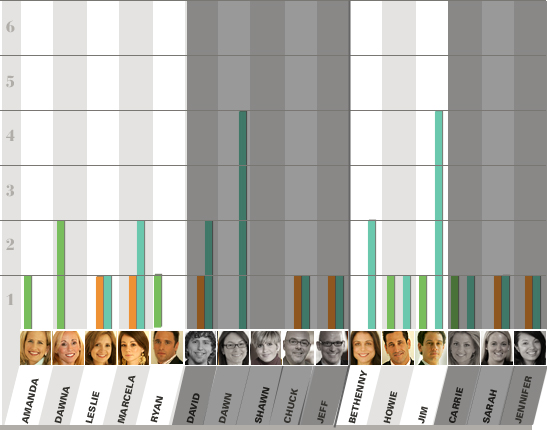
Now that half of the original eight
candidates are gone, the "endangered species list" will be replaced by a
roster of the remaining candidates, listed in order of the probability
that each of them will become Ms. Stewart's apprentice:
-
Dawna (Matchstick): As of now, no one
can match her 2-0 record as a project manager.
-
Amanda
(Matchstick): She has been a winning project manager on a very tough
task, is highly professional, and is very consistent in her performance.
-
Ryan
(Matchstick): He's also been a winning project manager who has a
positive, can-do attitude.
-
Bethenny (Primarius): She's a hard worker, but doesn't seem
to have the polish or the leadership skill to end up on top. She has yet
to serve as a project manager.
-
Leslie
(Matchstick): She always seems to have a big smile on her face, but she
is 0 for 1 as a project manager and engaged in some questionable sales
tactics in week five.
-
Howie (Primarius): He's been a winning
project manager, but his temper makes him doubtful as the ultimate
survivor of the season.
-
Jim
(Primarius): He was the winning project manager in week six, but let's
face it, he just doesn't fit.
-
Marcela
(Matchstick): She doesn't have as much leadership capability as the
top-rated candidates.
Gold Stars for This Week's Episode:
Dawna gets a gold star for being the first person this season
to rack up two victories as project manager. |
|
|
| The Report Card |
Primarius:
- Effort --
- Performance --
- Creativity --
|
|
|
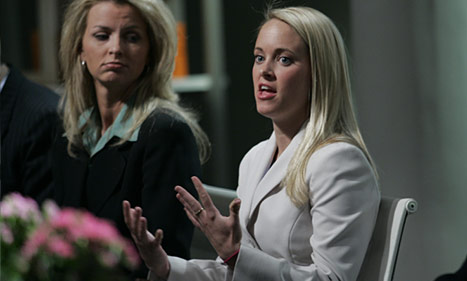
"It was
like the blind leading the blind. There was no strategy, no plan,
and it was getting worse by the minute." |
Matchstick:
- Effort --
- Performance --
- Creativity --
|
|
|
|
|
|