 |
Lo, there do I see
my father
Lo, there do I see my mother and my sisters
and my brothers
Lo, there do I see the line of my people back
to the beginning
Lo, they do call to me
They bid me take place among them
in the Halls of Valhalla
Where the brave may live forever...
Before the dawn of the second millennium (922 A.D.), the city of Baghdad is the center of one of the most highly developed civilizations in the world. Within its cultured protection, young Ahmed Ibn Fahdlan enjoys the privileges of a prominent position until he succumbs to a politically dangerous relationship with a beautiful young woman.
As punishment, Ahmed is sent away with his mentor and manservant, Melchisidek as an appointed emissary to a distant land to interact with and learn the ways of the Rus, also known as Vikings.
On his journeys, Ahmed meets Buliwyf, leader of a shipload of Viking adventurers whose mission is to report to aging King Hrothgar at the great hall of Heorot and offer their assistance and protection from a scourge causing supernatural terror and decimating the population--half-men, half-beasts that attack during the night and decapitate their victims. Buliwyf's band includes Herger the Joyous, Helfdane the Large, Roneth the Horseman, Rethel the Archer, Skeld the Superstitious, Weath the Musician, Edgtho the Silent, Halga the Wise, Hyglak the Quarrelsome, Haltaf the Boy, and Ragnar the Dour.

Although initially horrified by the Northmen's barbaric customs and lack of hygiene, Ahmed unexpectedly and involuntarily becomes one of their number when an old soothsayer whom the Vikings call the "Angel of Death" casts the bones and warns the band of adventurers that they will fail unless they are accompanied on their journey by a 13th warrior who is not from the North.
Arriving at the warriors' northern homeland, Buliwyf discovers that the King and his young wife, Queen Weilew, and Hrothgar's treacherous son Wigliff, have been unable to stop their enemy's rampage. Soon, Ahmed is on the front lines, fighting alongside Bulifwyf to defeat the creatures known as the Wendol--the "Eaters of the Dead."
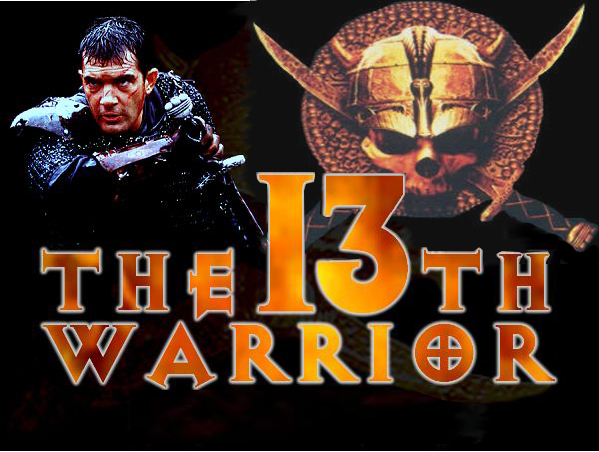
Based on award-winning author Michael Crichton's best-selling novel, Eaters of the Dead, Touchstone Pictures' "The 13th Warrior" purports to be a deconstruction of the legend of Beowulf. According to the classic heroic poem (composed around 1000 A.D.), Beowulf is a great Scandinavian warrior who answers King Hrothgar's pleas for help to kill the man-eating monster Grendel. Later, after slaying the creature, Beowulf enters Grendel's lair to destroy his mother. The 13th Warrior argues that "Grendel" is not actually one creature, but a host of costumed men who assault under cover of darkness, pretending to be fearsome, demonic apparitions. Buifwyf/Beowulf earns his reputation by driving them back then leading a small party of warriors on a search-and-destroy mission for the female leader of the attacking tribe.
| Characters | Viking Life | Viking Myth | Beowulf | Ask the Viking Answer Lady |