|
ask the viking answer lady |
|
Dear Viking Answer Lady:
Dubious |
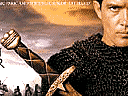
You are indeed correct to be sceptical. While undoubtedly Crichton had some familiarity with Ibn Fadlan's account, his well known novel Eaters of the Dead is totally fiction, mixing Ibn Fadlan with Beowulf and a bit of H.G. Wells' Morlocks added for flavor. There are, however, translations of Ibn Fadlan available, including the excerpts discussing Ibn Fadlan's adventures among the Rus as discussed below.
Since the release of 13th Warrior, the Viking Answer Lady's mail volume has tripled with questions inspired by the movie. Let me re-emphasize, and it doesn't seem I can do this enough,
Eaters of the Dead and 13th Warrior are FICTION!!
Let me take a moment to list the most common questions that I receive about the book or movie, and answer them here:
If you go to the back of the book and read Crichton's afterword, you will find the author's own words explaining that he used the Ibn Fadlan text to build the first three chapters of the book, and even Crichton can't remember what parts are fiction and what are real. Absolutely nothing past that point is from the real Ibn Fadlan. And it's dirt simple to figure out what is fiction and what is not, by reading the real Risala of Ibn Fadlan, presented above.
Once again, the book is fiction. If you read the book or pay attention to the movie, you quickly notice that the "wendol" are supposed to be some sort of pre-human or early human, probably Neanderthals. Aside from their appearance, there's the "Clan of the Cave Bear" thing going on with the bear symbols, there are Lascaux-like cave-paintings, and the "Venus of Willendorf" goddess images which all should give you a clue that these are supposed to be "cavemen" with appalling dietary preferences.
I'm not positive where Crichton picked up the term "wendol". It has obvious resemblances to the name "Grendel", which is in keeping with the Beowulf tie-ins throughout the tale. However, the modern archaeological term "Vendel" seems a more likely source of the word -- this being the term for the Iron Age Germanic culture of fully human people who immediately preceeded the Viking Age peoples, named after the typical artifacts found at the cemetary at Vendel, Sweden. As it is, Crichton's "wendol" seem more closely allied with H.G. Wells' Morlocks than with either Neanderthals or Vikings.
The only "bear people" of the Viking Age would have been the human, non-Neanderthal bersarks, the Viking Age equivalent of the modern Marine. You can read more about these warriors in my article Berserkergang
The "prayer" is a part of the ritual described by the real Ibn Fadlan where a slave girl/concubine of a deceased Rus chieftain is about to be sacrificed to accompany her master to the grave. It is not used by any of the Rus warriors themselves. The movie uses it twice, once during the chieftain's funeral, and again towards the end of the movie in the mouths of the warriors. The book echoes the real words as used by the real Ibn Fadlan (compare to the Ibn Fadlan text above):
The prayer as recounted in the movie, 13th Warrior:Lo, there do I see my father.
Lo, there do I see my mother, my sisters and my brothers.
Lo, there do I see the line of my people back to the beginning.
Lo, they do call to me.
They bid me take my place on Asgard in the halls of Valhalla,
Where the brave may live foreverThe prayer as recounted in the book, Eaters of the Dead:
Lo, I see here my father and mother.
Lo, now I see all my deceased relatives sitting.
Lo, there is my master, who is sitting in Paradise.
Paradise is so beautiful, so green.
With him are his men and boys.
He calls to me, so bring me to him.The problem with using "Asgard" and "Valhalla" is that Ibn Fadlan never actually learned to speak the language of the Rus. Instead, he has an interpreter, who translated the concepts into words in Ibn Fadlan's own language, hence "Paradise" instead of "Valhalla".
None, almost. This isn't a historical piece. 13th Warrior was meant to be a fantasy-esque romp of full-bore Kick Butt Theater, not history. Director John McTiernan has said:
"We were mostly concerned that we stayed accurate to the geography of the imagination," relates John McTiernan. "One of the best examples of how this concept plays out is with the costuming for the warriors. These were twelve pretty tough guys who made their living as mercenaries, traveling all over Europe. Contemporary audiences bring their own connotations to interpretation of costuming. For instance, there was no notion that these warriors were men in tights. Even if a piece of costuming might be historically accurate, it might have been emotionally wrong. Our aim was always to create an authentic feel and environment for the story, and one that supported the depiction of the characters and the action."
The intrepid director doesn't say how his Viking warriors were time-tripping to the Elizabethan Era and meeting up with Roman gladiators and Spanish Conquistadores. As one Gentle Reader has said, "Isn't that the lamest EVER excuse for not bothering about historically accurate costumes?"
Before I go on, let me point out that despite McTiernan's misconception, the Vikings were not "men in tights". I have to agree, therefore, that the excuse is just that, and pretty lame.The really glaring errors include:
- Bad clothing
For examples of what Buliwyf's warband and the hapless inhabitants of Rothgar's hall should have been wearing, consult the following:
Rus Male Costume (What the "13th Warrior" Vikings should have been wearing!)
Dress Among The Rus © 1997 Susan Carroll-Clark
Rus Serving in the Varangian Guard
Viking Men's Clothing © 26 March 1997 and 17 April 1997 Carolyn Priest-Dorman
Reconstructed 10th Century Viking Apron Dress
Viking Women's Clothing © 1991, 1999 Carolyn Priest-Dorman
Viking Woman's Apron-Dress © 1991 Monica Cellio
- Bad armor
The Viking Answer Lady has a fairly comprehensive article on Viking Arms and Armor Start there in your search for what real Viking armor and weapons should look like.
There were several really glaring inconsistencies in the "Viking" armor as shown in the movie. It's important to recall that the movie is supposedly occurring between 900-1000 AD:
In the Anglo-Saxon epic poem, the weapons and armor of Beowulf's men are described as being mail shirts, boar-crested helms, and ash spears:... Corselets glistened
hand-forged, hard; on their harness bright
the steel ring sang, as they strode along
in mail of battle, and marched to the hall.
There, weary of ocean, the wall along
they set their bucklers, their broad shields, down,
and bowed them to bench: the breastplates clanged,
war-gear of men; their weapons stacked,
spears of the seafarers stood together,
gray-tipped ash: that iron band
was worthily weaponed! -- A warrior proud
asked of the heroes their home and kin.
"Whence, now, bear ye burnished shields,
harness gray and helmets grim,
spears in multitude?
![]()
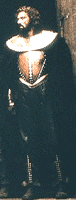
The Peascod Breastplate. Peascod breastplates were developed ca. 1580 by the famous Greenwich armorer of Elizabeth I's time, Jacob Topf. The peascod breastplate was shaped to imitate the fashionable doublet of the period. In other words, this is the armor that does go with "men in tights".
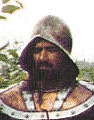
The Morion Helmet. The morion helmet was immortalized by the Spanish Conquistadores but was in use in many countries during the sixteenth and seventeenth centuries.
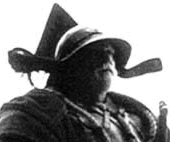
The Samnite Gladiator Helm (galea) from ancient Rome and Pompeii (ca 264BC to 1AD). For the Samnite helmet, see #293 in Pompeii AD 79, Treasures from the National Archaeological Museum Naples and the Pompeii Antiquarium (MFA, Boston & Knopf, 1978). For a fuller discussion of the Gladiatorial Games in ancient Rome, see page 163-187 in Sports and Games in the Ancient World by Vera Olivova (Orbis, 1984).
- Incorrect attribution of Óðinn as controlling men's fate, incorrect belief that wyrd cannot be changed
The concept of fate and destiny or wyrd is a unified theme of belief in Germanic thought. The epic poem Beowulf places these words in the mouth of the heroic warrior:
Gað á wyrd swá hío scel.
Goeth ever Wyrd as she shall. (l. 455b)
...
... Wyrd oft nereð
unfægne eorl, þonne his ellen deah.
For Wyrd oft saveth
earl undoomed if he doughty be! (ll. 572b-573)
Wyrd or fate is not under the rule of Óðinn, as 13th Warrior would have you believe. Instead, fate is in the keeping of goddesses called the Norns:
Þaðan koma meyiar, margs vitandi,
þrár, ór þeim sæ, er und þolli strendr;
Urð héto eina, aðra Verðandi
--scáro scíði--, Skuld ina þriðio;
þær lög löumlgðo, þær líf kuro
alda bornom, ørlög seggia.
(Thence come the maidens, Mighty in wisdom,
Three from the place, Under the tree,
Wyrd is called one, Another Verðandi
Scored they on wood, Scyld is the third;
There Laws they laid, There life chose,
To men's sons, And spoke ørlög.)
Völuspá 20-25The Norns lög lögðo "laws lay down" or more literally "lay layers." They also ørlög seggia "say ørlög." The word, ørlög is "ur-law, ancient law", but it is equally ancient layers of fate and destiny. There is a sense here of "weight of history" -- the layers are like literal "logs" in a woodpile -- it is easy to move the top logs, but very difficult indeed to shift the whole pile at once, or to move only the bottommost layers. Recent layers of wyrd or fate, the recent "layers laid down" or lög lögðo, may therefore be changed, for example by the valor of a warrior, as seen in the Beowulf quote above. But fate which involves many people, the destinies of whole familes, entire nations, or all the Nine Worlds, the "ur-law" or ørlög has much more depth, and is therefore much more difficult to shift. (Paul C. Bauschatz. The Well and the Tree. Amherst University of Massachusetts Press. 1982).
"[Man] has no power over wyrd 'fate', the destiny of the world, but he has freewill concerning his own destiny. The burden is placed firmly on the shoulders of the individual" (Graham D. Caie, The Judgment Day Theme in Old English Poetry. Publications of the Department of English, University of Copenhagen. Michael Chesnutt, Graham D. Caie, Lis Christensen and Niels Davidsen-Nielsen, eds. Copenhagen: Nova, 1976. p. 112.)- 13 Warriors?
The "13th Warrior" concept was a plot device in the movie used to explain just exactly how Ibn Fadlan ended up trailing along with this band of doughty Norse warriors. Actually, the real Beowulf set out for Hrothgar's hall with a party totalling 15 men -- himself and fourteen men in the war-band, none of whom was an Arab, and definitely not Ibn Fadlan:
This heard in his home Hygelac's thane,
great among Geats, of Grendel's doings.
He was the mightiest man of valor
in that same day of this our life,
stalwart and stately. A stout wave-walker (a ship)
he bade make ready. Yon battle-king, said he,
far o'er the swan-road he fain would seek,
the noble monarch who needed men!
The prince's journey by prudent folk
was little blamed, though they loved him dear;
they whetted the hero, and hailed good omens.
And now the bold one from bands of Geats
comrades chose, the keenest of warriors
e'er he could find; with fourteen men
the sea-wood (the ship) he sought, and, sailor proved,
led them on to the land's confines.- Viking Draft Horses??
Vikings didn't ride draft horses. It would have been a whole lot more reasonable for Ibn Fadlan to be teasing the Vikings about their dog-like horses than the other way around. For more information about Viking horses and horsemanship, see the Viking Answer Lady article Horses in the Viking Age.
- Horse Herds for Days...
The average horse requires 2 acres of pasture for grazing. The average cave has no pastures. So exactly where were the wendol keeping the enormous herd of cavalry-trained horses? And why hadn't King Rothgar's people noticed that there was an enormous horse herd nearby, or noticed the cavalry training necessary to get the horses to charge fortifications, fire, and armed men?
- How Many Dead Bears?
Bear population density is dependent upon the quality and availability of food resources in a given locale, as well as the species of bear, and how territorial (or not) the bears are. Still, my research tends to indicate that average bear population densities for brown bears and grizzlies tend to be one bear in a 20 to 40 square kilometer area. For every member of the wendol tribe to have a full bear skin, not to mention all of the many bear bones used in the wendol villiage as objets de art they'd have had to have completely exterminated all the bears of Scandinavia.
Still, there were a few good points
- Good clothing
In general, the extras were wearing fairly reasonable Viking clothing. I saw a number of quite accurate Viking outfits, male and female, among the extras. Note however that the women who you see the most of -- Queen Weilew, Olga, the seeress -- never are "fully dressed" as Viking women. They should be wearing a dress or chemise, over which would be an apron-dress or peplos-dress, and over that they might have a caftan, a shawl, or a coat.
- Good armor and weapons
![]()
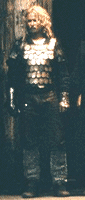
Strangely enough, it is the foreigner Ibn Fadlan who comes closest to being armored as an authentic Viking, wearing a mail hauberk. The only other halfway authentic armor in the film is the scale or lamellar armor worn by Herger the Joyous. Lamellar scale was worn by the Rus, and may have been the armor used by the Byzantine Emperor's Rus who served in the Varangian Guard.
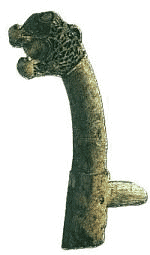
The Viking swords used in the film are the most authentic note. They are correct in most regards. The one really bad bit of "sword-fu" in the movie was when Ibn Fadlan supposedly takes a tempered steel sword and grinds it down into a saber -- which would of course totally destroy the temper and make it about as useful as a crowbar thereafter. For more information on Viking swords, see the following:Viking Age Swords
Norwegian Viking Swords
Regia Angelorum Anglo-Saxon and Viking Arms and Armor Pages -- Also includes a great photo of Viking Age warriors with the proper clothing, armor, and weapons.- Good Viking Ships
The only flaw in the Viking ships were the fantasy prow and sternposts. Actual Viking Age "dragon prows" were much more stylized. A very good element was that the sailors removed the dragon heads when approaching friendly shores -- an accurate bit of detail -- which was done to avoid affronting the local landvaettir, the "land wights" or spirits of the land.
- Interesting Casting Choice
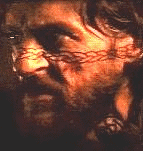
The tattooed Celt, Skeld the Superstitious is a reasonable addition to this Viking crew. The tattoos are authentic for the Rus as a start, according to the actual words of Ibn Fadlan (see above). And there were large Viking settlements and armed camps all over Ireland by the timeframe of the movie, and plenty of Irish-Danish and Irish-Norwegian crossbreeds to go around. I've seen people complaining about the "Celt in the Crew" but really the only point of complaint is in the fact that he's wearing a Scottish kilt -- which were not developed until much later.
- A Real Holmgang
The hólmgang or duel between Herger and one of Hyglak's men was very much in keeping with Viking Age accounts of duels. For a comprehensive look at the Norse custom of duelling, see the Viking Answer Lady's article on Hólmgang.
Page designed by Christie Ward (Gunnvör sílfrahárr).
For comments, additions, and corrections, please contact Gunnvör at gunnora@vikinganswerlady.com
Return to The Viking Answer Lady
| Home | Characters | Viking Myth | Viking Life | Beowulf |