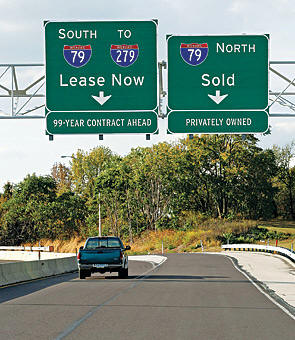
Pennsylvanians had been clamoring for a new road between Philadelphia and Lancaster for years, but the government just couldn't afford it. So in 1792 the state chartered a company that would build the nation's first private turnpike--62 miles (100 km) of stone and gravel--in exchange for the right to collect tolls. Today Pennsylvania finds itself in a similar bind, with the money it needs for roads and bridges far outstripping the money it gets from the gas tax and other revenue streams. So Governor Ed Rendell is turning back the clock, proposing a slew of deals with the private sector, starting with a long-term lease of the 359-mile (578 km) Pennsylvania Turnpike, which could bring the state an estimated $12 billion to $18 billion up front. "We have to be very creative to fund our infrastructure needs," says Rendell.
For states and cities looking to upgrade or replace aging infrastructure, partnering with private players is the biggest idea to come along since the interstate highway system started connecting the country with asphalt roads in the 1950s. The appeal: governments can stop worrying about roads, bridges, and tunnels, and companies get lucrative leases that allow them to collect money from drivers for generations.
The craze is being driven by investors who crave the steady cash flow of decades' worth of tolls. There are 71 projects worth $104 billion being considered for private development by state and local governments, according to the publication Public Works Financing. The proposals are feeding a new pack of investment funds from the likes of Goldman Sachs, Bank of America, and the Carlyle Group.
The deals, common in Europe for decades, got jump-started in the U.S. in 2005 when Chicago enriched its treasury by $1.8 billion by selling a 99-year lease of the Chicago Skyway to Spanish roads operator Cintra and Australian bank Macquarie. At about the same time, Texas bagged $1.2 billion to let a Cintra-led consortium build the first part of the Trans-Texas Corridor and collect tolls on it for 50 years. In 2006 Indiana signed a 75-year lease for the 157-mile (253 km) Indiana Toll Road in exchange for $3.8 billion, funding the state's transportation needs for the next decade--and grabbing the attention of other budget-conscious states.
"It was an earthquake in transportation," says Bob Poole, director of transportation studies at the Reason Foundation.
But since the spring, a backlash has taken hold. Texas, a pioneer in privatization under the enthusiastic leadership of Governor Rick Perry, saw its legislature impose a two-year moratorium on new projects. The Pennsylvania legislature bounced Rendell's first attempt to privatize the turnpike, though now he's trying again in the wake of shifting state politics. The mother of all toll roads, the New Jersey Turnpike, is under review, but New Jersey Governor Jon Corzine disappointed eager bankers in June when he flatly stated, "We're not going to privatize."
The issue exploded last May when a letter was sent by the House Transportation Committee to all 50 Governors expressing concern that a flood of local deals might put "profit and private interests" ahead of "public benefits from an integrated national transportation network". The committee threatened to undo any deals found not to be in the public interest. That's pointedly at odds with the Department of Transportation (DOT), which, following the lead of the Bush Administration, has been a huge supporter of privatization and helped pave the way by giving some companies large tax savings on their profit from investing in private roads. DOT also drafted model legislation for states considering deals and in at least one case--when Texas backed off a deal with Cintra--threatened to withhold highway and education funds from the state unless it honored the original contract.
So what's not to love about private roads?
Your assignment is to choose which position you take in this debate: should highways be provided and maintained by private companies operating for profit in a free market or is the nation's transportation system a necessity which should be built, maintained, regulated for everyone by the government?

-
This brief should be 5 paragraphs.
-
All sentence must be complete sentences.
-
The first paragraph of this Brief must be the Introduction.
-
The first sentence of this Brief will be the THESIS. The Thesis is a clear NORMATIVE (subjective) statement of the position the brief will take on the issue using the vocabulary and concepts from economics:
-
Should highways be provided and maintained by private companies operating for profit in a free market or is the nation's transportation system a necessity which should be built, maintained, regulated for everyone by the government?
-
-
The second sentence in the Introduction will be the OUTLINE for the rest of the brief listing the three supporting topics which will be presented to back up the position supported by the Brief.
-
The next three paragraphs will be Support paragraphs. Each support paragraph will begin with a Topic sentence, and will include at least one POSITIVE (objective) FACT taken from the online articles or the textbook which backs up the THESIS.
-
For the brief, use facts from the online articles and textbook; do NOT bring in outside facts.
-
You MUST use BOTH articles.
-
All facts in this Brief MUST be cited using (author's name) format.
-
A bibliography using proper MLA format citations should be at the end of your brief.
-
A Brief should NEVER be in first person.
-
A Brief should ALWAYS be IN YOUR OWN WORDS (IYOW); you may NOT cut and paste from the internet or any other source or you will receive a zero and this will be reported to the Honor Council.
-
Your brief should ALWAYS be printed out, not hand-written.
-
Your Brief is due at the beginning of the class on the assigned due date; assignments turned in after class will be penalized one point per day late.