| |
This week's assignment:
Design and bake an original wedding cake
and sell it at a wedding expo event. Martha Stewart provided each team with
a baker and kitchen. The team to earn the most money won. Thirteen
candidates remain in the competition between the teams Primarius (business
candidates) and Matchstick (creative candidates). Sales proved to be the
deciding factor this week, and Matchstick went down in flames -- for a third
straight time. They were unable to sell a single wedding cake at a premiere
wedding fair expo even though two chefs are on their team.
Primarius chose a mass-appeal market
strategy and created a more standard, but elegant, cake and had a sales team
that genuinely connected with their customers.
Matchstick relied on a risky niche
marketing strategy and created a white-and-pink oval, asymmetrical wedding
cake. Speaking to Stewart's right-hand man Charles, Matchstick team member
Shawn brashly offered to be sent home if the task wasn't won.
Primarius won by demonstrating that sales
skills are necessary in any competitive business. They sold five cakes for a
total of $3,658 while Matchstick sold zero. The most beautiful, most
delicious cake in the world isn't worth much if it can't be sold.
Matchstick lost, and Charles recalled
Shawn's offer to be fired in the conference room. Shawn recanted, explaining
the offer was made to show bravado and in jest, saying it was a tactic she
used in her career as a TV newscaster. You "fake it until you make it," she
said.
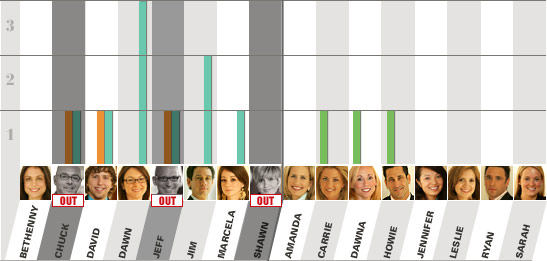
Stewart was not impressed by Shawn's
hubris and sent her home.
|
Lessons Learned
FIT
UNFIT
-
Know when to hold your tongue.
Shawn made three statements that eventually caused her downfall.
First, she arrogantly guaranteed that her team would win the task
and told Charles Koppelman that he could fire her if the team didn't
come out on top. Second, her initial reaction to the team's
cake—after Marcela had stayed up all night working on it—was that
she didn't like it. Third, she explained her boasting in the
conference room by pulling out a cliché used in the television
industry from which she came: "Fake it 'til you make it."
"Not in my business," retorted
Stewart, who promptly fired her. Faking it is never a good business
strategy. Successful leaders and business professionals know that
results, trust and integrity equate to winning. Cockiness is simply
something to avoid in business.
The bottom line? Shawn is clearly someone who needs to learn to
think before she speaks. Nothing is ever gained by boasting. It
creates unrealistic expectations in the minds of others, who are the
first to remind the braggart if he/she doesn't deliver on the big
promises.
-
Leaders who lose it.
Howie completely lost control of his emotions in
front of his teammates in a fight over cake stands. With veins
bulging in his forehead, he called Sarah a liar and went ballistic.
That left other team members questioning his leadership ability.
When leaders lose control,
followers no longer trust or respect them. More than anyone else, it
is the team leader who has the most power to influence a team either
positively or negatively. They are expected to lead in difficult
times as well as good times. Leaders who can remain calm, confident
and upbeat, even under intense pressure, create an environment of
trust, comfort and safety. Those who don't trigger negativity and
jeopardize a team's potential to do its best work.
-
Market research.
Matchstick initially made a good strategic move in
contacting a wedding cake expert to garner wedding cake trends.
Where they blew it was in contacting only one resource. Matchstick's
one and only source -- who specializes in a very high-end, narrow
niche market -- led them astray with advice to create an
asymmetrical pink cake. Unfortunately, Matchstick took this advice
and created a cake that one customer likened to a boot. Stewart
noted that in her company's long wedding magazine history, they had
featured only one asymmetrical cake.
If the oval cake had been one option in an entire product line of
cakes, having it available would not have been a bad strategy for
Matchstick. However, the situation demanded a single design that
would be acceptable to a broad range of possible customers, and
that's what Primarius had to offer.
The bottom line? Business strategies are not made in a vacuum. The
organization must maximize the opportunities available in the
environment and minimize the identified threats. For Matchstick and
Primarius, this week's task environment presented a mass-marketing
opportunity. The winning firm recognized this fact, the losing team
did not.
-
Give it up for the team.
Shawn's verbalized negative reaction to the finished cake was
insensitive. After all, Marcela had been working on the cake all
night long. If Shawn didn't like the cake, she should have respected
Marcela's product, kept her opinions to herself, and gotten behind
the sales effort for the good of the team. Instead, Shawn talked
herself into a bad attitude that was reflected in her lackluster
selling tactics.
The bottom line? Not everyone on a team will agree with the strategy
or tactics, but once a decision is made, it's up to the team members
to pull together and execute to the best of their abilities. A
football team's quarterback may not agree with the play called by
the coach, but once the play is called, everyone on the
team—including the quarterback--has to run the play and give 100
percent effort.
-
Not being flexible.
Matchstick refused to change its icing color for
customers. What kind of a rigid marketing/sales strategy was this?
One bride wanted her ribbons in blue, only to be told no, it only
came in pink and "you either love it or you hate it."
-
Weak leadership.
Matchstick's leader, David, was clearly out of his
league. His inexperience was painfully evident. He wasn't even able
to clearly identify which candidates contributed to his loss. He
seemed to be flying by the seat of his pants, admitting all he
really knows about cakes is they "taste good with milk."
Stewart wasn't impressed with
David's failure to identify the candidates responsible for their
failure, and she correctly identified the team's failure as a
"sales" problem.
The Endangered
Species List:
The following people are on this week's endangered
species list, based upon the likelihood that they will "just not fit in"
in the near future:
Jim
(Matchstick): He was not as insufferable this week as he was in the
first two episodes, and got something of a reprieve because his wife
gave birth to a baby girl while he was sequestered with his "Apprentice"
colleagues working on the task. However, it's hard to imagine Stewart
ever hiring him.
Dawn
(Matchstick): She's still on the list, simply because she has brought
little value-added to her team after three weeks, and because it is
clear that at least some of her teammates can't wait to see her go. She
melted into the background this week, but David dragged her into the
firing session anyway because in his opinion, she would never be able to
lead the team. She also got a bit of sympathy from Stewart, who
believed—correctly—that Dawn was not responsible for the team's poor
salesmanship.
Bethenny
(Matchstick): She always seems to be in the conference room at the end
when Stewart is trying to decide which candidate should be sent home. So
far, it's hard to tell what Bethenny brings to the table.
Gold Stars for This Week's Episode:
Ryan gets a gold star this week for
recognizing that selecting a wedding cake is an emotional buying
decision for engaged couples and for tailoring his sales pitch
accordingly.
|
| The Report Card |
Primarius:
- Effort --
- Performance --
- Creativity --
|
|
|

"If I want my team
to succeed, we need Dawn to go home." |
Matchstick:
- Effort --
- Performance --
- Creativity --
|
|
|
|
|
|