| |
This week's assignment:
At the end of last week's episode, Dawna and Bethenny had
been named the two finalists and had started organizing the events they were
assigned to run as their final tasks. Dawna, assisted by Amanda, Sarah and
Howie, worked on a Liz Claiborne fashion show to benefit Safe Horizon, which
assists victims of domestic violence. Bethenny and her teammates Jim, Carrie
and Ryan put on a circus, sponsored by Apple and Eve, that would benefit the
Boys and Girls Clubs.
Bethenny and Dawna overcame the two problems that were cliffhangers at the
end of last week's episode. Dawna was able to conduct a fashion show that
impressed her key contact at Liz Claiborne. The only obvious flaw was a
printed program that was very plain - not in keeping with the high-end image
of the event. Bethenny was able to gain control over the circus planning and
appeared to execute an exciting event.
Interestingly, there was no indication from representatives of Apple and
Eve, the Boys and Girls Clubs or Safe Horizon as to how they felt the
candidates had done. The main criterion for success seemed to be, "Could the
candidates make these events happen?" In that sense, both Bethenny and Dawna
were successful, because things came together and the events took place.
The final conference room scene, like the others in this season of the
Martha Stewart version of "The Apprentice," was not particularly
gripping or dramatic. In the conference room, both of Stewart's colleagues,
Charles Koppelman and Alexis Stewart, favored Dawna but were
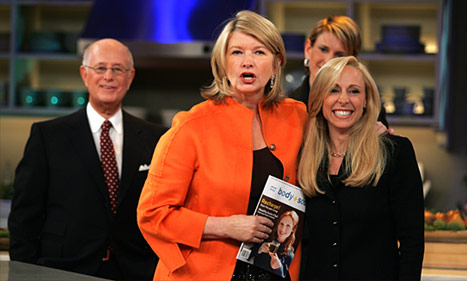
not overly enthusiastic about it. It was left to Martha Stewart to make the
final call, and she did, saying, "Dawna, you are clearly a talented manager
and we can always use someone with your business acumen, and I would like to
offer you the job as my apprentice." Regular readers of this series of
commentaries know that Dawna had a significant edge going into the final
task, so her selection as Stewart's apprentice should not be a big surprise.
|
Lessons Learned
FIT
- Maximizing team collaboration and potential.
Dawna proved that she could lead a team effectively. She delegated
appropriately, aligned team members' talents and skills with their
roles and key tasks and provided a high level of clear expectations,
organization and structure to her team. As a result, her team rose to
the challenge of creating and executing a large event with tight time
constraints.
- It's all in the details.
Managing a huge event requires tremendous organization, structure and
attention to the smallest detail. This goes under "fit" because Dawna
wisely created a sizeable checklist of required tasks to track event
details. Yet there was one arena where she could have done better.
Beyond checklists, effective project managers create a critical path
item plan outlining and detailing priorities and deadlines. There was
really no excuse for the poor program produced by Dawna's team. This
could have been avoided by requiring the sponsors to have
edits/changes to them by a deadline (leaving them enough time to be
printed!) and they should have had the creative layout (with the
sponsor's logo) already done. Instead, this team waited until the last
minute to print the entire piece without leaving enough time for the
creative work required to produce a professional brochure.
- Remain calm under pressure.
Dawna demonstrated that she can self-sooth and remain unflappable
under high stress, as opposed to Bethenny, who admitted she was
"manic" and "chaotic." The ability to remain calm under pressure is
critical to effective leadership -- despite how easily we can be
emotionally hijacked as human beings. Managing emotional impulses
requires focus and special effort. Anxiety is contagious and no one
spreads it more quickly on a team than the leader. As followers, we
expect our leaders to be the ones holding it together when things get
chaotic. Leaders set the stage for the emotions of the team.
UNFIT
-
Trust doesn't come
automatically to a leader. Bethenny dealt
with her team's lack of trust in her ability by simply asserting
that they should trust her because she was their leader. Trust is
not assigned by a title; trust is earned. Authority can be mandated
by position, but not trust. Trust isn't given just because a leader
demands it. Leaders can earn trust by addressing some of the
following:
-
Model what you ask for -- trust
them.
-
Protect your people.
-
Provide clear expectations,
order and structure.
-
Do what you say you will do.
-
Be transparent in your decision
making.
-
Listen well and be open to
influence.
-
Maintain calm during a storm.
-
Be fair.
-
Praise and acknowledge.
This is one of the major lessons we can glean from this series.
(Think of Dawna as your example and Bethenny as the non-example.)
Dawna began and ended with her team on the right foot: heartfelt
acknowledgement for an "awesome job." Bethenny, in contrast, began
and ended with her team on the wrong foot -- bolting afterward
without so much as a handshake to her team. She failed to recognize,
acknowledge or show proper appreciation for their considerable hard
work and effort on her behalf, something that was not lost on
Stewart. It's simple -- you have to care about your people. The need
for approval and recognition is a primary human drive. Most people
rate having a caring boss higher than they value fringe benefits or
money. People need to be acknowledged, understood and appreciated.
Recognize contributions, praise generously and encourage the heart
in your people.
- It pays to be calm:
Koppelman noted that in his opinion, Bethenny could be difficult to
work with, in spite of her high energy. One gets the impression that
at Martha Stewart Living Omnimedia, a calm demeanor in the face of
chaos goes a long way, and that perhaps Bethenny was a bit too
frenetic to "fit in."
The bottom line? There's a difference between being an
entrepreneurial independent contractor and working in a large
company with a lot of people. Organizations take on the character of
the leadership, and Stewart never seemed to get ruffled during the
13 weeks of the show. It's likely that the organization would be
better suited to someone with Dawna's calm countenance than
Bethenny's more excitable persona.
The End of Season Awards
As has been the
tradition in this series of columns, it's time to take a look back
throughout the season and bestow some awards:
-
Best Candidate to Not Make the
Finals: The winner is Amanda, who had a very
impressive win as a project manager and could have made it farther
down the line in the competition. Unfortunately, she lost her
enthusiasm in Week 9 and because of that, Marcela, a much weaker
candidate, stayed alive while Amanda was fired. Note to future
candidates - as hard as it is because of the rapid-fire nature of the
competition, you have to be at your best every day, no matter who the
project manager is.
-
Biggest Gap between Resumé and
Performance: This is a tough call. Honorable
mention goes to Leslie, who has a great educational background, worked
on Capitol Hill, runs a communications and marketing research firm,
and was named one of Hispanic Business magazine's "100 Most
Influential Hispanic Americans." With this powerhouse resumé, one
would have expected her to go farther, but she never clicked as a
project manager. The winner, though, is Dawn, a business owner, Mensa
member, and holder of two degrees who seemed to be completely out of
her element in the competition and who didn't last as long as Leslie.
-
Most Uncomfortable Moment:
The winner here is Martha Stewart, who at a victory breakfast at her
home for one of the teams, asked Marcela for a bite of Marcela's sweet
roll. Huh?
-
Best Firing Scene:
The best scene was in Week 2, when Stewart castigated Chuck for almost
giving up on the task. In a particularly feisty moment, Stewart told
Chuck that she had never given up on anything - even when she was
incarcerated.
-
Worst Boardroom Performance by a
Candidate: The winner is Jim, who when asked
by Stewart during one of the boardroom scenes, "Who should go home?"
replied, "Anyone but me."
-
Biggest "Oops" Performance by a
Candidate: The winner is Ryan, who drank too
much beer and started slurring his words when editing his team's video
commercial for Song Airlines in Week 11. This faux pas capped a
downward spiral for him after a promising start with two wins as a
project manager.
-
Most Annoying Candidate:
Jim. Week in and week out, he was the candidate everyone loved to
hate, but to his credit, he made the final three.
-
Meanest Candidate:
There's no clear winner here, as no candidate gave the impression of
being cutthroat, but Howie was pretty scary at times. When he got
angry with someone, his "in-your-face" attacks were almost over the
edge.
-
Most Loyal Candidate:
Sarah and Carrie tie for this honor. They were like two peas in a pod.
Baby boomers might remember "The Patty Duke Show" theme song from the
1960s - "…They laugh alike, they walk alike, at times they even talk
alike - you can lose your mind…" On "The Apprentice," Sarah and Carrie
didn't lose their minds, but they lost their jobs together as they
were both fired in Week 7.
Commentary: A Letter to Martha
Martha Stewart always sent a letter to the fired
candidate every week. Since this is the last episode – ever - of the
Martha Stewart version of "The Apprentice," having gone "one and done,"
it's time for someone to write a letter to Ms. Stewart. That person
might as well be me.
Dear Martha:
Let me say at the outset that I have enormous respect for anyone who has
the moxie, the focus and the determination to start a business and grow
it into a company that is known throughout the world, as you have done.
In addition, it's one thing to start a company, but it's quite another
to become a personification of the company. Martha, you are a brand,
just as Donald Trump is a brand. And, you have stuck with your company
through thick and thin. Even though I've never (to my knowledge) used
any of your recipes, decorating ideas or tips on entertaining, I admit
to some bias in that I really admire you and what you have accomplished.
"The Apprentice with Martha Stewart" is one piece of your effort aimed
at rebuilding your brand after you suffered significant personal and
professional trauma over the last couple of years. Your show will not
continue for a second season, but your weekly appearances on prime-time
TV have sent a message that "Martha Stewart is back!" And, you have
gotten a solid performer, Dawna, to add to your company's publishing
unit.
Several months ago, a reporter asked me how I thought your new show
would go. At the time, I told the reporter that I felt you and the
producers had a tough job. Having watched "The Apprentice" from the
beginning, I have developed the opinion that the majority of the people
who watch the show are most interested in the boardroom scenes. They
want to see Donald Trump relentlessly interrogate the candidates and
then dismiss someone with the crowning words, "You're fired." As I told
the reporter, I didn't think that it was in your best interest or in the
best interest of your brand for you to be overly aggressive or mean on
the show, which is at odds with the reason why most people watch "The
Apprentice" in the first place.
What we have learned is that people don't want a "kinder, gentler
version" of "The Apprentice," which is what you gave them. Even though
you had an interesting group of candidates - people such as Jim, Chuck
and Dawn come to mind - the conference room scenes in your show just
didn't have the passion or drama that would hold today's television
audience. I am sure that Charles Koppelman and your daughter Alexis are
great people and contribute a lot to your organization, but they never
seemed to find a comfort zone in front of the camera.
So, we are done. I wish you the best of luck with your future endeavors
and I look forward to many new and exciting things from Martha Stewart
Living Omnimedia. Best regards. - David Urban |
|
|
| The Report Card |
Primarius:
- Effort --
- Performance --
- Creativity --
|
|
|
"I'd like to offer you the
job." |
Matchstick:
- Effort --
- Performance --
- Creativity --
|
|
|
|
|
|